Stock Analysis · Realty Income Corporation (O)
Overview
Realty Income Corporation is a real estate investment trust, or REIT, focused on owning commercial properties that are leased to tenants under long-term agreements. Its model is simple: it acquires properties, signs leases that usually make the tenant responsible for property taxes, insurance, and maintenance, and collects rent. This structure helps make rental income relatively predictable and reduces many of the day-to-day costs that a landlord might otherwise carry.
The company operates at very large scale across the United States and Europe, with a portfolio spread across retail, industrial, gaming, and other property categories. Although Realty Income is widely known for retail real estate, it has been broadening the mix over time, which matters because it reduces reliance on any single tenant type or property category.
Its revenue is still led by rental income from commercial real estate. Based on company disclosures, the business is primarily driven by contractual rent from freestanding properties leased to large operating businesses. A practical way to think about the revenue mix is:
- Rental revenue from retail properties: approximately 70% to 75% of annualized base rent. This includes convenience stores, grocery-related uses, dollar stores, pharmacies, home improvement, and other necessity-oriented formats.
- Rental revenue from industrial properties: approximately 15% to 20%. This generally includes logistics, distribution, manufacturing, and warehouse assets.
- Rental revenue from gaming, data center, and other property types: approximately 10% to 15%. This bucket includes casinos and other diversified commercial assets that have become more relevant as the company has expanded beyond traditional retail.
- Geographic mix: the United States remains the dominant source of rent, while Europe and the United Kingdom represent a smaller but growing share.
Another useful way to view Realty Income is as a cash-flow platform rather than a traditional property trader. The company is not mainly trying to flip buildings for short-term gains. It is trying to build a large portfolio of income-producing assets, fund that portfolio efficiently, and raise rent over time through acquisitions and contractual lease terms.
The business has expanded meaningfully over the last several years, with revenue rising from a little above $2 billion in 2021 to nearly $5.7 billion in 2025. The broad pattern is positive, but there is also an important detail: interest expense has climbed sharply as the portfolio and debt base grew, so growth in revenue has not translated into equally smooth growth in net income.
Key Figures
| Metric | Value | Sector ⓘ |
|---|---|---|
| Date | Oct 17, 2026 | |
| Context | ||
| Sector | Real Estate | |
| Industry | REIT - Retail | |
| Market Cap ⓘ | $52.20B | |
| Beta ⓘ | 0.70 | |
Value (Cheapness) | ||
| P/E Ratio ⓘ | 39.98 | 17.38 |
| P/B Ratio ⓘ | 1.40 | 0.85 |
| FCF Yield ⓘ | 4.18% | 7.38% |
| Dividend Yield ⓘ | 5.88% | 4.85% |
| EBIT / EV ⓘ | 2.31% | 3.78% |
| PEG ⓘ | 2.85 | |
Growth (Business expansion) | ||
| Revenue Growth ⓘ | 9.60% | 5.30% |
| RPS Growth (5Y CAGR) ⓘ | 6.09% | 6.02% |
| EPS Growth (5Y CAGR) ⓘ | -0.19% | -11.37% |
| BVPS Growth (5Y CAGR) ⓘ | -8.16% | 0.45% |
| Margin Growth (5Y Trend) ⓘ | -0.10% | -0.22% |
| FCF Growth (5Y CAGR) ⓘ | 31.84% | 5.40% |
| DPS Growth (5Y CAGR) ⓘ | 3.45% | 5.02% |
Quality (Business durability) | ||
| ROIC (Latest) ⓘ | 2.70% | 5.69% |
| ROE (Latest) ⓘ | 3.48% | 7.56% |
| ROA (Latest) ⓘ | 1.79% | 2.85% |
| ROIC (5Y Median) ⓘ | 2.00% | 4.22% |
| ROE (5Y Median) ⓘ | 2.74% | 6.03% |
| ROA (5Y Median) ⓘ | 1.49% | 2.44% |
| Net Debt / EBIT (Latest) ⓘ | 1.15 | 7.59 |
| Net Debt / EBIT (5Y Median) ⓘ | 20.08 | 8.40 |
| Net Debt / EBITDA (Latest) ⓘ | 0.49 | 5.27 |
| Net Debt / Assets ⓘ | 2.89% | 37.76% |
| EBITDA / Interest ⓘ | 3.77 | 4.10 |
| Operating Margin (Latest) ⓘ | 32.47% | 35.29% |
| Operating Margin (5Y Median) ⓘ | 27.44% | 37.31% |
| Debt to Equity (Latest) ⓘ | 6.98% | 88.87% |
| Profit Margin (Latest) ⓘ | 20.90% | 19.61% |
| Free Cash Flow (Latest) ⓘ | $2.18B | |
Momentum (Price trend) | ||
| 3Y Return ⓘ | +29.33% | +30.75% |
| 12M Return (excl. last month) ⓘ | +2.82% | +4.36% |
| 6M Return ⓘ | -10.81% | -2.52% |
| Price vs. 200-Day MA ⓘ | -8.09% | -2.34% |
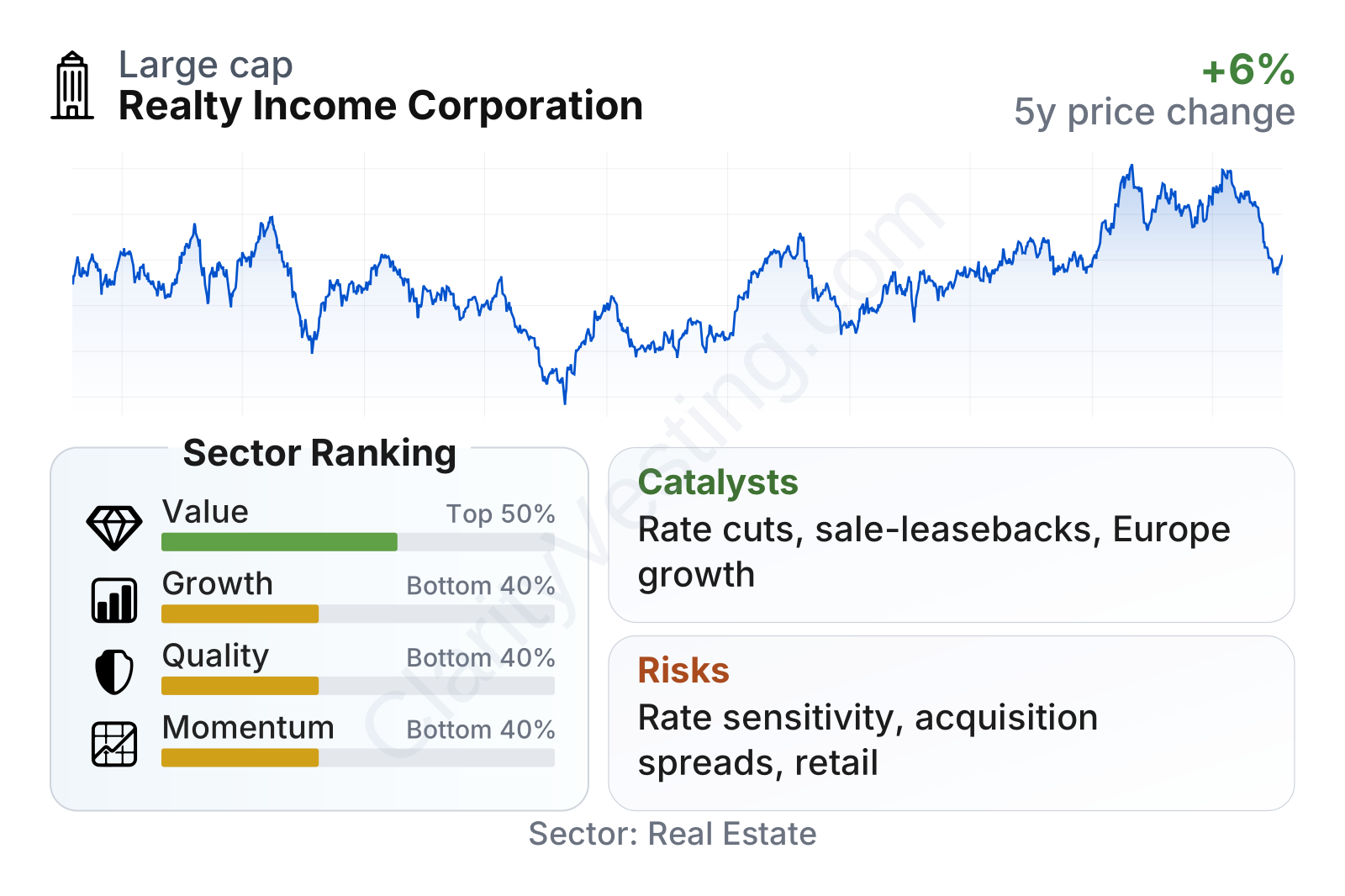
Realty Income is a very large REIT with below-market share price volatility, which fits its reputation as a steadier real estate name. The table shows a mixed picture. Income characteristics stand out, with a dividend yield above the sector median, but traditional valuation measures such as P/E and price-to-book sit above many peers. Growth in revenue has been respectable, yet quality indicators like returns on assets and capital remain weaker than sector medians, which is common in capital-heavy real estate but still worth noting.
The stock’s multi-year price record shows that Realty Income has been sensitive to interest-rate swings. It fell sharply during periods of higher bond yields and then recovered as sentiment toward rate-sensitive assets improved. That pattern is important for long-term readers because it shows that even a stable rental business can have a stock price that moves meaningfully with the financing environment.
Growth
Realty Income operates in a sector that should remain relevant for a long time: essential commercial real estate financed by long-duration leases. Physical stores and operating locations are still critical for many tenants, especially convenience, discount, grocery-linked, and service categories. On top of that, the company has been expanding into industrial and gaming properties, which gives it more room to grow than if it stayed only in traditional retail.
Its strategy is sensible for long-term expansion. Realty Income uses its scale, access to capital, and tenant relationships to buy properties from businesses that want to free up capital while continuing to operate from the same locations. This sale-leaseback model can be attractive in many rate environments because companies often value liquidity and balance sheet flexibility. For Realty Income, it creates a repeatable pipeline of acquisitions.
Revenue per share has generally moved upward over the last five years, which suggests that portfolio growth has not been driven only by issuing more shares. That matters because REITs often raise equity to fund acquisitions, and growth is more meaningful when income keeps rising on a per-share basis.
Dividend per share has also trended higher, although at a moderate pace. Realty Income is especially well known for its monthly dividend structure and long record of increases. For a long-term profile, the key point is not just the current yield but the consistency of cash distributions through different market conditions.
There are also a few practical catalysts supporting future growth. The company’s large size gives it access to deal opportunities that smaller landlords may not be able to finance. Its tenant base is spread across many industries, helping management direct new capital toward the segments with the best risk-adjusted economics. If borrowing costs stabilize or decline, acquisition economics could improve further because REIT valuations and property transaction activity often recover together.
Recent company updates have continued to emphasize investment activity, portfolio diversification, and access to multiple sources of capital. In the current environment, that combination is a meaningful advantage because not every real estate owner can stay active when financing markets are selective.
Risks
This article is for informational purposes only and does not constitute financial advice. Some content is AI-generated. See Disclaimer


