Stock Analysis · Nexpoint Residential Trust Inc (NXRT)
Overview
NexPoint Residential Trust is a residential real estate investment trust, or REIT. In simple terms, it owns apartment communities and makes money mainly by renting those homes to residents. The company focuses on multifamily properties, with a concentration in large Sun Belt markets where population growth, job creation, and household formation have generally been stronger than the U.S. average. Its strategy has centered on buying properties that can be improved, renovating units and common areas, and then aiming for higher rents and better property-level cash flow.
Its revenue base is relatively straightforward compared with many other listed companies because it is primarily tied to apartment operations. Based on recent annual reporting, the main sources of revenue are approximately:
- Rental income from apartment leases: about 85% to 90%. This is the core business and includes monthly rent paid by residents.
- Property and other ancillary income: about 10% to 15%. This usually includes items such as utility reimbursements, parking, late fees, pet-related fees, storage, and other resident service income.
- Gains from property sales or other non-recurring items: variable. These can materially affect reported profit in some periods, but they are not a stable operating revenue source.
NexPoint is not one of the largest apartment REITs. It is a smaller public landlord, which can create both opportunity and risk: the portfolio is more focused, but the company also has less scale than major peers. Over the last several years, the business has shown that rental operations can generate meaningful cash flow, but reported earnings have been more volatile because interest costs, asset sales, and property revaluations can move results sharply from year to year.
The financial flow over time shows a useful pattern: revenue expanded from 2021 through 2023, then softened in 2024 and 2025, while interest expense remained heavy. Operating profitability has often looked strong at the property level, but that strength has not consistently translated into net profit because financing costs have absorbed a large share of the operating income.
Key Figures
| Metric | Value | Sector ⓘ |
|---|---|---|
| Date | Oct 17, 2026 | |
| Context | ||
| Sector | Real Estate | |
| Industry | REIT - Residential | |
| Market Cap ⓘ | $1.01B | |
| Beta ⓘ | 1.21 | |
Value (Cheapness) | ||
| P/E Ratio ⓘ | N/A | 17.38 |
| P/B Ratio ⓘ | 2.06 | 0.85 |
| FCF Yield ⓘ | 6.61% | 7.38% |
| Dividend Yield ⓘ | 10.41% | 4.85% |
| EBIT / EV ⓘ | 13.04% | 3.78% |
| PEG ⓘ | 26.92 | |
Growth (Business expansion) | ||
| Revenue Growth ⓘ | 2.40% | 5.30% |
| RPS Growth (5Y CAGR) ⓘ | 3.84% | 6.02% |
| EPS Growth (5Y CAGR) ⓘ | N/A | -11.37% |
| BVPS Growth (5Y CAGR) ⓘ | -11.00% | 0.45% |
| Margin Growth (5Y Trend) ⓘ | -11.61% | -0.22% |
| FCF Growth (5Y CAGR) ⓘ | 3.35% | 5.40% |
| DPS Growth (5Y CAGR) ⓘ | 10.98% | 5.02% |
Quality (Business durability) | ||
| ROIC (Latest) ⓘ | 11.70% | 5.69% |
| ROE (Latest) ⓘ | -11.93% | 7.56% |
| ROA (Latest) ⓘ | -1.80% | 2.85% |
| ROIC (5Y Median) ⓘ | 1.55% | 4.22% |
| ROE (5Y Median) ⓘ | 0.25% | 6.03% |
| ROA (5Y Median) ⓘ | 0.06% | 2.44% |
| Net Debt / EBIT (Latest) ⓘ | 5.74 | 7.59 |
| Net Debt / EBIT (5Y Median) ⓘ | 29.80 | 8.40 |
| Net Debt / EBITDA (Latest) ⓘ | 4.26 | 5.27 |
| Net Debt / Assets ⓘ | 83.84% | 37.76% |
| EBITDA / Interest ⓘ | 1.20 | 4.10 |
| Operating Margin (Latest) ⓘ | 107.65% | 35.29% |
| Operating Margin (5Y Median) ⓘ | 23.04% | 37.31% |
| Debt to Equity (Latest) ⓘ | 641.29% | 88.87% |
| Profit Margin (Latest) ⓘ | -13.21% | 19.61% |
| Free Cash Flow (Latest) ⓘ | $66.47M | |
Momentum (Price trend) | ||
| 3Y Return ⓘ | -25.82% | +30.75% |
| 12M Return (excl. last month) ⓘ | -27.49% | +4.36% |
| 6M Return ⓘ | -18.11% | -2.52% |
| Price vs. 200-Day MA ⓘ | -23.74% | -2.34% |
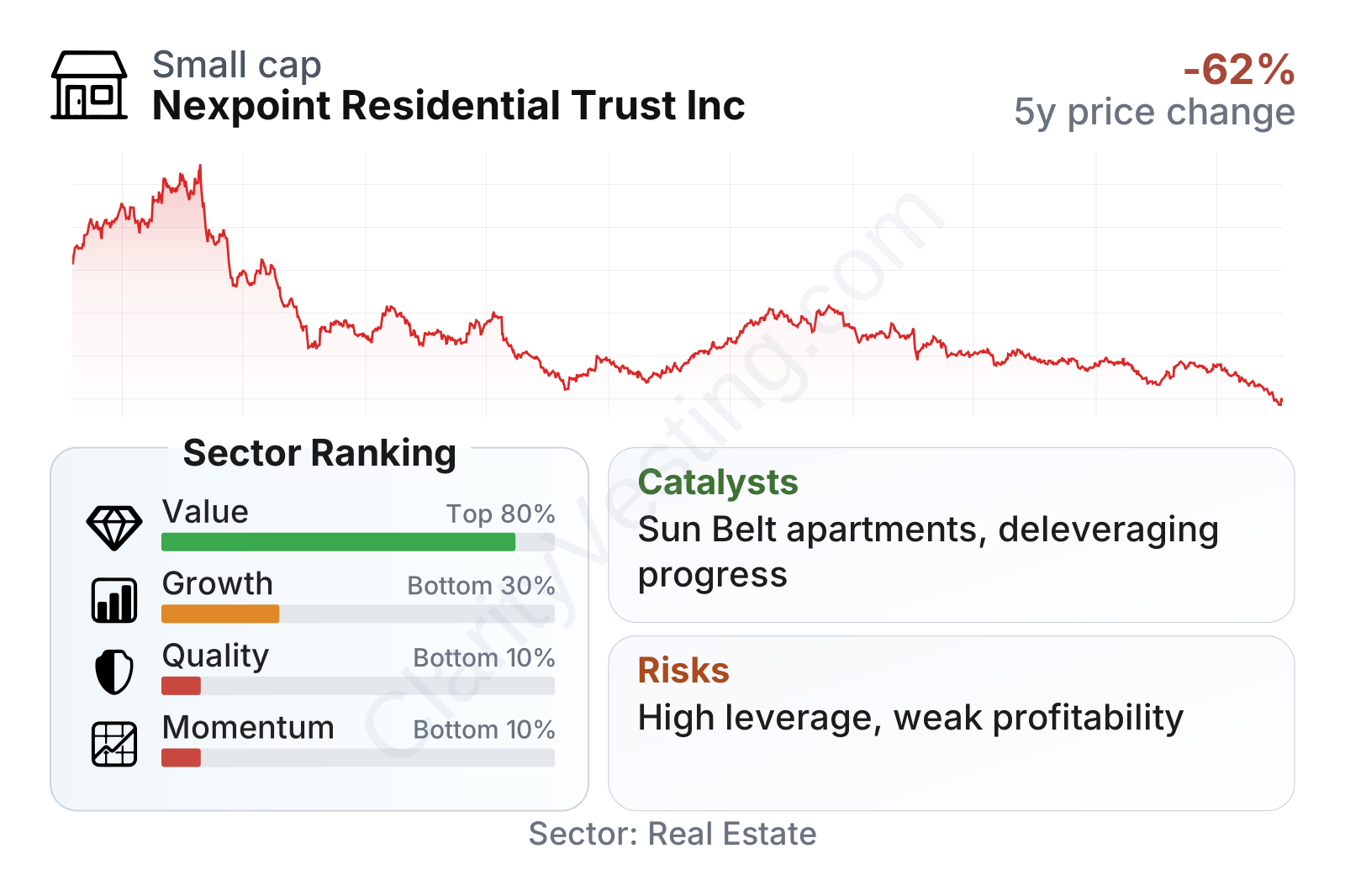
NexPoint Residential Trust is a small-cap REIT with a stock that has been noticeably more volatile than the broader market. The overall picture from the metrics is mixed. On valuation-linked measures, the shares look unusual rather than simply cheap or expensive: the dividend yield is high and earnings relative to enterprise value are strong, but price-to-book stands well above the sector median. Growth ranks weakly against peers, quality ranks near the bottom of the sector, and recent share-price momentum has also been poor. In plain language, the market seems to be recognizing the income stream but remains skeptical about balance-sheet strength, consistency of profits, and the durability of growth.
Growth
The company operates in a part of real estate that still benefits from long-term demand drivers. Apartment housing tends to be supported by population growth, limited affordability in the for-sale housing market, and migration toward lower-tax, higher-growth metros in the Sun Belt. Those trends matter for NexPoint because its portfolio is concentrated in exactly the kind of markets that have attracted residents and employers over the past decade.
NexPoint’s strategy also makes sense in principle for future growth. Rather than relying only on broad rent inflation, it has historically pursued a value-add model: acquire apartment communities, invest capital into unit upgrades and amenities, and try to lift rents and occupancy over time. That approach can work well in fragmented regional markets where there are many properties but fewer institutional owners. It is a more hands-on growth model than simply owning stabilized assets and waiting for market rents to rise.
Revenue per share improved clearly from 2021 to 2023, then flattened over the next two years. That suggests the company has already captured part of the benefit from acquisitions and renovations, but more recently growth has slowed. Relative to the residential REIT group, current expansion looks modest, which means future progress will likely depend more on execution at the property level, selective capital recycling, and cost discipline than on a broad sector tailwind alone.
One notable positive is the dividend record. Dividend per share has risen steadily over the last five years, with growth running well above the sector median. For a REIT, that points to management’s willingness to return cash and signals confidence in underlying property cash generation. The sharp rise in trailing dividend yield, however, has also been helped by a lower share price, so the market is not reading the payout increase as an uncomplicated sign of strength.
A practical catalyst for the company is the possibility of easing financing pressure if interest rates stabilize or move lower over time. Apartment REITs are sensitive to borrowing costs, and NexPoint is especially exposed because interest expense has been a major drag on net income. Another potential opportunity is asset repositioning: when a smaller REIT can sell mature assets, reduce leverage, and reinvest selectively, the impact on financial performance can be meaningful. Recent company updates have also emphasized portfolio management and capital allocation steps rather than aggressive expansion, which suggests near-term growth may come more from improving the balance sheet and property economics than from rapid external acquisitions.
Risks
This article is for informational purposes only and does not constitute financial advice. Some content is AI-generated. See Disclaimer


