Stock Analysis · Nextdoor Holdings Inc (NXDR)
Overview
Nextdoor Holdings Inc operates a neighborhood-focused social platform. Its product is built around verified local communities where residents can exchange recommendations, discuss nearby issues, discover local businesses, and receive public agency updates. In simple terms, it is a digital network centered on where people live rather than on broader interest groups or national audiences.
The business model is still heavily concentrated in advertising. Based on the company’s recent annual disclosures, revenue comes primarily from selling advertising placements to businesses and brands that want to reach users in specific local areas. Nextdoor also has a smaller and less material contribution from other arrangements tied to partnerships or ancillary activities, but advertising remains the economic core of the company.
The main revenue sources can be summarized as follows:
- Advertising revenue: about 95% to 100% — promoted posts, sponsored local content, and ad inventory sold to national brands and local businesses targeting neighborhood audiences.
- Other revenue: about 0% to 5% — smaller items such as partnership-related activity or non-core commercial arrangements, depending on the reporting period.
What stands out in the business mix is not diversification, but focus. Nextdoor is essentially a single-engine company: if advertising demand improves and engagement strengthens, results can move quickly; if not, there is not much else to offset weakness. Financially, revenue has grown from roughly $192 million in 2021 to around $258 million in 2025, while losses have narrowed meaningfully over that period. Gross profit remains high, which is typical for digital platforms, but operating expenses have historically consumed too much of that margin.
The long-term pattern shows a business with strong gross margins and improving cost discipline. Revenue has advanced gradually, operating losses have become much smaller than they were a few years ago, and selling expenses came down notably in 2025. The central question is no longer whether the platform can generate gross profit, but whether it can convert that gross profit into durable earnings.
Key Figures
| Metric | Value | Sector ⓘ |
|---|---|---|
| Date | Oct 31, 2026 | |
| Context | ||
| Sector | Communication Services | |
| Industry | Internet Content & Information | |
| Market Cap ⓘ | $1.03B | |
| Beta ⓘ | 1.41 | |
Value (Cheapness) | ||
| P/E Ratio ⓘ | N/A | 18.47 |
| FCF Yield ⓘ | 1.19% | 14.23% |
| Dividend Yield ⓘ | N/A | 2.78% |
| EBIT / EV ⓘ | -6.62% | 4.73% |
| PEG ⓘ | N/A | |
Growth (Business expansion) | ||
| Revenue Growth ⓘ | 14.50% | 6.10% |
| RPS Growth (5Y CAGR) ⓘ | -15.59% | 4.57% |
| EPS Growth (5Y CAGR) ⓘ | -44.76% | -17.96% |
| Margin Growth (5Y Trend) ⓘ | N/A | 1.32% |
| FCF Growth (5Y CAGR) ⓘ | N/A | 5.75% |
| DPS Growth (5Y CAGR) ⓘ | N/A | 5.19% |
Quality (Business durability) | ||
| ROIC (Latest) ⓘ | -7.04% | 9.19% |
| ROIC (5Y Median) ⓘ | N/A | 8.24% |
| Net Debt / EBIT (Latest) ⓘ | N/A | 1.92 |
| Net Debt / EBIT (5Y Median) ⓘ | N/A | 2.88 |
| Net Debt / EBITDA (Latest) ⓘ | N/A | 1.22 |
| Net Debt / Assets ⓘ | -7.76% | 18.63% |
| EBITDA / Interest ⓘ | N/A | 8.36 |
| Operating Margin (Latest) ⓘ | -13.75% | 15.68% |
| Operating Margin (5Y Median) ⓘ | -49.52% | 13.39% |
| Debt to Equity (Latest) ⓘ | 6.74% | 59.65% |
| Profit Margin (Latest) ⓘ | -11.08% | 8.74% |
| Free Cash Flow (Latest) ⓘ | $12.27M | |
Momentum (Price trend) | ||
| 3Y Return ⓘ | +41.44% | +46.16% |
| 12M Return (excl. last month) ⓘ | +7.79% | +1.26% |
| 6M Return ⓘ | +65.16% | 0.00% |
| Price vs. 200-Day MA ⓘ | +25.70% | +0.87% |
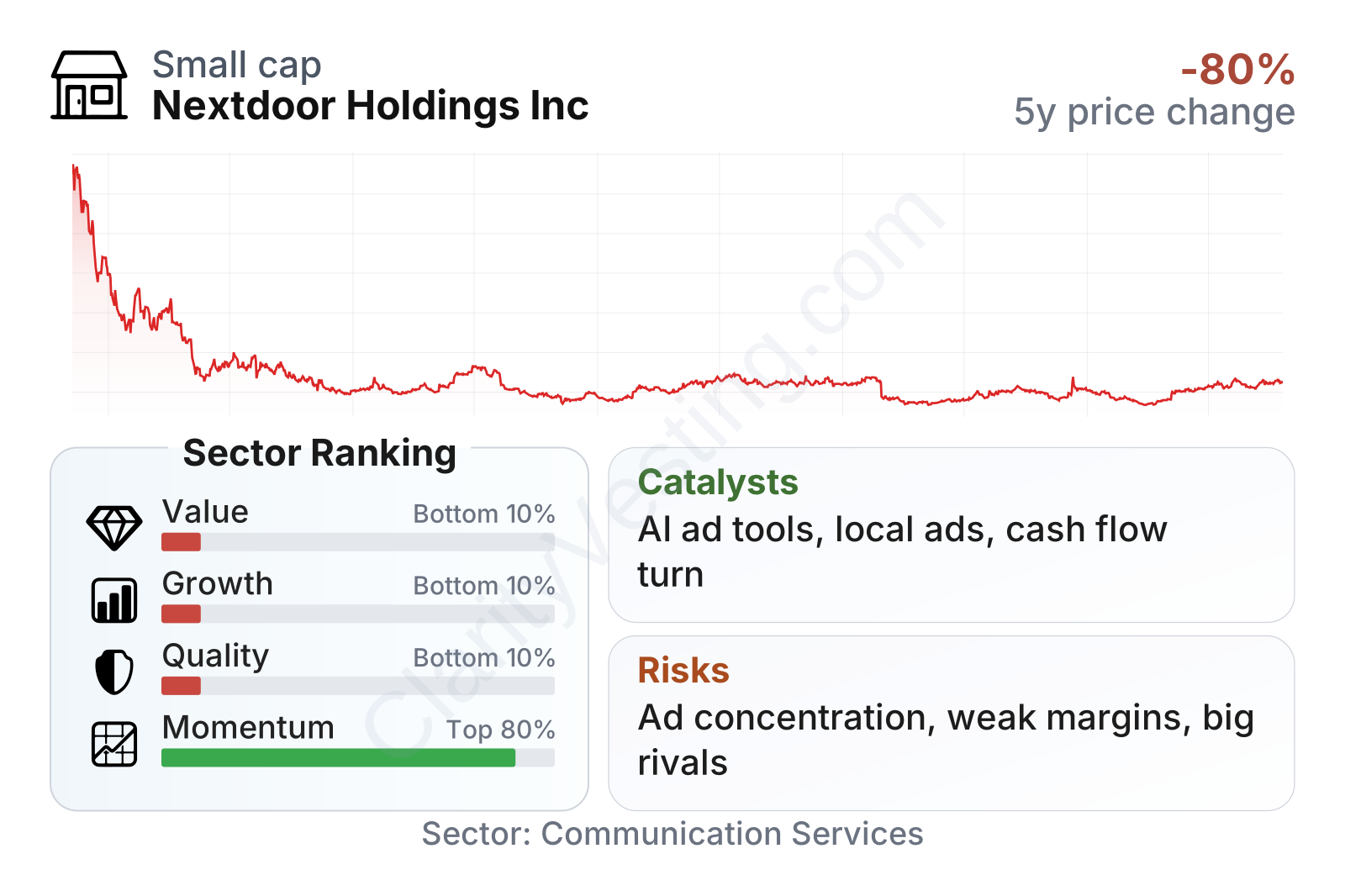
Nextdoor is a small-cap company with higher-than-average share volatility, which is common for younger internet platforms still working toward steady profitability. The factor profile is mixed: recent share-price momentum has been strong relative to much of the sector, but value, growth quality, and profitability measures remain weak versus sector medians. Revenue growth has recently moved ahead of the sector, yet that has not translated into solid returns on capital or positive margins. The balance sheet is a brighter point, with low leverage and positive free cash flow emerging after a long period of cash burn.
Growth
Nextdoor operates in a part of the digital economy that remains relevant over the long run: local online advertising, local business discovery, and community engagement. These are durable needs. Small businesses still need efficient ways to reach nearby customers, and public agencies increasingly use digital channels to communicate at the neighborhood level. That gives the company exposure to a real market rather than a purely experimental category.
Its strategy also has a rational logic. Unlike broad social platforms that compete for entertainment time, Nextdoor is trying to own a more utility-based use case: local recommendations, neighborhood alerts, service provider discovery, and community information. If this positioning works, it can support more frequent commercial interactions and stronger ad relevance because location data matters directly to the advertiser.
Recent top-line momentum has improved again after a weaker period in 2022 and 2023. Growth accelerated through much of 2024, cooled in 2025, and then strengthened again into 2026, with year-over-year revenue growth running in the mid-teens in the latest period. That is comfortably above the sector median shown in the metrics table. Even so, the longer-term record is less impressive, because revenue per share over five years remains negative, meaning dilution and uneven scaling have limited the benefit to shareholders.
A more encouraging recent change is cash generation. Free cash flow moved from deeply negative territory a few years ago to positive territory more recently. That matters because it suggests the company’s cost controls are beginning to show up in the cash profile, not just in adjusted narratives. The latest trailing free cash flow is still modest for a public company of this size, but the direction is clearly better.
As for catalysts, several are worth watching. One is the continued rollout of ad tools and measurement features aimed at improving monetization for local and national advertisers. Another is product refinement around recommendations, business pages, and public agency communication, which can increase user utility and commercial inventory at the same time. The company has also emphasized artificial intelligence features to improve content relevance, ad performance, and platform efficiency. If these initiatives lift engagement and ad pricing together, the operating model could improve faster than revenue alone would suggest.
Recent company communications have also pointed to partnerships and product updates designed to make the platform more useful for nearby commerce and public information. These developments do not guarantee a step-change in results, but they fit the core thesis: Nextdoor does not need to become a mass-media platform; it needs to become the default digital layer for neighborhoods.
Risks
This article is for informational purposes only and does not constitute financial advice. Some content is AI-generated. See Disclaimer


