Stock Analysis · NEXTDC Limited (NXDCF)
Overview
NEXTDC Limited is an Australian data center operator. In simple terms, it builds and runs highly secure facilities where businesses place servers, networking equipment, and critical digital infrastructure. Customers use these sites to store data, run cloud services, connect to telecom networks, and support applications that need high reliability. The company focuses on carrier-neutral facilities, meaning customers can connect to multiple telecom and cloud providers rather than being locked into one network.
The business model is fairly straightforward: NEXTDC invests heavily to develop data centers, fills them with customers over time, and then earns recurring revenue from space, power, connectivity, and related services. This tends to create sticky customer relationships because moving IT systems out of a live data center can be costly and disruptive.
Based on company reporting, revenue is primarily generated from recurring data center services. Public disclosures typically separate the business into broad service categories rather than a long list of product lines. The main sources are approximately:
- Colocation services: the largest contributor, estimated at 70% to 80% of revenue. This includes space, power, cooling, and physical hosting for customer equipment.
- Interconnection and connectivity services: estimated at 10% to 20% of revenue. This includes cross-connects and access to cloud, network, and IT service partners within NEXTDC facilities.
- Managed and other services: estimated at 5% to 10% of revenue. This can include setup, migration, support, and other related services.
NEXTDC’s customer base spans enterprises, cloud platforms, government users, and network providers. That mix matters because it reduces dependence on a single industry and places the company close to large digital trends such as cloud migration, AI workloads, cybersecurity needs, and growing demand for low-latency connectivity.
The company’s revenue base has expanded strongly over the last several years, but profitability has been pressured by the cost of expansion, rising operating expenses, and financing costs. That is typical for a capital-intensive data center platform in build-out mode, though it means headline profit can lag behind demand growth for a long time.
The long-term picture shows a business with steadily rising revenue, while the path from revenue to profit has become more volatile. Gross profit improved meaningfully through 2025, but interest expense remained heavy and operating leverage has not yet fully emerged. That helps explain why the company can look operationally stronger than its bottom-line results suggest.
Key Figures
| Metric | Value | Sector ⓘ |
|---|---|---|
| Date | Oct 03, 2026 | |
| Context | ||
| Sector | Technology | |
| Industry | Information Technology Services | |
| Market Cap ⓘ | $5.80B | |
| Beta ⓘ | 1.21 | |
Value (Cheapness) | ||
| P/E Ratio ⓘ | 84.78 | 29.95 |
| FCF Yield ⓘ | -57.40% | 4.22% |
| Dividend Yield ⓘ | N/A | 1.30% |
| EBIT / EV ⓘ | -0.37% | 2.83% |
| PEG ⓘ | N/A | |
Growth (Business expansion) | ||
| Revenue Growth ⓘ | 19.40% | 15.80% |
| RPS Growth (5Y CAGR) ⓘ | 4.08% | 8.55% |
| EPS Growth (5Y CAGR) ⓘ | N/A | -11.72% |
| Margin Growth (5Y Trend) ⓘ | -26.08% | 0.39% |
| FCF Growth (5Y CAGR) ⓘ | N/A | 9.72% |
| DPS Growth (5Y CAGR) ⓘ | -4.01% | 7.73% |
Quality (Business durability) | ||
| ROIC (Latest) ⓘ | N/A | 9.36% |
| ROIC (5Y Median) ⓘ | 0.73% | 8.32% |
| Net Debt / EBIT (Latest) ⓘ | 182.08 | 0.50 |
| Net Debt / EBIT (5Y Median) ⓘ | 14.16 | 0.46 |
| Net Debt / EBITDA (Latest) ⓘ | 5.67 | 0.28 |
| Net Debt / Assets ⓘ | 24.25% | 3.44% |
| EBITDA / Interest ⓘ | 3.94 | 12.67 |
| Operating Margin (Latest) ⓘ | -3.63% | 9.81% |
| Operating Margin (5Y Median) ⓘ | 12.38% | 8.50% |
| Debt to Equity (Latest) ⓘ | 55.10% | 33.33% |
| Profit Margin (Latest) ⓘ | 16.53% | 7.15% |
| Free Cash Flow (Latest) ⓘ | -$3.33B | |
Momentum (Price trend) | ||
| 3Y Return ⓘ | -4.53% | +49.46% |
| 12M Return (excl. last month) ⓘ | 0.00% | +16.51% |
| 6M Return ⓘ | -7.07% | +24.29% |
| Price vs. 200-Day MA ⓘ | -24.72% | +4.74% |
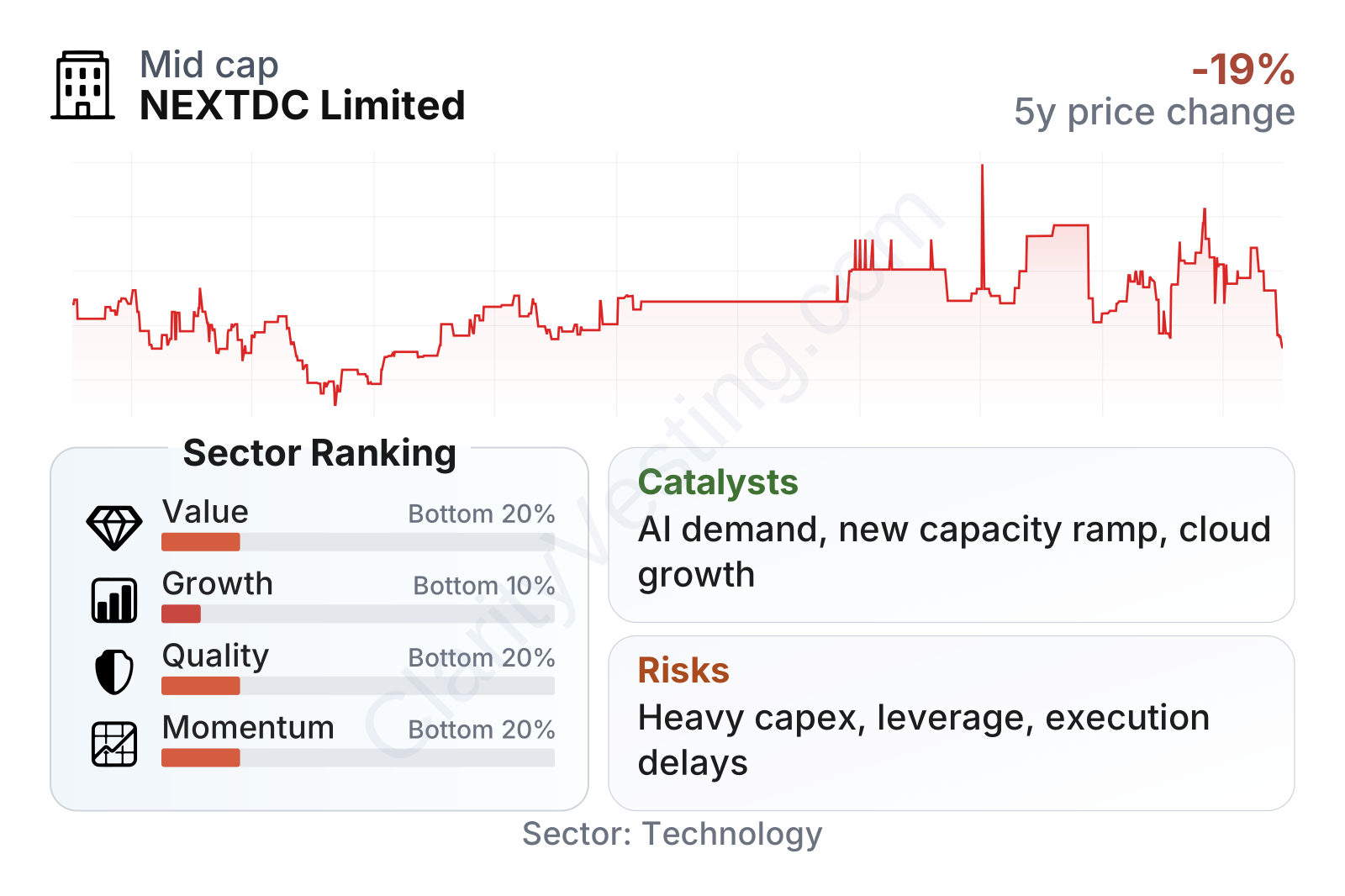
NEXTDC is a mid-to-large sized technology infrastructure company with a stock that has been volatile over the last several years. The share price recovered from the 2022 downturn, reached new highs in 2025, and then pulled back again, which fits a business that is closely tied to interest-rate expectations, funding conditions, and the market’s willingness to pay for future growth.
The metrics table points to a mixed profile. Revenue growth is still solid, running above the sector median recently, but several other measures are weaker. Valuation multiples remain elevated, free cash flow is deeply negative, and leverage-related metrics are stretched compared with typical technology service peers. Quality and momentum also rank near the lower end of the sector, showing that the market is still waiting for stronger proof that expansion spending will translate into durable earnings and cash generation.
Growth
NEXTDC operates in a sector with strong structural tailwinds. Demand for data center capacity is being supported by cloud computing, rising data use, digital transformation, enterprise outsourcing, and increasingly by AI workloads that require dense, power-hungry infrastructure. These are not short-lived trends. They are part of a longer shift toward more outsourced computing and connectivity.
The company’s strategy broadly makes sense for that environment. It is building capacity ahead of demand in major Australian markets and positioning its campuses as ecosystems where customers can connect to telecom carriers, cloud providers, and business partners in one place. This creates a network effect: the more participants inside a facility, the more useful that facility becomes. For data centers, this can be a meaningful advantage because customers often value connectivity options as much as physical space.
Revenue has continued to move upward, including recent year-over-year growth of roughly 19%, which is ahead of the sector median. That is a healthy sign for demand. Even so, the longer five-year revenue-per-share growth trend is less impressive, suggesting that capital raising and expansion have diluted some of the growth benefit on a per-share basis. In other words, the business is getting larger, but the value creation per share still needs to catch up.
A key catalyst is AI-related infrastructure demand. Training and inference workloads need high-density power, cooling, and strong network connectivity, which plays directly into premium data center offerings. Another catalyst is Australia’s ongoing cloud adoption and the need for sovereign or locally hosted infrastructure, especially for regulated industries and public sector users.
Recent company updates have also emphasized new customer wins, additional contracted capacity, and continued development of new data halls and campuses. Those announcements matter because the economics of a data center platform usually improve as built capacity is filled over time. The important question is not only whether NEXTDC can keep building, but whether it can fill that capacity fast enough to improve returns.
Risks
This article is for informational purposes only and does not constitute financial advice. Some content is AI-generated. See Disclaimer