Stock Analysis · NorthWestern Corporation (NWE)
Overview
NorthWestern Corporation is a regulated utility that provides electricity and natural gas to customers in the northern Rocky Mountain and Great Plains region, mainly in Montana, South Dakota, and Nebraska. Its business is straightforward: it owns power generation, transmission, and distribution assets for electricity, and pipelines and local distribution networks for natural gas. Because utility rates are generally set through state regulation, NorthWestern’s earnings profile is usually more stable than that of many industrial or technology companies.
The company’s revenue is primarily tied to customer energy usage and approved rates. Based on its recent annual reporting, electricity is the larger business, while natural gas remains a meaningful secondary contributor.
- Electric utility operations: about 65% to 75% of total utility revenue. This includes retail electric sales, transmission services, and other electric-related regulated activities.
- Natural gas utility operations: about 25% to 35% of total utility revenue. This includes retail natural gas distribution, transportation, and related regulated services.
That mix matters because electric utilities often carry the largest long-term investment opportunities through grid upgrades, generation projects, and rate base expansion. NorthWestern has also been investing in owned generation and reliability-focused infrastructure, which can support future earnings if regulators allow cost recovery.
Over the last several years, revenue has trended upward overall, but interest expense has also climbed, reflecting the capital-heavy nature of the business and a higher-rate financing environment. Operating income has remained fairly resilient, while net income has been more uneven.
Key Figures
| Metric | Value | Sector ⓘ |
|---|---|---|
| Date | Oct 17, 2026 | |
| Context | ||
| Sector | Utilities | |
| Industry | Utilities - Regulated Electric | |
| Market Cap ⓘ | $4.63B | |
| Beta ⓘ | 0.32 | |
Value (Cheapness) | ||
| P/E Ratio ⓘ | 26.88 | 17.28 |
| P/B Ratio ⓘ | 1.58 | 1.51 |
| FCF Yield ⓘ | -4.15% | 0.65% |
| Dividend Yield ⓘ | 3.58% | 3.77% |
| EBIT / EV ⓘ | 4.28% | 5.01% |
| PEG ⓘ | 2.71 | |
Growth (Business expansion) | ||
| Revenue Growth ⓘ | 14.60% | 6.10% |
| RPS Growth (5Y CAGR) ⓘ | -0.21% | 3.87% |
| EPS Growth (5Y CAGR) ⓘ | -13.96% | -11.30% |
| BVPS Growth (5Y CAGR) ⓘ | 1.04% | 4.23% |
| Margin Growth (5Y Trend) ⓘ | 0.29% | 3.57% |
| FCF Growth (5Y CAGR) ⓘ | -11.75% | -8.84% |
| DPS Growth (5Y CAGR) ⓘ | 1.50% | 4.84% |
Quality (Business durability) | ||
| ROIC (Latest) ⓘ | 5.71% | 6.53% |
| ROA (Latest) ⓘ | 2.02% | 3.20% |
| ROIC (5Y Median) ⓘ | 5.60% | 5.95% |
| ROA (5Y Median) ⓘ | 2.60% | 2.75% |
| Net Debt / EBIT (Latest) ⓘ | 10.74 | 7.13 |
| Net Debt / EBIT (5Y Median) ⓘ | 8.99 | 7.23 |
| Net Debt / EBITDA (Latest) ⓘ | 6.06 | 4.31 |
| Net Debt / Assets ⓘ | 41.27% | 38.42% |
| EBITDA / Interest ⓘ | 3.75 | 4.58 |
| Operating Margin (Latest) ⓘ | 19.77% | 20.83% |
| Operating Margin (5Y Median) ⓘ | 20.98% | 20.08% |
| Debt to Equity (Latest) ⓘ | 124.22% | 137.69% |
| Profit Margin (Latest) ⓘ | 10.13% | 11.37% |
| Free Cash Flow (Latest) ⓘ | -$192.16M | |
Momentum (Price trend) | ||
| 3Y Return ⓘ | +76.54% | +52.37% |
| 12M Return (excl. last month) ⓘ | +26.34% | +8.84% |
| 6M Return ⓘ | +3.59% | -3.95% |
| Price vs. 200-Day MA ⓘ | +8.40% | -0.79% |
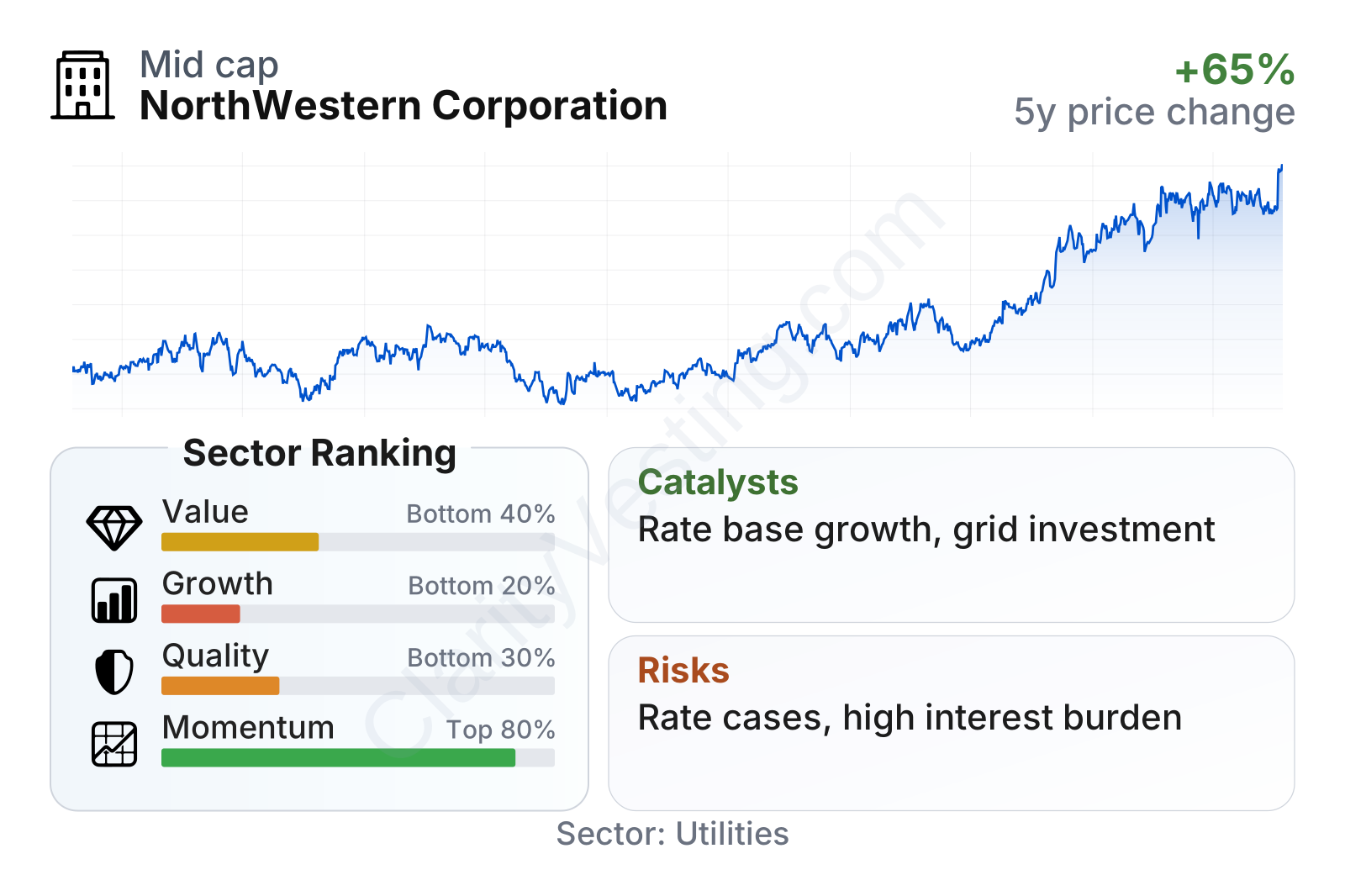
NorthWestern is a mid-sized regulated utility with a relatively low beta of 0.36, which fits the usual defensive profile of the sector. In the latest factor snapshot, momentum looks stronger than much of the utility group, but value, growth, and quality rank in the lower part of the sector. In simple terms, the stock’s recent market performance has been solid, while the underlying fundamentals look more mixed than the share price trend might suggest.
The current valuation metrics stand out. The earnings multiple is above the utility median, while the dividend yield is roughly in line with the sector. Price-to-book is near the sector norm, which suggests the premium is being paid more for current market sentiment and perceived stability than for unusually strong balance sheet or profitability metrics.
Growth
NorthWestern operates in a sector that generally grows slowly, but steadily. Regulated utilities do not usually depend on rapid customer expansion; their main growth engine is capital investment that becomes part of the regulated asset base. When a utility builds or upgrades generation, transmission, and distribution infrastructure, it can often earn a regulated return on that investment once approved by state commissions. That makes this a sector where execution, regulation, and project selection matter more than pure volume growth.
NorthWestern’s strategy appears aligned with that model. The company has been investing in reliability, capacity, and system modernization, including owned generation and grid-related projects. For a utility serving regions with weather exposure and resource adequacy needs, this can create a practical path to earnings growth. The broad industry backdrop is also supportive: electric systems across the U.S. need modernization, and utilities are increasingly spending on resilience, wildfire mitigation, transmission, and cleaner generation resources.
Revenue per share has been mostly flat across the last five years, with a dip in 2023 and a recovery afterward. That pattern supports the view that NorthWestern is not a high-growth utility, but rather a business trying to convert infrastructure investment into steady regulated expansion over time. The latest year-over-year revenue growth was notably stronger than the sector median, yet the longer-term growth record remains modest.
Free cash flow has remained negative, which is common in utilities that are spending heavily on infrastructure. On its own, negative free cash flow is not automatically a warning sign for this sector, because large capital programs often come before future rate recovery. The key question is whether those projects translate into a larger regulated asset base and eventually into stronger earnings and cash generation. If NorthWestern can continue placing assets into service and recover costs through approved rates, that spending could become a meaningful catalyst.
A recent opportunity for the company comes from the need for dependable local generation and grid reliability in its service territories. Utilities with clear capital plans and constructive regulatory outcomes can benefit from a multi-year runway of investments. For NorthWestern, the most important growth catalyst is less about dramatic market expansion and more about disciplined execution on regulated projects that can raise earnings gradually.
Risks
This article is for informational purposes only and does not constitute financial advice. Some content is AI-generated. See Disclaimer


