Stock Analysis · Northwest Bancshares Inc (NWBI)
Overview
Northwest Bancshares is a regional bank holding company built around Northwest Bank. It provides everyday banking services to consumers, small businesses, and commercial customers across markets that include Pennsylvania, New York, Ohio, and Indiana. In simple terms, it gathers deposits from customers, lends that money out at higher rates, and earns fees from services such as wealth management, card activity, and other banking operations.
For a bank like Northwest, revenue is mainly made of net interest income, which is the spread between what it earns on loans and securities and what it pays on deposits and borrowings. The rest comes from non-interest income, which includes service charges, interchange and card fees, wealth and trust revenue, mortgage banking, and other banking-related fees. Based on the company’s recent annual mix, the revenue profile is approximately:
- Net interest income: about 75% to 80% of total revenue. This is the core engine of the business and reflects earnings from commercial loans, residential mortgages, consumer lending, and securities after funding costs.
- Service charges and fees: about 8% to 10%. This generally includes deposit account charges, transaction-related fees, and customer service fees.
- Wealth management, trust, and insurance-related revenue: about 5% to 7%. These activities add fee income that is less tied to interest rates than traditional lending.
- Mortgage banking, card income, and other non-interest income: about 8% to 12%. This bucket can move around depending on lending volumes, refinancing activity, and customer payment trends.
That mix matters for long-term analysis. A bank with a larger share of fee income usually has more diversification, but Northwest remains primarily a spread-based banking business. Its performance therefore depends heavily on loan growth, deposit costs, credit quality, and the broader path of interest rates.
The multiyear financial flow shows a business that has expanded revenue meaningfully since 2021, but with pressure from rising funding costs and operating expenses. Revenue has grown from a little above $530 million in 2021 to nearly $880 million in 2025, while net income has been more volatile and remains below the 2021 level. That points to a bank that has gained scale, but has not converted all of that extra revenue into equally strong profitability.
Key Figures
| Metric | Value | Sector ⓘ |
|---|---|---|
| Date | Oct 17, 2026 | |
| Context | ||
| Sector | Financial Services | |
| Industry | Banks - Regional | |
| Market Cap ⓘ | $2.15B | |
| Beta ⓘ | 0.69 | |
Value (Cheapness) | ||
| P/E Ratio ⓘ | 14.11 | 12.26 |
| P/B Ratio ⓘ | 1.14 | 1.23 |
| FCF Yield ⓘ | 6.41% | 10.40% |
| Dividend Yield ⓘ | 5.44% | 3.02% |
| EBIT / EV ⓘ | N/A | 8.14% |
| PEG ⓘ | 2.29 | |
Growth (Business expansion) | ||
| Revenue Growth ⓘ | 23.20% | 9.35% |
| RPS Growth (5Y CAGR) ⓘ | 9.19% | 12.19% |
| EPS Growth (5Y CAGR) ⓘ | -10.25% | -9.53% |
| BVPS Growth (5Y CAGR) ⓘ | 0.83% | 4.99% |
| Margin Growth (5Y Trend) ⓘ | -18.87% | -3.86% |
| FCF Growth (5Y CAGR) ⓘ | -6.80% | 4.81% |
| DPS Growth (5Y CAGR) ⓘ | -1.30% | 8.79% |
Quality (Business durability) | ||
| ROIC (Latest) ⓘ | N/A | 9.49% |
| ROE (Latest) ⓘ | 8.09% | 13.90% |
| ROA (Latest) ⓘ | 0.91% | 1.55% |
| ROIC (5Y Median) ⓘ | 5.86% | 7.86% |
| ROE (5Y Median) ⓘ | 8.69% | 12.17% |
| ROA (5Y Median) ⓘ | 0.93% | 1.30% |
| Net Debt / EBIT (Latest) ⓘ | N/A | 0.96 |
| Net Debt / EBIT (5Y Median) ⓘ | 1.29 | 0.73 |
| Net Debt / EBITDA (Latest) ⓘ | 4.57 | 0.92 |
| Operating Margin (Latest) ⓘ | N/A | 22.30% |
| Operating Margin (5Y Median) ⓘ | 25.01% | 24.63% |
| Debt to Equity (Latest) ⓘ | 44.47% | 58.56% |
| Profit Margin (Latest) ⓘ | 23.37% | 26.57% |
| Free Cash Flow (Latest) ⓘ | $137.64M | |
Momentum (Price trend) | ||
| 3Y Return ⓘ | +73.92% | +88.33% |
| 12M Return (excl. last month) ⓘ | +33.09% | +19.38% |
| 6M Return ⓘ | +15.10% | +4.75% |
| Price vs. 200-Day MA ⓘ | +7.93% | +3.50% |
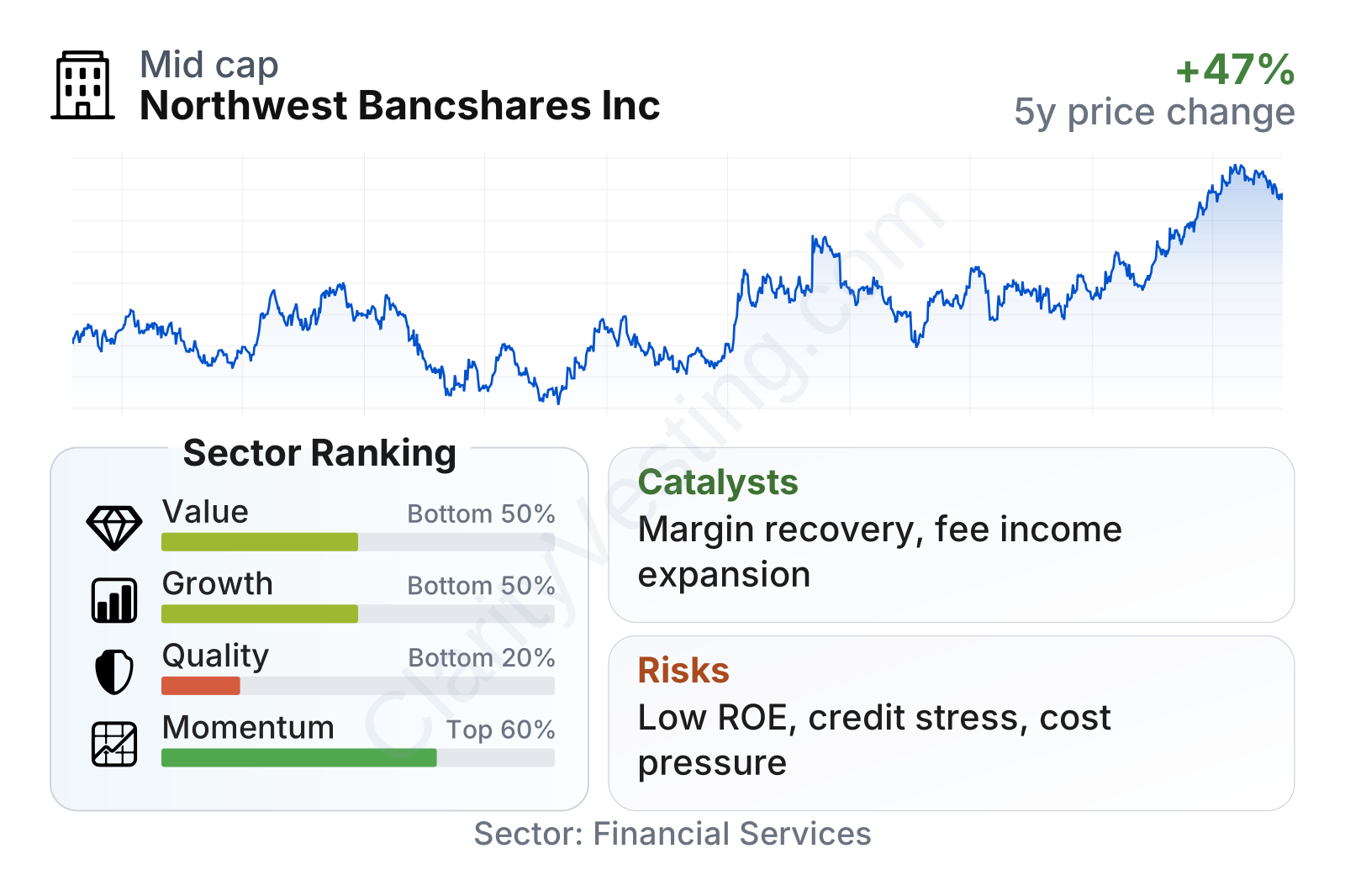
Northwest Bancshares is a mid-sized regional bank with a relatively low share-price volatility profile, as reflected by a beta below 1. The stock’s recent market performance has improved, with stronger returns over the past 6 to 12 months than the typical regional bank, but the broader fundamental picture is more mixed. Income-oriented characteristics stand out because the dividend yield is materially above the sector median, while value metrics are not deeply discounted on earnings. Quality and growth rankings sit in the lower half of the sector, which suggests that the market is recognizing some recent improvement without assigning the company a premium reserved for stronger operators.
Growth
Regional banking is not a high-growth industry in the way software or semiconductors can be, but it remains an essential part of the economy. Demand for deposits, mortgages, consumer banking, and commercial credit tends to rise over time with population, business formation, and local economic activity. For Northwest, the key long-term growth question is less about entering a booming sector and more about whether it can steadily grow loans and fee businesses while protecting margins.
The company’s strategy is sensible for that goal. Northwest has emphasized relationship banking, small business and commercial lending, and a broader mix of fee-based services. This matters because regional banks that rely only on plain-vanilla lending can become too exposed to interest-rate swings. A more balanced model can soften that impact. Recent revenue growth has been strong on a year-over-year basis, well above the sector median, which indicates that the franchise has been expanding or at least benefiting from a better revenue environment.
Still, growth has not been consistently strong over a longer period. Five-year revenue-per-share growth has trailed the sector median, and earnings per share have been uneven rather than steadily compounding. The earnings trend shows that Northwest stayed near the low $1 per share range for several years, dipped in 2024, and then improved in 2025. That pattern suggests recovery potential, but not yet a clear long-term acceleration.
Book value per share has been gradually rising again after an earlier decline, which is an encouraging sign for a bank. Since book value represents a large part of a bank’s economic base, steady progress here can support long-term resilience. The pace, however, has been modest compared with many peers, so it looks more like stabilization than strong compounding.
A potential catalyst is the interest-rate environment itself. If deposit costs stabilize while asset yields remain favorable, banks like Northwest can rebuild net interest margin and improve earnings power without needing dramatic balance-sheet growth. Another possible support is continued expansion in fee-generating businesses such as wealth management and other customer service lines, which would make revenue less dependent on pure spread income. The company’s recent revenue rebound and improved stock performance suggest that the market has started to recognize this possibility.
Risks
This article is for informational purposes only and does not constitute financial advice. Some content is AI-generated. See Disclaimer


