Stock Analysis · Novocure Ltd (NVCR)
Overview
Novocure Ltd is a medical device company focused on cancer treatment. Its core technology is called Tumor Treating Fields, or TTFields, which uses electric fields delivered through wearable devices to disrupt cancer cell division. The company’s commercial platform is known as Optune, with newer versions such as Optune Gio designed to be used by patients at home while they continue daily activities. Novocure’s treatments are prescribed for specific cancer types and are typically used alongside standard cancer care rather than as a replacement for surgery, radiation, or drug therapy.
The business model is relatively simple compared with many healthcare companies: Novocure mainly generates revenue from treatment systems and related support provided to patients and healthcare providers. Based on company reporting, revenue remains heavily concentrated in its lead product family and in a limited number of approved cancer indications.
Main revenue sources are approximately the following:
- Optune/Optune Gio therapy for glioblastoma: the large majority of revenue, historically well above 80%. This includes device usage, arrays, and related services for patients with approved brain cancer indications.
- Other approved indications and geographic expansion: a smaller but growing share, likely below 20% today. This includes use in additional cancer settings where the therapy has received approval or reimbursement support in certain markets.
- Collaboration and other revenue: minimal. Novocure is not primarily a milestone-and-royalty biotechnology model; most sales come from its own commercial operations.
Geographically, Novocure has historically generated most of its revenue from the United States, with additional contribution from Europe, Japan, and selected international markets. That mix matters because reimbursement decisions, physician adoption, and regulatory approvals can materially affect growth.
What stands out in the financial structure is that gross profit has remained strong as revenue expanded, but operating expenses have also stayed very high. Research and development spending alone has remained above $200 million annually in recent years, while selling and administrative costs have also been substantial as the company funds clinical trials and commercial expansion. Revenue has recovered since 2023, but the company has not yet translated that into consistent profitability.
The business shows a favorable gross-profit profile for a device company, but most of that benefit is being reinvested into trials, market development, and infrastructure. That helps explain why losses have narrowed from their worst levels without disappearing.
Key Figures
| Metric | Value | Sector ⓘ |
|---|---|---|
| Date | Oct 17, 2026 | |
| Context | ||
| Sector | Healthcare | |
| Industry | Medical Devices | |
| Market Cap ⓘ | $1.61B | |
| Beta ⓘ | 0.99 | |
Value (Cheapness) | ||
| P/E Ratio ⓘ | N/A | 24.79 |
| P/B Ratio ⓘ | 4.94 | 3.08 |
| FCF Yield ⓘ | -1.31% | 3.15% |
| Dividend Yield ⓘ | N/A | 1.94% |
| EBIT / EV ⓘ | -8.84% | 0.57% |
| PEG ⓘ | -0.47 | |
Growth (Business expansion) | ||
| Revenue Growth ⓘ | 15.60% | 7.45% |
| RPS Growth (5Y CAGR) ⓘ | 3.25% | 8.61% |
| EPS Growth (5Y CAGR) ⓘ | -4.18% | -17.81% |
| BVPS Growth (5Y CAGR) ⓘ | -6.34% | 3.72% |
| Margin Growth (5Y Trend) ⓘ | N/A | -0.62% |
| FCF Growth (5Y CAGR) ⓘ | N/A | 1.04% |
| DPS Growth (5Y CAGR) ⓘ | N/A | 6.77% |
Quality (Business durability) | ||
| ROIC (Latest) ⓘ | -17.26% | 3.24% |
| ROA (Latest) ⓘ | -13.78% | 3.01% |
| ROIC (5Y Median) ⓘ | -9.68% | 4.60% |
| ROA (5Y Median) ⓘ | -13.32% | 1.89% |
| Net Debt / EBIT (Latest) ⓘ | N/A | 1.34 |
| Net Debt / EBIT (5Y Median) ⓘ | N/A | 1.84 |
| Net Debt / EBITDA (Latest) ⓘ | N/A | 1.00 |
| Net Debt / Assets ⓘ | 17.57% | 5.45% |
| EBITDA / Interest ⓘ | N/A | 9.64 |
| Operating Margin (Latest) ⓘ | -21.30% | 9.27% |
| Operating Margin (5Y Median) ⓘ | -19.96% | 7.38% |
| Debt to Equity (Latest) ⓘ | 69.04% | 28.58% |
| Profit Margin (Latest) ⓘ | -21.25% | 3.59% |
| Free Cash Flow (Latest) ⓘ | -$21.12M | |
Momentum (Price trend) | ||
| 3Y Return ⓘ | -5.45% | +42.80% |
| 12M Return (excl. last month) ⓘ | +26.97% | +18.50% |
| 6M Return ⓘ | +18.41% | +7.57% |
| Price vs. 200-Day MA ⓘ | -2.51% | +5.12% |
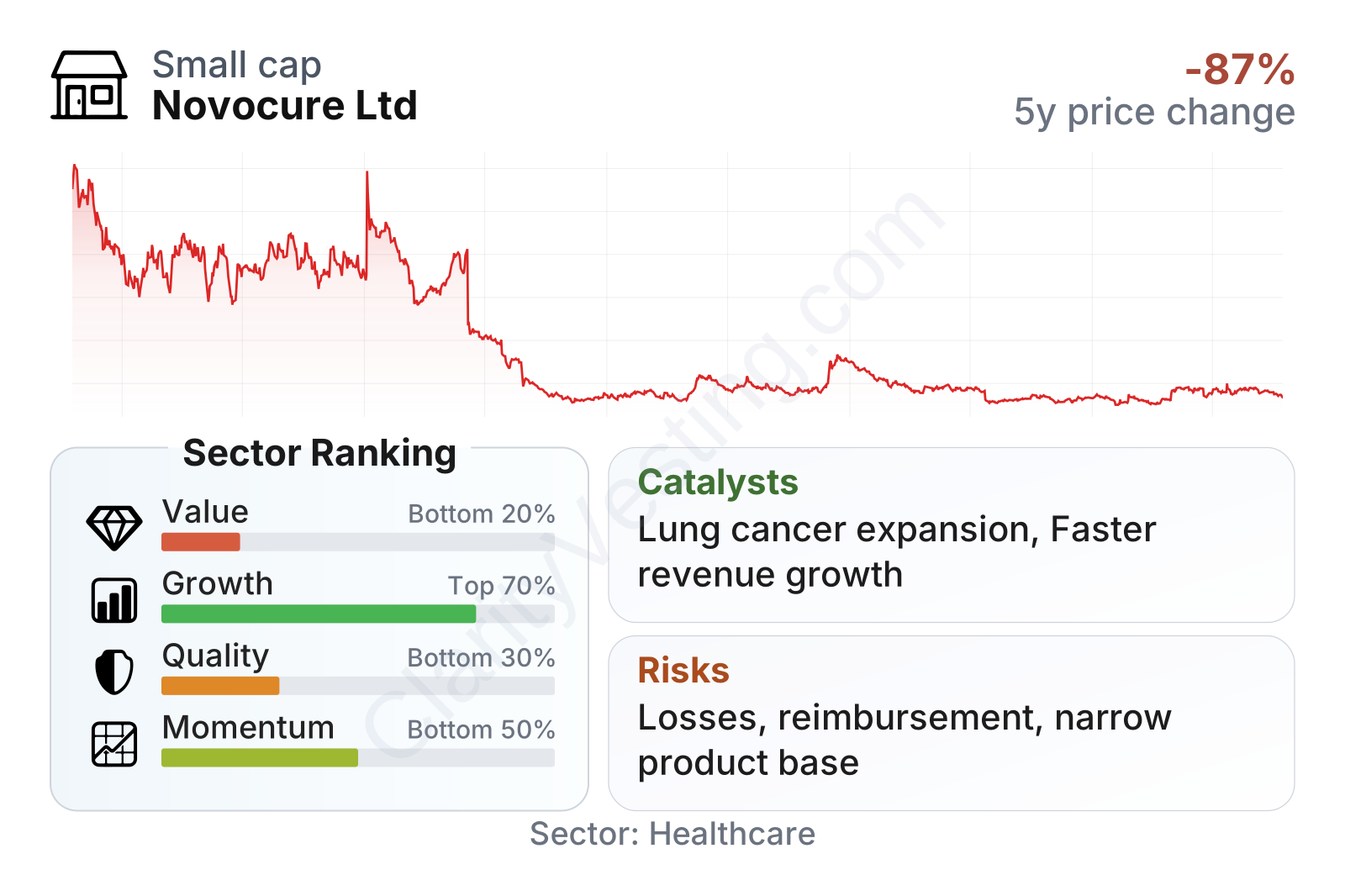
Novocure is a mid-sized healthcare company with stock-price behavior that has been highly volatile over the last several years. The recent share rebound has been stronger than the broader healthcare median over 6 and 12 months, but that follows a very deep multiyear decline, so the longer picture still looks uneven.
The table points to a mixed profile. Growth metrics are better than much of the sector, helped by recent revenue expansion of about 16% year over year, which is above the sector median. Momentum has also improved. By contrast, value and quality metrics remain weak: profitability is still negative, free cash flow is slightly negative, return on capital is below sector norms, and the price-to-book ratio sits above the sector median despite those operating weaknesses.
Growth
Novocure operates in oncology, one of the largest and most active areas in healthcare. Cancer treatment remains a growing market because of aging populations, broader diagnosis rates, longer treatment durations, and continued demand for therapies that can improve survival or quality of life. Within that market, Novocure is trying to build a distinct category rather than compete directly as another drug developer. If that category gains wider acceptance, growth could come from both new patients and new tumor types.
The company’s strategy is logical for long-term expansion. It already has a commercial base in glioblastoma, and management has been trying to use that installed platform to move into larger cancer populations. That matters because glioblastoma is a serious disease but a relatively small market. For Novocure, the biggest long-term opportunity is not squeezing more from its existing niche; it is proving that TTFields can work in more common cancers where patient populations are much larger.
Revenue growth has clearly improved since the contraction period in 2022 and much of 2023. The pattern shifted back to positive territory in late 2023, then strengthened through 2024 and remained positive into 2026. That is an encouraging operational change because it suggests the commercial business has regained traction rather than simply stabilizing.
A major catalyst is the company’s push into non-small cell lung cancer. Positive clinical and regulatory progress in that setting would matter far more than incremental gains in its legacy business because lung cancer represents a much larger addressable market. Novocure has also been evaluating TTFields in additional solid tumors, including brain metastases and pancreatic cancer, which keeps the pipeline relevant even if individual programs face delays or mixed outcomes.
Recent company communications have continued to emphasize execution around launches, reimbursement, and physician adoption in newly approved indications. In a business like this, approval alone is not enough. Real growth requires doctors to prescribe the therapy, payers to reimburse it, and patients to stay on treatment long enough to create durable revenue. That makes commercial execution just as important as clinical success.
Cash generation remains the weak point in the growth picture. Free cash flow has improved from the worst levels seen in 2024, but it remains negative on a trailing basis. That means growth is currently being pursued with ongoing cash consumption, even if the burn rate has become more manageable.
Risks
This article is for informational purposes only and does not constitute financial advice. Some content is AI-generated. See Disclaimer


