Stock Analysis · Nucor Corp (NUE)
Overview
Nucor is one of the largest steel companies in the United States. It makes steel and steel products used in construction, manufacturing, infrastructure, automotive, energy, and industrial equipment. The company is best known for operating electric arc furnace mini-mills, which melt scrap steel and other metallic inputs instead of relying mainly on traditional blast furnace production. That model has helped Nucor build a reputation for flexibility, relatively efficient operations, and a lower carbon footprint than many older steelmaking methods.
Nucor’s business is spread across three main segments: steel mills, steel products, and raw materials. The steel mills segment produces sheet steel, plate, bar, structural steel, and other core mill products. Steel products includes value-added downstream items such as joists, deck, rebar fabrication, cold finished steel, grating, fasteners, and metal building systems. Raw materials supports the system with scrap processing, direct reduced iron, pig iron, and related trading activities. This structure matters because it gives Nucor exposure not only to steel prices, but also to fabricated products and input sourcing.
Based on the company’s recent annual reporting structure, revenue is primarily generated from steel mills, followed by steel products, then raw materials. The mix can shift with steel pricing and demand, but a reasonable recent approximation is:
- Steel mills: about 67% to 72% of revenue. This includes sheet, plate, structural, bar, and other mill products sold to a wide range of industrial and construction customers.
- Steel products: about 20% to 25% of revenue. This includes fabricated and downstream products that usually carry a more specialized role in projects and industrial applications.
- Raw materials: about 8% to 12% of revenue. This includes scrap processing and metallic feedstocks that help supply Nucor’s own mills while also serving external customers.
Nucor’s operating model is also unusually decentralized for a large industrial company. Individual plants have significant autonomy, while management emphasizes performance-based pay and disciplined capital allocation. Over time, that approach has supported strong returns through steel cycles, even though earnings can still rise and fall sharply when selling prices weaken.
The financial flow over recent years shows how cyclical this business is. Revenue and profits surged in 2021 and 2022, then normalized in 2023 through 2025 as steel margins compressed. Even with that pullback, Nucor remained profitable, which says a lot about the resilience of its asset base and cost structure compared with weaker producers.
Key Figures
| Metric | Value | Sector ⓘ |
|---|---|---|
| Date | Oct 24, 2026 | |
| Context | ||
| Sector | Basic Materials | |
| Industry | Steel | |
| Market Cap ⓘ | $59.33B | |
| Beta ⓘ | 1.85 | |
Value (Cheapness) | ||
| P/E Ratio ⓘ | 20.85 | 16.92 |
| P/B Ratio ⓘ | 2.89 | 1.66 |
| FCF Yield ⓘ | 2.67% | 5.83% |
| Dividend Yield ⓘ | 0.86% | 2.07% |
| EBIT / EV ⓘ | 7.03% | 6.38% |
| PEG ⓘ | 5.21 | |
Growth (Business expansion) | ||
| Revenue Growth ⓘ | 23.00% | 11.25% |
| RPS Growth (5Y CAGR) ⓘ | 3.14% | 4.49% |
| EPS Growth (5Y CAGR) ⓘ | -28.74% | -15.24% |
| BVPS Growth (5Y CAGR) ⓘ | 16.92% | 5.49% |
| Margin Growth (5Y Trend) ⓘ | -17.24% | -1.54% |
| FCF Growth (5Y CAGR) ⓘ | N/A | 0.37% |
| DPS Growth (5Y CAGR) ⓘ | 7.70% | 5.91% |
Quality (Business durability) | ||
| ROIC (Latest) ⓘ | 11.91% | 9.59% |
| ROA (Latest) ⓘ | 8.04% | 4.92% |
| ROIC (5Y Median) ⓘ | 19.38% | 7.91% |
| ROA (5Y Median) ⓘ | 13.34% | 3.92% |
| Net Debt / EBIT (Latest) ⓘ | 1.09 | 1.36 |
| Net Debt / EBIT (5Y Median) ⓘ | 0.35 | 1.69 |
| Net Debt / EBITDA (Latest) ⓘ | 0.80 | 0.93 |
| Net Debt / Assets ⓘ | 12.50% | 13.69% |
| EBITDA / Interest ⓘ | 39.74 | 12.38 |
| Operating Margin (Latest) ⓘ | 11.77% | 13.24% |
| Operating Margin (5Y Median) ⓘ | 18.78% | 11.82% |
| Debt to Equity (Latest) ⓘ | 32.11% | 40.30% |
| Profit Margin (Latest) ⓘ | 7.99% | 6.38% |
| Free Cash Flow (Latest) ⓘ | $1.58B | |
Momentum (Price trend) | ||
| 3Y Return ⓘ | +95.18% | +73.47% |
| 12M Return (excl. last month) ⓘ | +84.28% | +27.59% |
| 6M Return ⓘ | +27.76% | -4.02% |
| Price vs. 200-Day MA ⓘ | +20.47% | -0.65% |
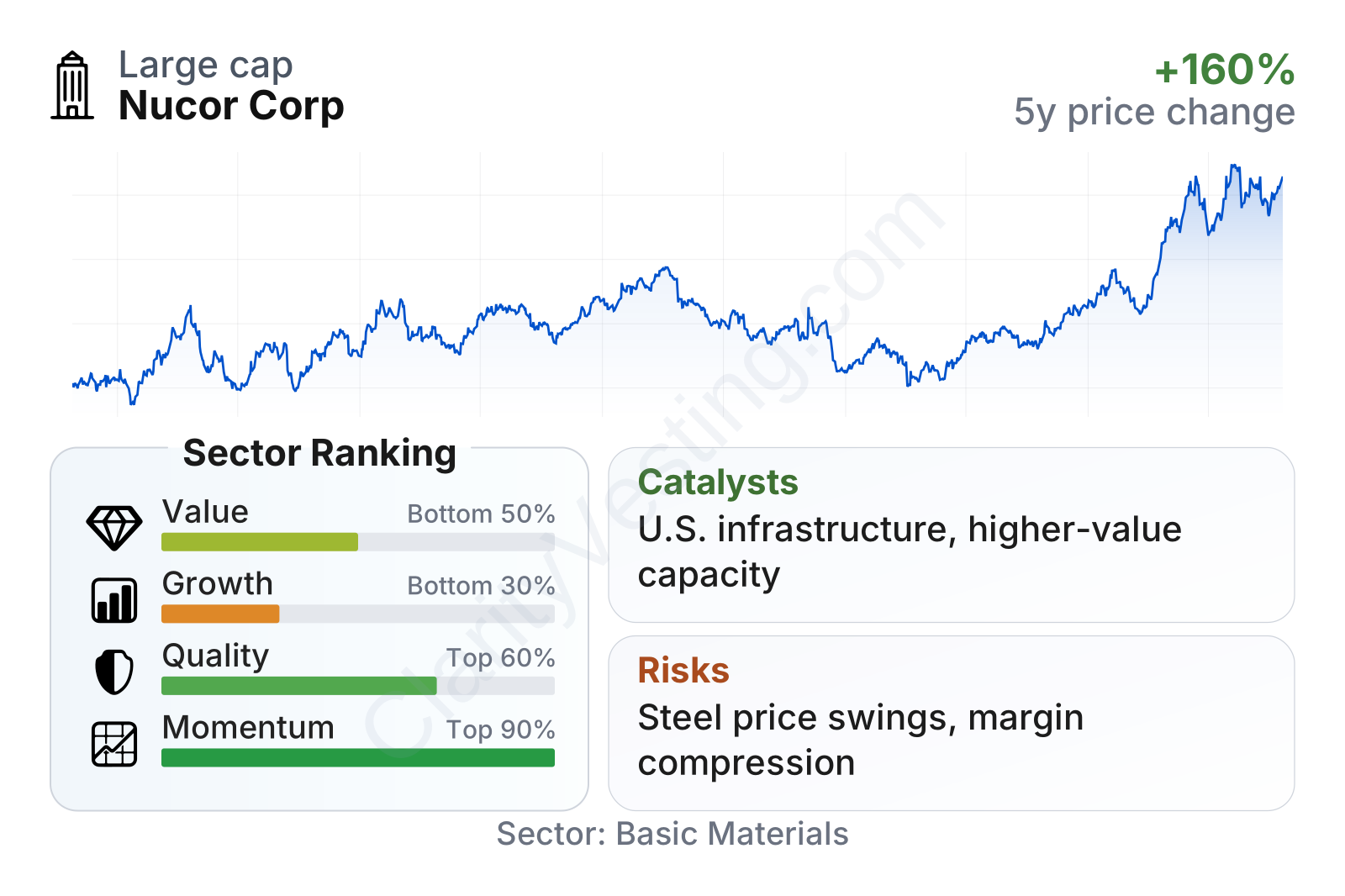
Nucor is a very large U.S. steel producer with above-average share price volatility, which is common for cyclical materials companies. The latest factor breakdown paints a mixed but understandable picture: quality remains solid, momentum is strong, while value and growth rankings look less attractive. In plain terms, the company still appears financially sound and operationally capable, but the stock has already reflected part of that recovery, and recent multi-year earnings growth has been uneven because the industry moved off unusually high 2021-2022 profit levels.
Profitability and capital efficiency are still better than many peers, with returns on capital and assets above sector medians. Balance sheet measures also remain healthy, with modest leverage and very strong interest coverage. On the other hand, free cash flow yield and dividend yield are not especially high relative to the broader materials sector, which suggests the current market valuation is not obviously cheap.
Growth
Steel is not a steady high-growth industry in the way software or semiconductors can be, but it remains essential. Demand is supported by construction, manufacturing, infrastructure, data centers, power transmission, and energy projects. In the United States, there is also a structural push toward domestic industrial capacity, which matters for a company like Nucor because it is heavily exposed to North American production rather than overseas commodity exports.
Nucor’s strategy for future expansion is centered on adding higher-value capacity, broadening downstream products, and improving raw material self-sufficiency. In recent years the company has invested in new sheet and plate capacity, expanded rebar and utility structures exposure, and built out metallics capabilities. That strategy makes sense because it aims to reduce dependence on any single steel category and increase participation in segments where customer relationships and product specialization matter more than pure commodity pricing.
Recent revenue trends suggest the business is moving out of a weaker part of the cycle. After a prolonged stretch of year-over-year declines through 2023 and much of 2024, growth turned positive again and has recently accelerated into the low-20% range. That does not guarantee a straight line upward, but it does indicate improving demand, pricing, volume, or a combination of the three.
Cash generation tells a more cautious story. Free cash flow remains positive, but it is far below the peak levels seen earlier in the cycle. That partly reflects lower earnings versus the boom period and partly reflects ongoing capital spending to position the business for future output and product mix improvements. For a long-term view, this matters because Nucor is still funding growth from a position of financial strength rather than stretching its balance sheet.
One notable catalyst is U.S. infrastructure and industrial buildout. Projects tied to grid expansion, manufacturing reshoring, energy transmission, warehouses, and non-residential construction can support demand for rebar, structural steel, plate, and other products where Nucor has meaningful presence. Another is the company’s ability to capture more value from downstream fabricated products, which can help reduce the earnings swing that comes from raw steel price moves alone.
There is also a longer-term environmental angle. Nucor’s electric arc furnace model is generally less carbon-intensive than traditional integrated steelmaking. As customers place more emphasis on lower-emission supply chains, this could become a stronger competitive differentiator, especially in large industrial and construction contracts.
Risks
This article is for informational purposes only and does not constitute financial advice. Some content is AI-generated. See Disclaimer


