Stock Analysis · Nu Holdings Ltd (NU)
Overview
Nu Holdings is a digital financial services company best known for Nubank, one of the largest independent digital banking platforms in the world. The company operates mainly in Brazil and has expanded into Mexico and Colombia. Its model is built around offering banking, credit, payments, savings, investing, insurance, and business banking through a mobile-first platform with relatively low physical infrastructure compared with traditional banks.
For a long-term view, the key point is that Nu is not a single-product company anymore. It started with credit cards, then added personal loans, deposits, checking accounts, investments, insurance, and services for merchants and small businesses. That broadening matters because it can increase revenue per customer over time while lowering customer acquisition costs if people use more products inside the same app.
Based on company disclosures, Nu’s revenue is primarily generated from interest income and fee income tied to lending, cards, and financial services activity. Exact percentages can shift by quarter and country, but the broad revenue mix is centered on the following areas:
- Interest income from credit products and securities: approximately 70% to 80% of revenue. This includes income from credit cards, personal loans, and returns on interest-earning assets.
- Fee and commission income: approximately 15% to 25% of revenue. This includes interchange fees, late fees, marketplace-related fees, and service fees connected to banking and payments.
- Other financial income: generally a smaller share, often below 10%. This can include hedging effects, transactional items, and ancillary services depending on the reporting period.
Geographically, Brazil remains the core engine of the business by a wide margin, while Mexico has become the most important expansion market and Colombia is still earlier in its development. In simple terms, Nu today is a fast-growing digital bank that still earns most of its money from Brazil, mostly through lending and card-related activity, but with a growing opportunity to deepen relationships across a very large customer base.
The business flow over the past few years shows a notable shift: revenue has scaled rapidly, profitability has moved from losses to sizable net income, and operating expenses have grown much more slowly than revenue. That is an important sign that the platform is gaining efficiency as it matures.
Key Figures
| Metric | Value | Sector ⓘ |
|---|---|---|
| Date | Oct 17, 2026 | |
| Context | ||
| Sector | Financial Services | |
| Industry | Banks - Regional | |
| Market Cap ⓘ | $72.12B | |
| Beta ⓘ | 0.95 | |
Value (Cheapness) | ||
| P/E Ratio ⓘ | 21.33 | 12.26 |
| P/B Ratio ⓘ | 5.45 | 1.23 |
| FCF Yield ⓘ | -5.85% | 10.40% |
| Dividend Yield ⓘ | N/A | 3.02% |
| EBIT / EV ⓘ | 6.99% | 8.14% |
| PEG ⓘ | 0.63 | |
Growth (Business expansion) | ||
| Revenue Growth ⓘ | 52.10% | 9.35% |
| RPS Growth (5Y CAGR) ⓘ | 72.15% | 12.19% |
| EPS Growth (5Y CAGR) ⓘ | N/A | -9.53% |
| BVPS Growth (5Y CAGR) ⓘ | 24.21% | 4.99% |
| Margin Growth (5Y Trend) ⓘ | 12.75% | -3.86% |
| FCF Growth (5Y CAGR) ⓘ | N/A | 4.81% |
| DPS Growth (5Y CAGR) ⓘ | N/A | 8.79% |
Quality (Business durability) | ||
| ROIC (Latest) ⓘ | 25.34% | 9.49% |
| ROE (Latest) ⓘ | 30.31% | 13.90% |
| ROA (Latest) ⓘ | 4.77% | 1.55% |
| ROIC (5Y Median) ⓘ | 19.19% | 7.86% |
| ROE (5Y Median) ⓘ | 18.24% | 12.17% |
| ROA (5Y Median) ⓘ | 2.81% | 1.30% |
| Net Debt / EBIT (Latest) ⓘ | 5.10 | 0.96 |
| Net Debt / EBIT (5Y Median) ⓘ | -4.91 | 0.73 |
| Net Debt / EBITDA (Latest) ⓘ | 4.96 | 0.92 |
| Operating Margin (Latest) ⓘ | 22.67% | 22.30% |
| Operating Margin (5Y Median) ⓘ | 24.39% | 24.63% |
| Debt to Equity (Latest) ⓘ | 317.17% | 58.56% |
| Profit Margin (Latest) ⓘ | 42.73% | 26.57% |
| Free Cash Flow (Latest) ⓘ | -$4.22B | |
Momentum (Price trend) | ||
| 3Y Return ⓘ | +86.46% | +88.33% |
| 12M Return (excl. last month) ⓘ | -10.81% | +19.38% |
| 6M Return ⓘ | -3.98% | +4.75% |
| Price vs. 200-Day MA ⓘ | +0.50% | +3.50% |
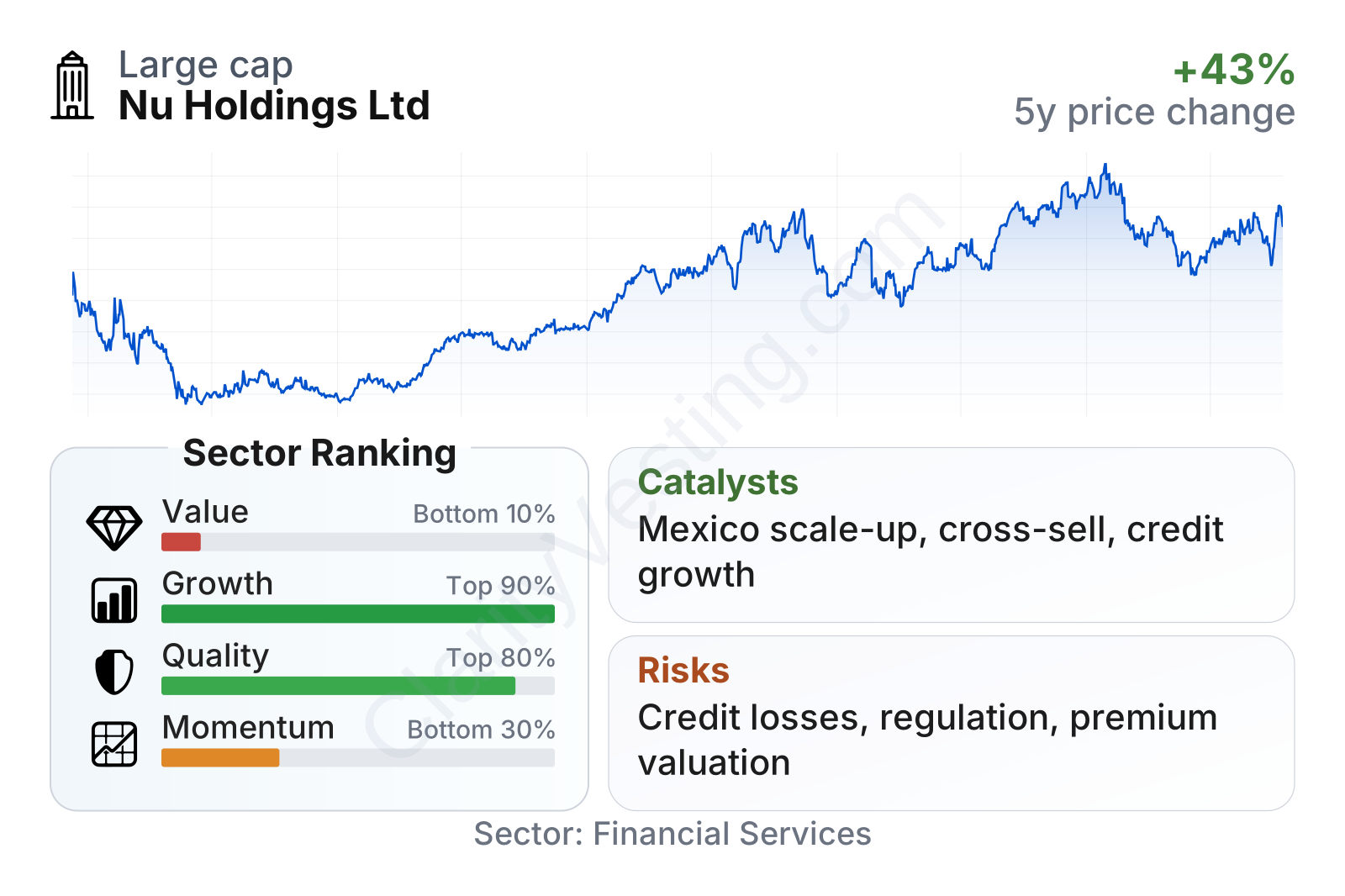
Nu is now a large financial company by market value, but its trading pattern still reflects a growth stock rather than a traditional bank. The share price has been highly volatile since listing, with a deep drawdown in 2022, a strong recovery afterward, and more mixed performance recently. That pattern is common when the market is trying to balance fast growth against the risks that come with consumer lending and expansion across emerging markets.
The overall factor profile is unusual for a bank. Growth ranks very high versus the sector, quality is also strong, but value looks weak because the stock trades at noticeably richer multiples than most regional banks. Momentum has softened more recently, which suggests that the market has become more selective after a strong rerating period.
Growth
Nu operates in a sector with durable long-term tailwinds. In Latin America, digital banking and digital payments still have room to expand as more consumers move away from cash, branch-based banking, and legacy institutions with higher fees and slower service. Brazil is already a large digital finance market, but the opportunity has not disappeared because customer monetization can keep rising even after customer acquisition slows. Mexico and Colombia add another layer of runway because digital banking penetration is still developing.
Nu’s strategy makes sense for future growth because it combines three reinforcing elements: low-cost customer acquisition through a simple app-based offering, cross-selling into a broader product set, and gradual credit expansion using data gathered from user behavior. This is important because a digital bank can look impressive when it is only adding customers, but the stronger model is one that also improves deposits, loans, engagement, and profitability per active user over time. Nu has been moving in that direction.
The earnings trend illustrates that transition clearly. After losses in 2021 and 2022, earnings turned positive in 2023 and then continued to grow through 2024 and 2025. That kind of progression suggests Nu is no longer just proving that it can grow; it is increasingly proving that it can grow while producing meaningful profits.
Book value per share has also climbed steadily, which matters for a financial company because it shows the balance sheet is compounding alongside reported earnings. A rising book value is especially important here because it indicates growth is not coming only from headline customer numbers, but also from a stronger capital base.
A major catalyst is the company’s ability to increase average revenue per active customer without losing its low-cost positioning. If Nu keeps converting users from basic accounts into borrowers, investors, insured customers, and business clients, growth can continue even if customer additions become less explosive than in the early years. Another catalyst is Mexico, where Nu has been building deposits, credit, and brand awareness in a market that is large enough to become a second major earnings engine over time.
Recent company updates have also highlighted product expansion beyond cards, including secured and unsecured lending, payroll-related offerings, investment tools, and services for small businesses. Those initiatives are significant because they can lift monetization and diversify revenue away from a narrow dependence on one product category. In short, Nu still appears to be in a growth phase, but it is now a more financially mature version of that growth than it was at listing.
Risks
This article is for informational purposes only and does not constitute financial advice. Some content is AI-generated. See Disclaimer


