Stock Analysis · Nexteer Automotive Group Limited (NTXVF)
Overview
Nexteer Automotive Group Limited is an auto-parts supplier focused on steering and motion control systems. In simple terms, it develops and manufactures the hardware, software, and integrated systems that help vehicles steer, handle, and increasingly support advanced driver-assistance functions. Its products are used by global automakers across passenger cars, pickups, SUVs, and increasingly electrified vehicle platforms.
The company’s business is centered on steering, which remains its core activity, but it has expanded into adjacent technologies such as driveline systems and software-enabled motion control. That matters because modern vehicles need more electronic content, more safety features, and tighter integration between mechanical systems and software.
Based on the company’s annual reporting and product disclosures, Nexteer’s revenue mix is primarily built around the following sources:
- Electric power steering and related steering systems: approximately 70% to 80% of revenue. This includes column-assist, single-pinion, dual-pinion, and rack-assist electric power steering systems, as well as electronic control units and related components.
- Driveline systems: approximately 10% to 20% of revenue. This business includes halfshafts, constant-velocity joints, and driveline products used to transfer power from the powertrain to the wheels.
- Hydraulic steering and other legacy steering products: approximately 5% to 10% of revenue. This portion has been structurally pressured as the industry shifts toward electric steering.
- Software, advanced steering functions, and other motion-control solutions: a small but rising share of revenue. This includes steer-by-wire development, rear-wheel steering, and technologies linked to automated driving and vehicle control.
Nexteer serves a broad group of carmakers, and its footprint spans North America, Asia-Pacific, Europe, and other regions. That geographic spread reduces reliance on a single market, but it also exposes the company to swings in global vehicle production, customer mix, and trade policy.
Over the last several years, revenue has trended upward from about $3.4 billion in 2021 to around $4.6 billion in 2025, while gross profit and operating income also improved. The more notable point is that research and development spending has remained meaningful and even increased over time, showing that Nexteer is trying to stay relevant as steering systems become more software-driven and electronically controlled.
The financial flow shows a business with thin manufacturing margins but improving profitability. Revenue has grown steadily, cost of goods still absorbs the vast majority of sales, and operating profit has recovered more clearly in the latest period. Research and development remains sizable, which is important in a market where future contracts increasingly depend on electronics, software integration, and safety-related functions.
Key Figures
| Metric | Value | Sector ⓘ |
|---|---|---|
| Date | Oct 03, 2026 | |
| Context | ||
| Sector | Consumer Cyclical | |
| Industry | Auto Parts | |
| Market Cap ⓘ | $1.72B | |
| Beta ⓘ | 1.78 | |
Value (Cheapness) | ||
| P/E Ratio ⓘ | 11.88 | 17.04 |
| P/B Ratio ⓘ | 0.71 | 1.61 |
| FCF Yield ⓘ | 38.61% | 9.02% |
| Dividend Yield ⓘ | 3.03% | 2.75% |
| EBIT / EV ⓘ | 39.80% | 6.69% |
| PEG ⓘ | N/A | |
Growth (Business expansion) | ||
| Revenue Growth ⓘ | 3.90% | 5.60% |
| RPS Growth (5Y CAGR) ⓘ | 8.15% | 9.04% |
| EPS Growth (5Y CAGR) ⓘ | -48.64% | -17.44% |
| BVPS Growth (5Y CAGR) ⓘ | 1.39% | 5.73% |
| Margin Growth (5Y Trend) ⓘ | 0.43% | -0.26% |
| FCF Growth (5Y CAGR) ⓘ | N/A | 4.91% |
| DPS Growth (5Y CAGR) ⓘ | -1.89% | 10.48% |
Quality (Business durability) | ||
| ROIC (Latest) ⓘ | 12.54% | 12.38% |
| ROA (Latest) ⓘ | 6.31% | 5.54% |
| ROIC (5Y Median) ⓘ | 3.73% | 10.63% |
| ROA (5Y Median) ⓘ | 1.79% | 5.44% |
| Net Debt / EBIT (Latest) ⓘ | -1.36 | 2.16 |
| Net Debt / EBIT (5Y Median) ⓘ | -2.30 | 2.31 |
| Net Debt / EBITDA (Latest) ⓘ | -0.58 | 1.52 |
| Net Debt / Assets ⓘ | -13.12% | 21.74% |
| EBITDA / Interest ⓘ | 68.08 | 9.06 |
| Operating Margin (Latest) ⓘ | 4.18% | 9.12% |
| Operating Margin (5Y Median) ⓘ | 2.75% | 9.56% |
| Debt to Equity (Latest) ⓘ | 3.76% | 76.18% |
| Profit Margin (Latest) ⓘ | 2.66% | 5.30% |
| Free Cash Flow (Latest) ⓘ | $665.90M | |
Momentum (Price trend) | ||
| 3Y Return ⓘ | +3.52% | +11.77% |
| 12M Return (excl. last month) ⓘ | -31.11% | +0.61% |
| 6M Return ⓘ | -23.75% | +1.32% |
| Price vs. 200-Day MA ⓘ | -11.30% | -3.47% |
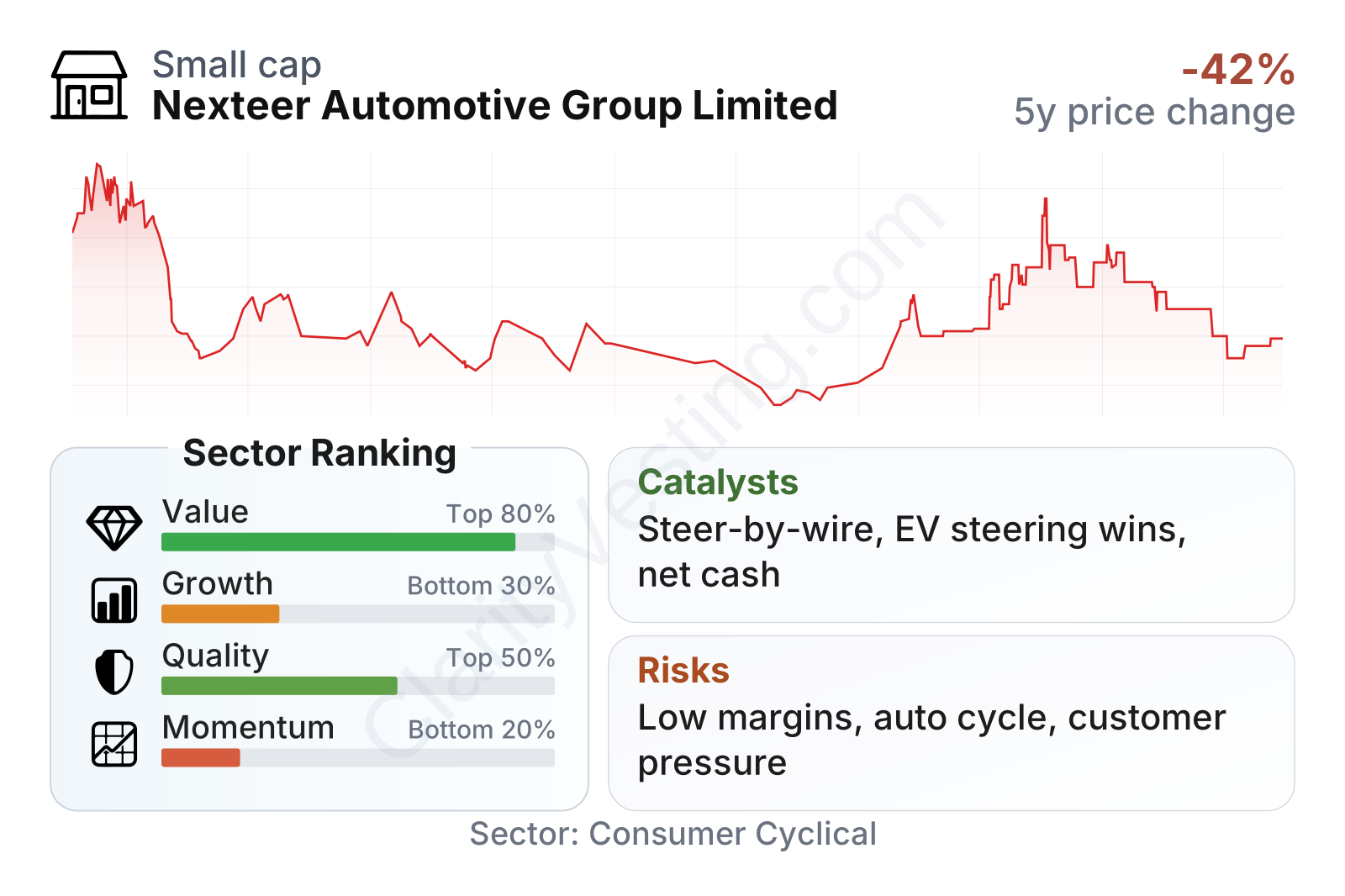
Nexteer stands out more on valuation and balance-sheet strength than on growth or market momentum. The company screens as inexpensive versus the broader auto-parts group on earnings and book value, while free cash flow generation appears notably strong. Financial leverage is also very low, which is unusual in a manufacturing business. On the other hand, growth metrics trail much of the sector, profitability remains below the industry median, and the stock’s recent price trend has been weak and more volatile than average.
Growth
Nexteer operates in a part of the automotive market that still has room for long-term expansion. Steering is not a fading category, but the type of steering content inside vehicles is changing. Electric power steering has largely replaced hydraulic systems in newer platforms because it improves fuel efficiency, supports electric vehicles better, and enables driver-assistance features. That shift benefits suppliers that already have scale and engineering capabilities in electric steering.
The company’s strategy broadly fits that direction. Nexteer has been positioning itself around higher-content systems rather than low-tech commodity parts. That includes steering systems for battery electric vehicles, steer-by-wire, rear-wheel steering, and software-enabled vehicle motion control. These are attractive areas because they can increase content per vehicle and make the supplier more embedded in a customer’s platform design.
Recent growth has been positive but not especially strong relative to the wider sector. Revenue has increased over the last few years, yet the pace has been moderate rather than exceptional. That suggests the company is participating in favorable technology shifts, but still faces the reality of uneven global auto production and customer-specific program timing.
A potentially important catalyst is the continued adoption of advanced steering architectures in electric and higher-end vehicles. Steer-by-wire and rear-wheel steering are still early compared with conventional systems, but they can become more meaningful if automakers use them to differentiate ride quality, packaging, and automated driving capability. Nexteer’s ongoing engineering spending suggests management sees this as a real opportunity rather than a side project.
Another positive factor is financial flexibility. With net cash rather than heavy net debt, the company has more room to invest in new programs, absorb temporary market weakness, or support shareholder returns than a heavily levered peer would. In a cyclical industry, that flexibility can matter as much as top-line growth.
Recent company communications have also pointed to program wins and development work tied to electrification and software-rich steering applications. For long-term analysis, the main point is not any single announcement, but that Nexteer is still winning business in the categories that should matter more over the next vehicle cycle.
Risks
This article is for informational purposes only and does not constitute financial advice. Some content is AI-generated. See Disclaimer