Stock Analysis · Northern Trust Corporation (NTRS)
Overview
Northern Trust Corporation is a U.S. financial institution focused on servicing wealthy individuals, families, institutions, and other financial firms. Its business is centered on custody, asset servicing, wealth management, asset management, and related banking services. In simple terms, the company helps clients safeguard assets, administer complex investment portfolios, manage money, and handle specialized financial operations that are difficult to do in-house.
The company operates through two main client segments: Wealth Management and Asset Servicing, with a smaller business called Asset Management that invests money on behalf of institutions and individuals. Northern Trust also earns income from traditional banking activities such as net interest income on deposits and loans, but its identity is more specialized than a typical retail bank. That makes it more tied to fee income, client asset levels, and institutional relationships than to consumer lending.
Based on recent annual reporting, Northern Trust’s revenue mix is broadly driven by the following sources, from largest to smallest:
- Trust, investment, and other servicing fees: approximately 50% to 60% of total revenue. This includes custody, fund administration, wealth advisory, investment management fees, and related servicing income.
- Net interest income: approximately 35% to 45% of total revenue. This is the spread between what the company earns on interest-bearing assets and what it pays on deposits and other funding.
- Foreign exchange trading income, security commissions, and other noninterest income: approximately 5% to 10% of total revenue. This includes ancillary market and transaction services tied to client activity.
Northern Trust’s business model benefits from long-standing client relationships and a large base of assets under custody and administration. That scale matters because institutional clients usually place a high value on reliability, compliance, technology, and operational continuity. Revenue has expanded strongly in recent years, but profit conversion has been more uneven because expenses and funding costs have also moved higher.
The revenue base has grown materially since 2021, with a particularly strong jump through 2024 before some pullback in 2025. Operating income and net income also improved sharply in 2024, showing that earnings can rebound when business activity and market conditions are supportive. At the same time, the cost structure remains substantial, which means growth in revenue does not automatically translate into the same pace of growth in profits.
Key Figures
| Metric | Value | Sector ⓘ |
|---|---|---|
| Date | Oct 24, 2026 | |
| Context | ||
| Sector | Financial Services | |
| Industry | Asset Management | |
| Market Cap ⓘ | $30.54B | |
| Beta ⓘ | 1.25 | |
Value (Cheapness) | ||
| P/E Ratio ⓘ | 14.23 | 12.46 |
| P/B Ratio ⓘ | 2.43 | 1.25 |
| FCF Yield ⓘ | 0.43% | 9.82% |
| Dividend Yield ⓘ | N/A | 2.94% |
| EBIT / EV ⓘ | 8.14% | 8.11% |
| PEG ⓘ | 0.98 | |
Growth (Business expansion) | ||
| Revenue Growth ⓘ | 36.40% | 9.10% |
| RPS Growth (5Y CAGR) ⓘ | 25.00% | 12.31% |
| EPS Growth (5Y CAGR) ⓘ | 10.35% | -6.97% |
| BVPS Growth (5Y CAGR) ⓘ | -46.54% | 5.02% |
| Margin Growth (5Y Trend) ⓘ | -14.68% | -4.00% |
| FCF Growth (5Y CAGR) ⓘ | 44.26% | 4.71% |
| DPS Growth (5Y CAGR) ⓘ | 2.93% | 8.92% |
Quality (Business durability) | ||
| ROIC (Latest) ⓘ | 8.57% | 9.18% |
| ROE (Latest) ⓘ | 19.08% | 13.93% |
| ROA (Latest) ⓘ | 1.46% | 1.57% |
| ROIC (5Y Median) ⓘ | 6.74% | 7.80% |
| ROE (5Y Median) ⓘ | 9.56% | 12.15% |
| ROA (5Y Median) ⓘ | 0.87% | 1.28% |
| Net Debt / EBIT (Latest) ⓘ | -11.96 | 1.02 |
| Net Debt / EBIT (5Y Median) ⓘ | -16.26 | 0.72 |
| Net Debt / EBITDA (Latest) ⓘ | -1.38 | 0.88 |
| Operating Margin (Latest) ⓘ | 19.83% | 22.30% |
| Operating Margin (5Y Median) ⓘ | 16.75% | 24.50% |
| Debt to Equity (Latest) ⓘ | 16.24% | 59.34% |
| Profit Margin (Latest) ⓘ | 24.67% | 26.42% |
| Free Cash Flow (Latest) ⓘ | $131.10M | |
Momentum (Price trend) | ||
| 3Y Return ⓘ | +181.29% | +95.73% |
| 12M Return (excl. last month) ⓘ | +34.37% | +17.30% |
| 6M Return ⓘ | -0.27% | +6.07% |
| Price vs. 200-Day MA ⓘ | +1.39% | +5.36% |
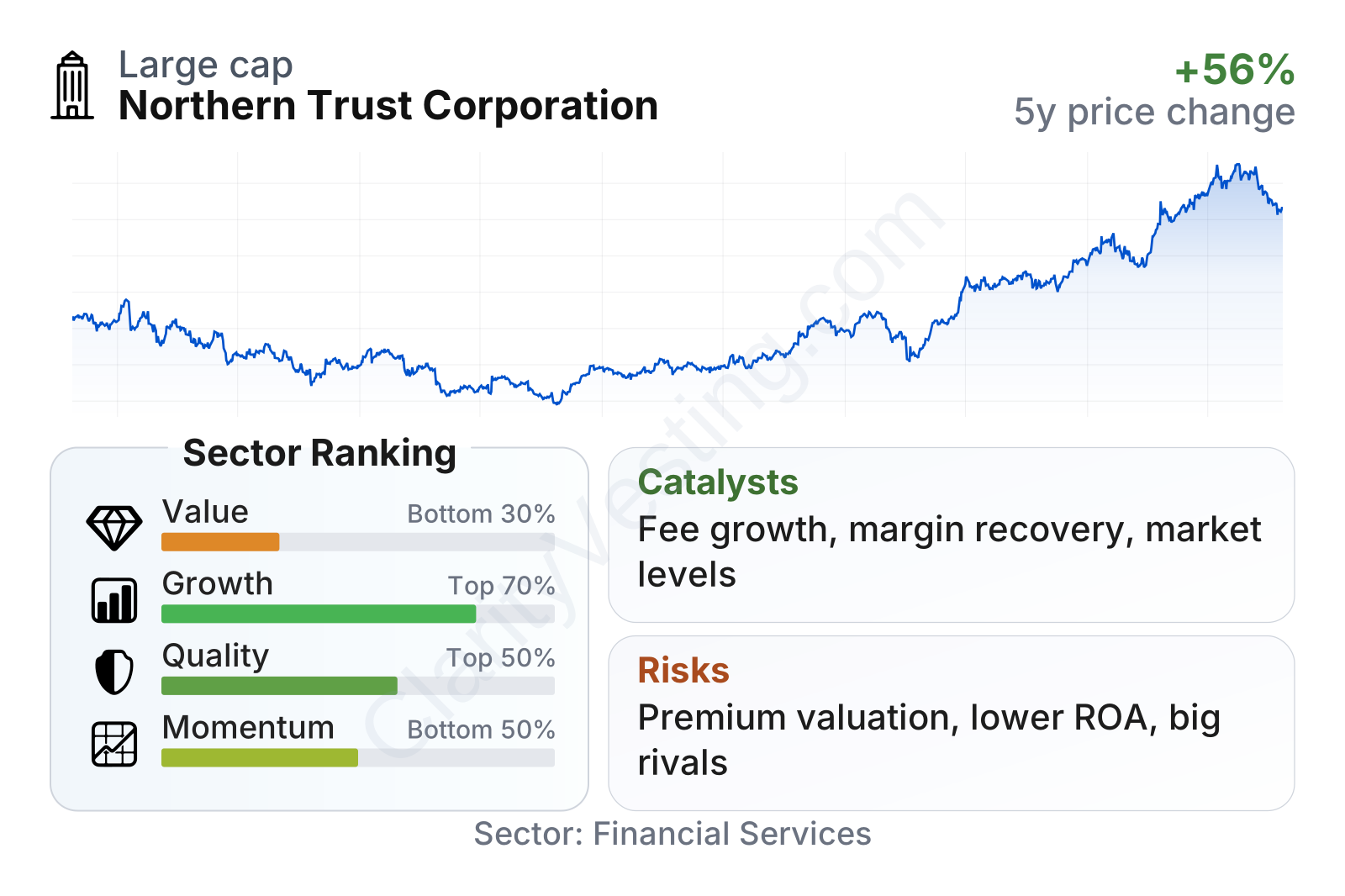
Northern Trust is a large financial company with a market value above $30 billion, so it has meaningful scale without being among the very largest global custodians. Recent market performance has been strong, with returns over the last six months, last year, and three years all ahead of the sector median. On growth measures, revenue trends look better than many peers, while quality metrics are mixed: return on equity is above the sector median, but return on assets and longer-term profitability measures remain less impressive. On valuation, the shares screen as more expensive than much of the sector on both earnings and book value, which suggests the market is already recognizing some recent improvement.
Growth
Northern Trust operates in areas that should remain relevant for a long time. Global asset pools continue to expand over time, institutional investors face heavier reporting and compliance needs, and wealthy clients increasingly require integrated advice, estate planning, and investment support. These are supportive industry conditions, especially for firms with established reputations in custody, administration, and fiduciary services.
The company’s strategy also makes practical sense. Rather than trying to compete broadly with mass-market banks, Northern Trust focuses on specialized, relationship-driven services where switching providers can be disruptive for clients. This can support durable revenue, especially in asset servicing and wealth management. Technology spending, automation, and operating platform improvements are also important because large clients want scale, accuracy, and efficiency from service providers.
Earnings per share show a business that went through pressure in 2022 and 2023, then rebounded strongly in 2024. The following year eased from that peak, which suggests the profit profile is improving but not yet on a perfectly steady path. That pattern fits a company whose results are influenced by interest rates, market levels, client activity, and expense discipline all at once.
Book value per share has trended upward in the most recent years shown, which is a constructive sign for a financial company because book value represents the capital base supporting the business. The sharp break between 2021 and 2022 appears to reflect a comparability issue rather than a normal operating trend, so the more useful takeaway is the steady climb from 2022 onward.
One notable catalyst is the company’s sensitivity to healthier market levels and client asset growth. When equity markets rise and client balances increase, fee-based income can expand. Another catalyst is a more stable interest-rate environment, which can improve visibility on deposit costs and interest margins. Northern Trust has also highlighted productivity and expense actions in recent reporting, and if those efforts continue to take hold, revenue growth may convert into better profitability than in prior years.
Recent company updates have also pointed to momentum in servicing and wealth-related activity, which matters because these lines tend to be sticky and less dependent on one-time events. For a long-term view, the key question is not whether growth will be linear each year, but whether the firm can steadily compound client assets, fee income, and earnings power over a full cycle. Current trends suggest that possibility remains intact, although not without fluctuations.
Risks
This article is for informational purposes only and does not constitute financial advice. Some content is AI-generated. See Disclaimer


