Stock Analysis · Natera Inc (NTRA)
Overview
Natera is a molecular diagnostics company focused on genetic testing that can be done from blood samples or other patient specimens. Its business is built around using cell-free DNA analysis to help doctors make decisions in women’s health, cancer care, and organ transplant monitoring. In simple terms, the company sells tests that help detect genetic conditions in a pregnancy, track cancer after treatment, and watch for signs that a transplanted organ may be under attack.
The company’s revenue mainly comes from test volumes processed through its laboratory network, with the largest contribution from oncology. Based on recent company reporting, the mix is approximately:
- Oncology testing: about 54% of revenue. This includes Signatera for molecular residual disease and recurrence monitoring, plus Altera and tissue-based oncology testing.
- Women’s health testing: about 35% of revenue. This mainly includes Panorama non-invasive prenatal screening, Horizon carrier screening, and related reproductive health tests.
- Organ health testing: about 11% of revenue. This primarily includes Prospera transplant assessment and other organ-related testing.
Natera’s business model depends on increasing test adoption, broadening insurance reimbursement, and expanding the number of clinical situations where its assays are used. Over the last few years, oncology has become the main engine of expansion, changing the company from a prenatal-testing specialist into a broader precision diagnostics platform.
Revenue growth has been very strong, and gross profit has expanded much faster than costs of running the tests. At the same time, operating expenses remain elevated because the company is still spending heavily on commercialization and research, especially in oncology.
The financial profile shows a business that has scaled meaningfully: revenue has more than tripled since 2021, gross profit has widened sharply, and net losses have narrowed substantially even though spending on sales and research continues to rise.
Key Figures
| Metric | Value | Sector ⓘ |
|---|---|---|
| Date | Oct 03, 2026 | |
| Context | ||
| Sector | Healthcare | |
| Industry | Diagnostics & Research | |
| Market Cap ⓘ | $59.58B | |
| Beta ⓘ | 1.53 | |
Value (Cheapness) | ||
| P/E Ratio ⓘ | N/A | 24.06 |
| P/B Ratio ⓘ | 32.13 | 3.08 |
| FCF Yield ⓘ | 0.12% | 3.07% |
| Dividend Yield ⓘ | N/A | 2.05% |
| EBIT / EV ⓘ | -0.44% | 0.63% |
| PEG ⓘ | N/A | |
Growth (Business expansion) | ||
| Revenue Growth ⓘ | 37.70% | 7.50% |
| RPS Growth (5Y CAGR) ⓘ | 25.01% | 8.70% |
| EPS Growth (5Y CAGR) ⓘ | -35.61% | -18.20% |
| BVPS Growth (5Y CAGR) ⓘ | 14.79% | 3.95% |
| Margin Growth (5Y Trend) ⓘ | N/A | -0.58% |
| FCF Growth (5Y CAGR) ⓘ | N/A | 0.88% |
| DPS Growth (5Y CAGR) ⓘ | N/A | 6.80% |
Quality (Business durability) | ||
| ROIC (Latest) ⓘ | -11.09% | 3.29% |
| ROA (Latest) ⓘ | -8.59% | 3.02% |
| ROIC (5Y Median) ⓘ | -29.96% | 4.75% |
| ROA (5Y Median) ⓘ | -30.66% | 1.93% |
| Net Debt / EBIT (Latest) ⓘ | N/A | 1.33 |
| Net Debt / EBIT (5Y Median) ⓘ | N/A | 1.83 |
| Net Debt / EBITDA (Latest) ⓘ | N/A | 0.99 |
| Net Debt / Assets ⓘ | -32.10% | 5.33% |
| EBITDA / Interest ⓘ | N/A | 9.63 |
| Operating Margin (Latest) ⓘ | -9.03% | 9.25% |
| Operating Margin (5Y Median) ⓘ | -38.97% | 7.80% |
| Debt to Equity (Latest) ⓘ | 13.09% | 28.99% |
| Profit Margin (Latest) ⓘ | -7.11% | 3.60% |
| Free Cash Flow (Latest) ⓘ | $71.70M | |
Momentum (Price trend) | ||
| 3Y Return ⓘ | +835.14% | +37.48% |
| 12M Return (excl. last month) ⓘ | +90.64% | +20.85% |
| 6M Return ⓘ | +101.01% | +9.73% |
| Price vs. 200-Day MA ⓘ | +64.61% | +4.69% |
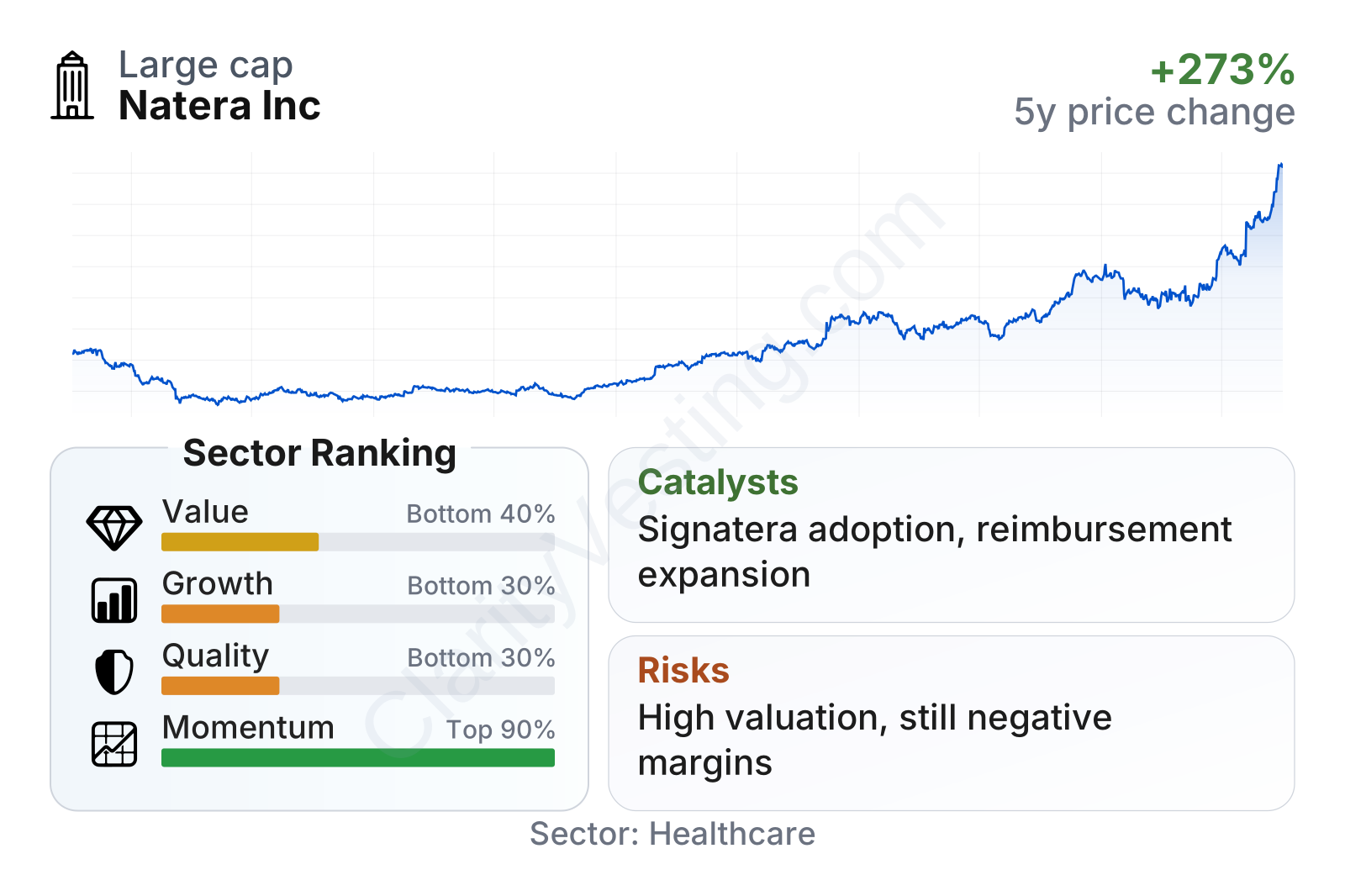
Natera is now a large diagnostics company by market value, but its fundamentals still look like a business in transition rather than a mature healthcare name. Growth and market momentum stand out, while valuation and profitability metrics remain weak versus the healthcare sector. The stock has also been volatile, which fits a company whose outlook is closely tied to future adoption and margin improvement rather than current earnings power.
Growth
Natera operates in segments of healthcare that have long-term structural support. Precision oncology is gaining attention because doctors increasingly want tools that can detect residual disease, monitor recurrence earlier, and guide treatment decisions with more personalized information. Transplant monitoring also benefits from a clear medical need, since early detection of rejection can improve outcomes. In women’s health, non-invasive genetic screening is already well established, but there is still room for broader use and product extension.
The company’s strategy is coherent: build a large installed clinical base in women’s health, then use that testing scale and laboratory expertise to expand into higher-value oncology and transplant applications. That matters because oncology tends to offer larger commercial potential per patient and can create recurring testing opportunities over time as patients are monitored after treatment.
Recent revenue growth has remained unusually strong for a company of this size, with year-over-year expansion still close to 40% in the latest period. That is far above the healthcare sector median and suggests Natera is still gaining share, expanding reimbursement, or both.
Another important shift is cash generation. Free cash flow moved from deeply negative territory in earlier years to positive territory more recently. That does not mean the business is fully mature, but it does show that scale is beginning to change the economics of the model.
One of the clearest catalysts is Signatera, the company’s personalized cancer monitoring test. Natera has continued to publish clinical evidence, expand collaborations, and push for broader use across multiple tumor types. Clinical guideline inclusion, stronger reimbursement coverage, and wider physician adoption could all support further expansion. Management has also highlighted continued growth in oncology volumes and average selling price support from better payer coverage.
Recent company updates have also pointed to ongoing adoption in transplant monitoring and to a growing body of evidence around cancer recurrence monitoring. For a diagnostics company, this matters because new data can directly influence doctor behavior, payer decisions, and eventually standard-of-care positioning.
Risks
This article is for informational purposes only and does not constitute financial advice. Some content is AI-generated. See Disclaimer