Stock Analysis · Nutrien Ltd (NTR)
Overview
Nutrien Ltd is one of the world’s largest crop input companies. It operates across the farm supply chain: producing crop nutrients, distributing agricultural products, and serving growers through a broad retail network. In simple terms, the company helps farmers improve crop yields by selling fertilizers such as potash, nitrogen, and phosphate, while also supplying seeds, crop protection products, and agronomic services.
Its business is built around two large activities: making fertilizers and selling farm inputs directly to growers. That mix matters because it gives Nutrien exposure to both global commodity markets and local farm demand. When fertilizer prices are strong, the production side can expand quickly. When commodity prices weaken, the retail network can provide more stability than a pure fertilizer producer.
Based on recent company reporting, Nutrien’s revenue mix is approximately structured as follows:
- Retail: about 55% of revenue. This includes crop protection products, seed, nutrients sold through retail channels, and agronomic advice delivered through a large store network in North America, South America, and Australia.
- Nitrogen: about 19% of revenue. This segment produces nitrogen-based fertilizers used for major crops and industrial applications.
- Potash: about 17% of revenue. Potash is a key nutrient for improving crop quality and yield, and Nutrien is one of the largest producers globally.
- Phosphate: about 9% of revenue. This business produces phosphate fertilizers and feed products tied to crop and livestock demand.
Geographically, the company is centered on North American agriculture but also has meaningful international exposure through exports and retail operations in other farming markets. That combination gives it scale, but it also means results can swing with fertilizer prices, crop economics, and weather conditions.
Over the last several years, the company’s income profile has shown how cyclical this industry can be. Revenue and profits surged in 2022 during the fertilizer price spike, then normalized sharply in 2023 and 2024 before recovering in 2025. Operating costs have stayed relatively controlled, but earnings remain heavily influenced by commodity pricing rather than purely by volume growth.
The business has demonstrated that it can generate very high profits in favorable markets, but the more recent pattern also shows that those peaks are not steady. The key takeaway is that Nutrien combines large scale and vertical integration with a financial profile that still moves with the fertilizer cycle.
Key Figures
| Metric | Value | Sector ⓘ |
|---|---|---|
| Date | Oct 24, 2026 | |
| Context | ||
| Sector | Basic Materials | |
| Industry | Agricultural Inputs | |
| Market Cap ⓘ | $32.51B | |
| Beta ⓘ | 1.13 | |
Value (Cheapness) | ||
| P/E Ratio ⓘ | 13.99 | 16.92 |
| P/B Ratio ⓘ | 1.26 | 1.66 |
| FCF Yield ⓘ | 6.49% | 5.83% |
| Dividend Yield ⓘ | 3.17% | 2.07% |
| EBIT / EV ⓘ | 8.15% | 6.38% |
| PEG ⓘ | 1.98 | |
Growth (Business expansion) | ||
| Revenue Growth ⓘ | 4.00% | 11.25% |
| RPS Growth (5Y CAGR) ⓘ | 3.31% | 4.49% |
| EPS Growth (5Y CAGR) ⓘ | -31.43% | -15.24% |
| BVPS Growth (5Y CAGR) ⓘ | 5.80% | 5.49% |
| Margin Growth (5Y Trend) ⓘ | -2.66% | -1.54% |
| FCF Growth (5Y CAGR) ⓘ | -0.79% | 0.37% |
| DPS Growth (5Y CAGR) ⓘ | 4.95% | 5.91% |
Quality (Business durability) | ||
| ROIC (Latest) ⓘ | 7.98% | 9.59% |
| ROA (Latest) ⓘ | 4.52% | 4.92% |
| ROIC (5Y Median) ⓘ | 7.92% | 7.91% |
| ROA (5Y Median) ⓘ | 4.36% | 3.92% |
| Net Debt / EBIT (Latest) ⓘ | 3.02 | 1.36 |
| Net Debt / EBIT (5Y Median) ⓘ | 3.24 | 1.69 |
| Net Debt / EBITDA (Latest) ⓘ | 1.87 | 0.93 |
| Net Debt / Assets ⓘ | 22.05% | 13.69% |
| EBITDA / Interest ⓘ | 8.47 | 12.38 |
| Operating Margin (Latest) ⓘ | 13.85% | 13.24% |
| Operating Margin (5Y Median) ⓘ | 14.05% | 11.82% |
| Debt to Equity (Latest) ⓘ | 49.14% | 40.30% |
| Profit Margin (Latest) ⓘ | 8.72% | 6.38% |
| Free Cash Flow (Latest) ⓘ | $2.11B | |
Momentum (Price trend) | ||
| 3Y Return ⓘ | +28.75% | +73.47% |
| 12M Return (excl. last month) ⓘ | +36.27% | +27.59% |
| 6M Return ⓘ | -4.68% | -4.02% |
| Price vs. 200-Day MA ⓘ | -2.39% | -0.65% |
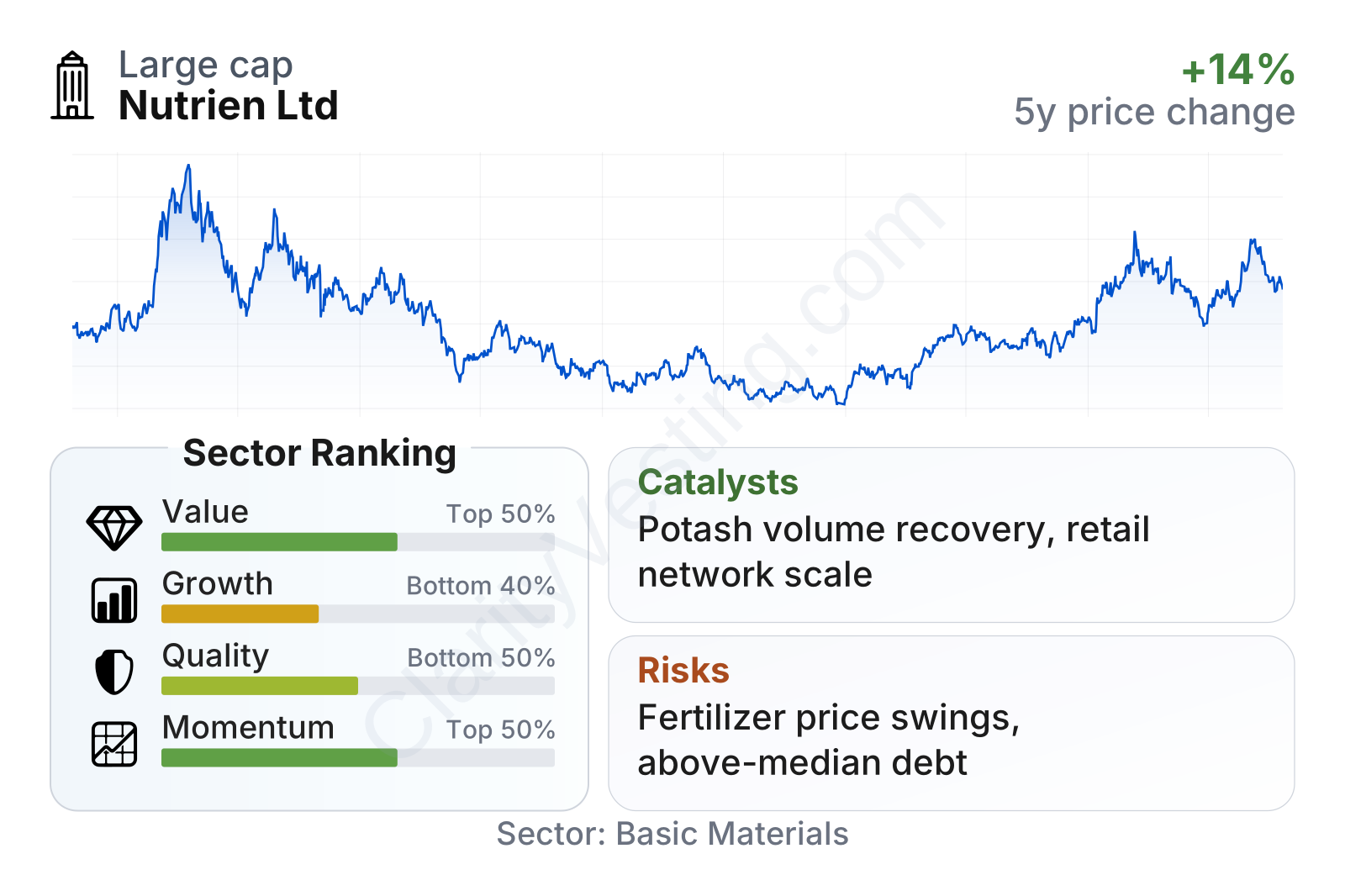
Nutrien is a large agricultural inputs company with share-price volatility that is not unusual for a commodity-linked business. On valuation measures, it sits in a relatively favorable position versus much of its sector, with earnings and book multiples below the sector median and a free cash flow yield slightly above it. The dividend yield is also above the sector median. The weaker areas are growth, balance-sheet leverage, and recent share-price momentum, which suggests the market is still treating the company as a cyclical name rather than a steady compounder.
Growth
Nutrien operates in a sector with durable long-term relevance. Global agriculture must support population growth, changing diets, and limited high-quality farmland, all of which support ongoing demand for fertilizers and crop services. That does not mean demand rises smoothly every year, but it does create a strong structural base for the industry over time.
The company’s strategy makes industrial sense. Nutrien combines low-cost potash production with a large retail distribution network, allowing it to participate both upstream and downstream. Potash is especially important because it is one of the most concentrated parts of the fertilizer market, and large-scale, low-cost assets can remain competitive through the cycle. Retail adds recurring customer relationships and gives the company direct access to farm-level spending patterns.
Recent revenue trends show a business that has moved out of a downturn and back into modest expansion. After steep declines through 2023 and much of 2024 as fertilizer prices normalized, year-over-year growth turned positive again through 2025 and remained positive in 2026, though at a much slower pace than the 2022 boom. That pattern suggests normalization and early recovery rather than a full new upcycle.
Cash generation has also improved from the low point, even if it remains below earlier peaks. Free cash flow moved down significantly after the extraordinary 2022 environment, then recovered to a more solid level. For a cyclical producer, that matters because internally generated cash supports dividends, maintenance spending, and debt management without relying too heavily on ideal market conditions.
Several catalysts can support future growth. Potash demand remains tied to global crop production and soil nutrient replacement, while Nutrien continues to have the ability to adjust production from its large Saskatchewan asset base. The retail network also creates opportunities to grow higher-value services, digital farm tools, and cross-selling across seeds, crop protection, and nutrients. In addition, a more stable fertilizer pricing environment after the recent downcycle could allow earnings to improve even without dramatic volume gains.
Recent company updates have also pointed to a more constructive operating backdrop than the one seen in 2023 and 2024. Higher potash shipments, efforts to optimize nitrogen operations, and ongoing cost discipline all point to better earnings sensitivity if farm demand remains healthy. The opportunity is not based on a single breakthrough product; it comes from Nutrien’s scale and from a recovery in the underlying cycle.
Risks
This article is for informational purposes only and does not constitute financial advice. Some content is AI-generated. See Disclaimer


