Stock Analysis · Intellia Therapeutics Inc (NTLA)
Overview
Intellia Therapeutics is a biotechnology company focused on gene editing. Its main goal is to develop medicines that can make precise changes to DNA using CRISPR-based technology. In simple terms, the company is trying to treat serious diseases at their genetic root rather than only managing symptoms. Its programs include both in vivo treatments, where editing happens directly inside the body, and ex vivo approaches, where cells are modified outside the body and then returned to the patient.
The business is still in the clinical-development stage, which means it does not yet generate recurring product sales from approved medicines. Revenue therefore comes mostly from partnerships and research-related payments rather than commercialized drugs. Based on recent annual results and company disclosures, the revenue mix is approximately:
- Collaboration revenue: about 100% of total revenue. This includes research funding, milestone payments, and other amounts recognized under partnership agreements, notably with larger pharmaceutical companies.
- Product revenue: 0%. Intellia does not currently have approved products generating commercial sales.
- Other revenue: minimal. Any remaining amount is not currently a meaningful contributor compared with collaboration revenue.
This revenue profile matters because it makes results uneven from year to year. A company like Intellia can post higher revenue when milestones are reached, then show declines when those payments do not repeat, even if the underlying research pipeline is still progressing.
Over the last several years, operating expenses have been driven overwhelmingly by research and development. That is typical for a gene-editing company trying to move multiple drug candidates through human trials. The broad pattern is clear: revenue remains modest, while research spending stays very high, which explains the company’s continuing losses.
The cost structure shows a company still in build mode. Research spending has consistently been the largest use of cash by a wide margin, while total revenue remains small compared with operating expenses. There was some improvement in losses in 2025, but the business is still far from self-funding.
Key Figures
| Metric | Value | Sector ⓘ |
|---|---|---|
| Date | Oct 17, 2026 | |
| Context | ||
| Sector | Healthcare | |
| Industry | Biotechnology | |
| Market Cap ⓘ | $1.60B | |
| Beta ⓘ | 1.80 | |
Value (Cheapness) | ||
| P/E Ratio ⓘ | N/A | 24.79 |
| P/B Ratio ⓘ | 2.08 | 3.08 |
| FCF Yield ⓘ | -21.77% | 3.15% |
| Dividend Yield ⓘ | N/A | 1.94% |
| EBIT / EV ⓘ | -29.25% | 0.57% |
| PEG ⓘ | -0.10 | |
Growth (Business expansion) | ||
| Revenue Growth ⓘ | -46.20% | 7.45% |
| RPS Growth (5Y CAGR) ⓘ | 7.58% | 8.61% |
| EPS Growth (5Y CAGR) ⓘ | -30.15% | -17.81% |
| BVPS Growth (5Y CAGR) ⓘ | -19.39% | 3.72% |
| Margin Growth (5Y Trend) ⓘ | N/A | -0.62% |
| FCF Growth (5Y CAGR) ⓘ | N/A | 1.04% |
| DPS Growth (5Y CAGR) ⓘ | N/A | 6.77% |
Quality (Business durability) | ||
| ROIC (Latest) ⓘ | -45.08% | 3.24% |
| ROA (Latest) ⓘ | -44.88% | 3.01% |
| ROIC (5Y Median) ⓘ | -32.84% | 4.60% |
| ROA (5Y Median) ⓘ | -34.11% | 1.89% |
| Net Debt / EBIT (Latest) ⓘ | N/A | 1.34 |
| Net Debt / EBIT (5Y Median) ⓘ | N/A | 1.84 |
| Net Debt / EBITDA (Latest) ⓘ | N/A | 1.00 |
| Net Debt / Assets ⓘ | -3.82% | 5.45% |
| EBITDA / Interest ⓘ | N/A | 9.64 |
| Operating Margin (Latest) ⓘ | -672.16% | 9.27% |
| Operating Margin (5Y Median) ⓘ | -896.77% | 7.38% |
| Debt to Equity (Latest) ⓘ | 10.09% | 28.58% |
| Profit Margin (Latest) ⓘ | N/A | 3.59% |
| Free Cash Flow (Latest) ⓘ | -$348.69M | |
Momentum (Price trend) | ||
| 3Y Return ⓘ | -61.73% | +42.80% |
| 12M Return (excl. last month) ⓘ | -1.82% | +18.50% |
| 6M Return ⓘ | -24.10% | +7.57% |
| Price vs. 200-Day MA ⓘ | -12.68% | +5.12% |
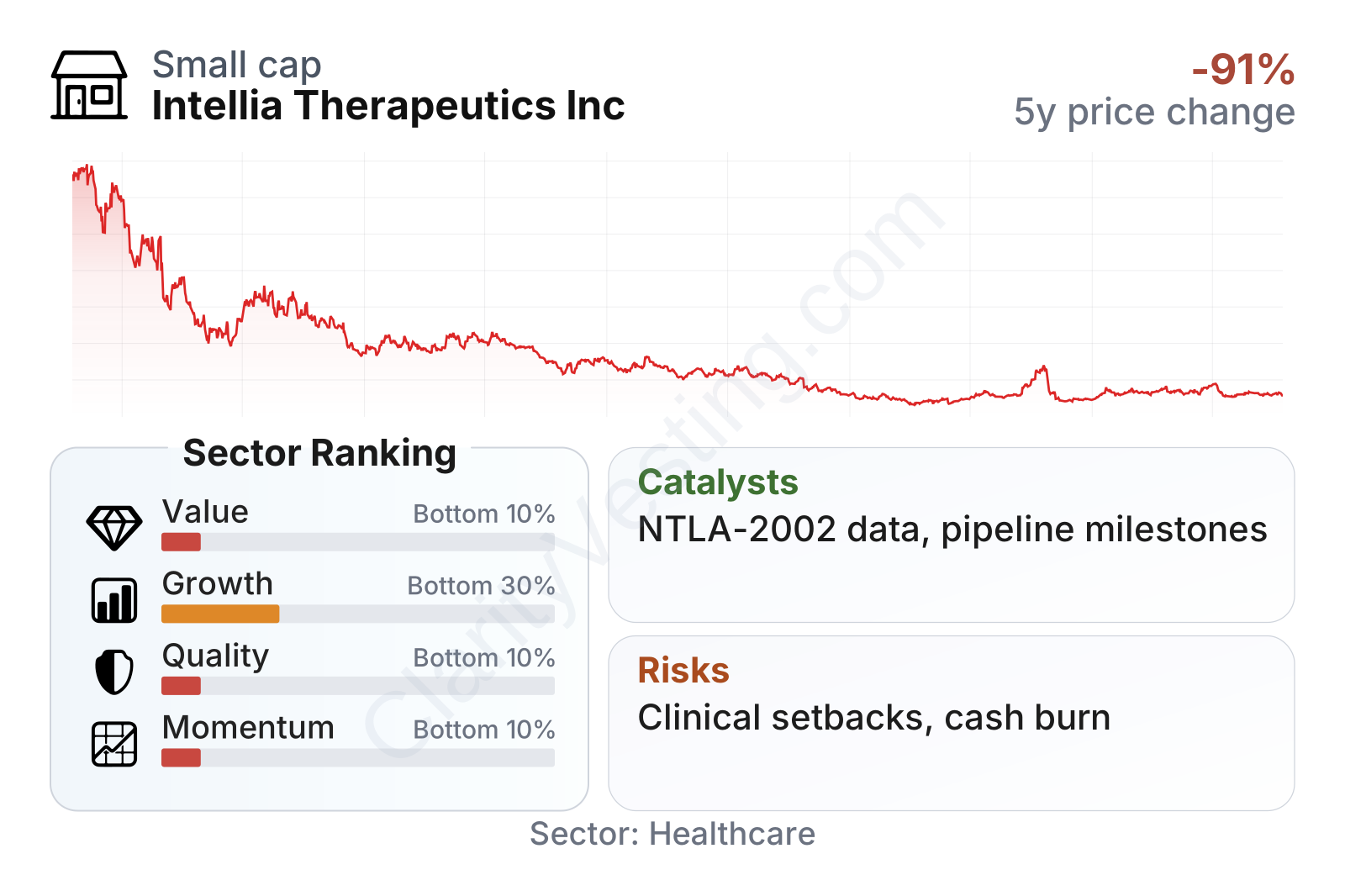
Intellia is now a relatively small biotech by market value, and its share price history has been highly volatile. The stock is far below its 2021 levels, reflecting both broader pressure on development-stage biotech companies and company-specific uncertainty around clinical execution. The metrics table also shows a difficult current profile: value, quality, growth, and momentum all rank near the lower end of the healthcare sector. That does not automatically mean the science is weak, but it does show that today’s financial results are not yet supporting the valuation in the same way a mature pharmaceutical business would.
One notable positive point is the balance sheet structure. Debt is low compared with many peers, and the company has historically relied more on equity financing and partnership funding than on heavy borrowing. The main weakness is profitability: margins, returns on capital, and cash generation remain deeply negative, which is typical for a company still spending heavily before product launch.
Growth
Intellia operates in a sector with meaningful long-term potential. Gene editing is one of the more ambitious areas in biotechnology because successful treatments could offer durable or even one-time interventions for diseases caused by specific genetic errors. If this field continues to advance, companies with credible human data, strong intellectual property, and scalable delivery technology could have large commercial opportunities.
Intellia’s strategy makes sense in that context. The company has focused on building a platform rather than relying on a single asset. Its leading programs target areas where genetic interventions could produce measurable biological changes, which is especially important in early clinical development because investors, partners, and regulators want clear evidence that the editing approach works in humans.
A major catalyst has been the company’s continued advancement of in vivo CRISPR programs, particularly in transthyretin amyloidosis and hereditary angioedema. These programs matter because they test whether Intellia can safely deliver gene-editing treatment directly inside the body, one of the hardest and most commercially important challenges in the field. Positive clinical readouts in these areas could strengthen confidence not only in individual drug candidates but also in the broader platform.
Recent company updates have also highlighted continued regulatory and clinical progress across the pipeline, including advancement of key studies and ongoing patient follow-up. For a development-stage biotech, these milestones are often more important than near-term revenue because they shape the probability of future commercialization, partnerships, and access to capital.
Reported revenue growth has been very uneven, with sharp swings between strong increases and steep declines. That pattern is not unusual here because collaboration accounting can create lumpy results. It means revenue growth alone is not a reliable signal of underlying business momentum; pipeline progress is the more important indicator.
Cash burn remains significant, but the trend has improved somewhat from the worst period. Free cash flow is still strongly negative, showing that growth currently depends on existing cash resources and external funding rather than internally generated cash. For long-term analysis, the key question is whether clinical progress is moving fast enough to justify that ongoing spending.
Risks
This article is for informational purposes only and does not constitute financial advice. Some content is AI-generated. See Disclaimer


