Stock Analysis · Norfolk Southern Corporation (NSC)
Overview
Norfolk Southern Corporation is one of the major freight railroad companies in the eastern United States. It operates a large rail network that moves raw materials, manufactured goods, and consumer products between ports, factories, warehouses, utilities, and population centers. Railroads are a critical part of the economy because they carry heavy freight over long distances at lower fuel use per ton-mile than trucking.
The business mainly earns revenue by charging customers to transport freight. Based on the company’s recent annual reporting, revenue is spread across several commodity groups rather than depending on one single market, which is useful in a cyclical industry.
- Merchandise: approximately 55% to 60% of revenue. This is the largest segment and includes chemicals, agriculture and forest products, metals and construction materials, and automotive-related shipments.
- Intermodal: approximately 25% to 30% of revenue. This covers containers and trailers moved by rail, often linked to consumer goods, imports, and domestic distribution networks.
- Coal: approximately 15% to 20% of revenue. This includes coal for export and for domestic utility or industrial use, though coal is structurally less important than it used to be.
That mix matters because it shows Norfolk Southern is not only a coal railroad. Its future increasingly depends on intermodal efficiency, merchandise pricing, service reliability, and industrial demand across the eastern U.S.
The business remains highly cash generative despite uneven results in recent years. Revenue has stayed near a fairly stable range, while profitability has moved more sharply because railroad earnings are very sensitive to service disruptions, labor productivity, fuel, pricing, and network efficiency.
The long-term picture shows a company with relatively steady revenue but noticeable swings in costs and earnings. After a weaker 2023, profitability improved again, highlighting how much results depend on operating discipline rather than just top-line growth.
Key Figures
| Metric | Value | Sector ⓘ |
|---|---|---|
| Date | Oct 03, 2026 | |
| Context | ||
| Sector | Industrials | |
| Industry | Railroads | |
| Market Cap ⓘ | $70.30B | |
| Beta ⓘ | 1.27 | |
Value (Cheapness) | ||
| P/E Ratio ⓘ | 26.73 | 22.45 |
| P/B Ratio ⓘ | 4.28 | 1.98 |
| FCF Yield ⓘ | 5.46% | 6.31% |
| Dividend Yield ⓘ | 1.72% | 1.96% |
| EBIT / EV ⓘ | 4.65% | 4.81% |
| PEG ⓘ | 3.72 | |
Growth (Business expansion) | ||
| Revenue Growth ⓘ | 11.40% | 9.10% |
| RPS Growth (5Y CAGR) ⓘ | 4.80% | 7.75% |
| EPS Growth (5Y CAGR) ⓘ | -18.93% | -13.59% |
| BVPS Growth (5Y CAGR) ⓘ | 5.90% | 6.22% |
| Margin Growth (5Y Trend) ⓘ | -4.01% | 0.72% |
| FCF Growth (5Y CAGR) ⓘ | -6.19% | 10.98% |
| DPS Growth (5Y CAGR) ⓘ | 6.87% | 9.48% |
Quality (Business durability) | ||
| ROIC (Latest) ⓘ | 9.65% | 10.92% |
| ROA (Latest) ⓘ | 5.88% | 5.41% |
| ROIC (5Y Median) ⓘ | 10.89% | 9.21% |
| ROA (5Y Median) ⓘ | 6.46% | 4.94% |
| Net Debt / EBIT (Latest) ⓘ | 3.87 | 2.07 |
| Net Debt / EBIT (5Y Median) ⓘ | 3.49 | 2.28 |
| Net Debt / EBITDA (Latest) ⓘ | 2.87 | 1.43 |
| Net Debt / Assets ⓘ | 34.46% | 19.27% |
| EBITDA / Interest ⓘ | 6.89 | 9.53 |
| Operating Margin (Latest) ⓘ | 32.02% | 10.50% |
| Operating Margin (5Y Median) ⓘ | 36.59% | 10.27% |
| Debt to Equity (Latest) ⓘ | 102.23% | 65.48% |
| Profit Margin (Latest) ⓘ | 21.02% | 6.62% |
| Free Cash Flow (Latest) ⓘ | $3.83B | |
Momentum (Price trend) | ||
| 3Y Return ⓘ | +67.19% | +58.56% |
| 12M Return (excl. last month) ⓘ | +24.59% | +15.63% |
| 6M Return ⓘ | +8.56% | +4.19% |
| Price vs. 200-Day MA ⓘ | -0.13% | +0.93% |
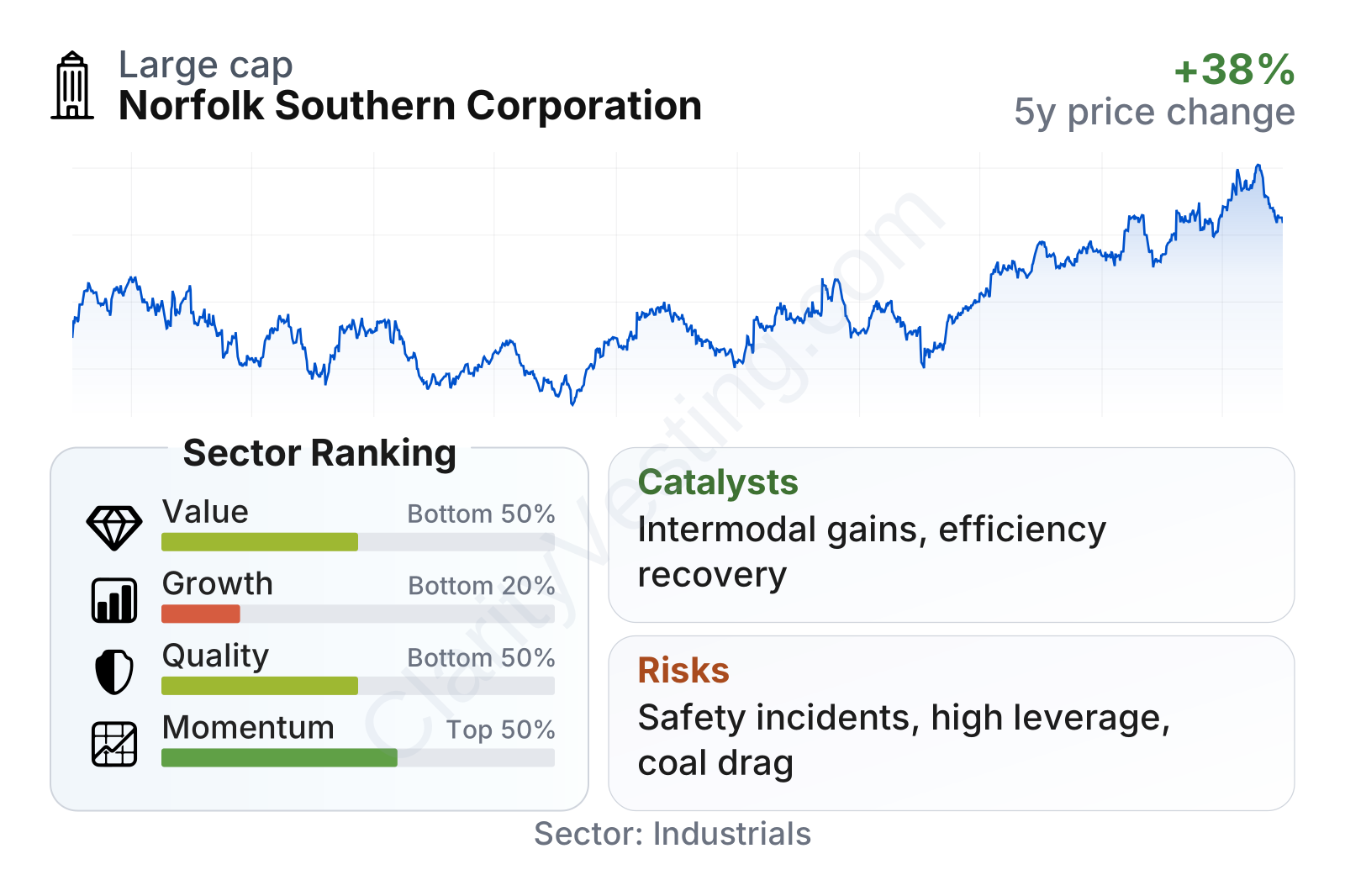
Norfolk Southern is a large industrial company with above-average share price volatility for the sector. The latest factor breakdown suggests a mixed profile: growth and valuation rank weaker than many industrial peers, while market performance has been stronger than average. Profitability remains solid in absolute terms, but leverage is heavier than the sector median, which reduces some of that quality advantage.
The stock chart shows that the shares were volatile over the past several years, with a sharp recovery from the 2023 weakness and a strong advance into 2026. That rebound indicates the market has regained confidence in earnings normalization and execution improvement.
Growth
Railroads are not a high-growth industry, but they are an essential one. Over the long run, freight rail tends to grow with industrial production, consumer demand, export flows, and supply-chain shifts. The sector also benefits from rail’s fuel efficiency and lower emissions intensity versus long-haul trucking, which supports its relevance even in a slower-growth economy.
For Norfolk Southern, the growth case is less about opening new markets and more about running the network better, improving service, taking price above inflation where possible, and winning more intermodal and merchandise volume. That is a realistic strategy for a mature railroad. If management executes well, modest volume growth can still translate into meaningful profit growth because fixed costs are high and efficiency gains matter a lot.
Recent revenue growth has been uneven, with declines in parts of 2023 and 2024 followed by a stronger rebound more recently. The latest year-over-year improvement is encouraging, but the wider pattern still looks cyclical rather than consistently compounding. That fits the nature of railroads: demand can improve quickly, but it often depends on the broader economy, export activity, and customer inventories.
Free cash flow has also been volatile, including a negative reading in 2024 before recovering strongly. The more recent bounce back toward the upper end of the past few years is an important positive sign because free cash flow supports dividends, capital spending, and debt management. For a railroad, this is especially relevant: the company must keep investing in track, terminals, locomotives, and technology, so durable cash generation matters more than short bursts of accounting profit.
Several catalysts could support future expansion. Norfolk Southern continues to focus on productivity, terminal efficiency, service consistency, and network simplification. Intermodal remains an especially important opportunity because eastern freight corridors connect major ports and dense consumer regions. If highway congestion, driver shortages, or shipper interest in lower-emission transport persist, rail intermodal can capture incremental share.
Recent company communications have also emphasized safety, service restoration, and operational improvement after the disruption tied to the East Palestine derailment period. If those efforts continue translating into better train speed, dwell, and asset utilization, earnings can improve even without dramatic revenue growth.
Risks
This article is for informational purposes only and does not constitute financial advice. Some content is AI-generated. See Disclaimer