Stock Analysis · Natural Resource Partners LP (NRP)
Overview
Natural Resource Partners LP is a U.S. natural resources owner structured as a limited partnership. Unlike a traditional mining company, it generally does not operate mines itself. Its business model is mainly to own mineral rights and collect payments from third parties that mine coal, produce aggregates, or use its land and infrastructure. That makes the company more of a royalty and asset-management business than a direct commodity producer.
The partnership has historically been closely tied to coal, especially thermal coal used in power generation, but it also owns other mineral and land interests. In recent years, management has emphasized cash generation, debt reduction, disciplined capital returns, and selective development of non-coal assets such as soda ash and carbon-neutrality-related opportunities.
Based on recent annual disclosures, NRP’s revenue mix is still heavily concentrated in mineral rights and royalty income. The main sources of revenue are approximately the following:
- Mineral rights revenue: about 80% to 90% — mostly coal royalty revenue, plus other royalties tied to aggregates, trona/soda ash, and related natural resource properties. This is the core business and the main cash engine.
- Other revenue and services: about 10% to 20% — includes fees, transportation or infrastructure-related income, and smaller asset-based revenue streams.
- Carbon-neutral and emerging resource activities: currently small — this includes development-stage opportunities that are strategically important but not yet large contributors to current revenue.
This structure matters for long-term analysis because royalties usually require less capital spending than owning and running mines. That can support high margins and strong cash conversion when commodity demand is favorable. At the same time, it does not remove exposure to coal volumes, lease activity, and the health of NRP’s operating partners.
The business has remained highly profitable, but the overall revenue base has come down from the 2022 peak. Even so, costs have stayed relatively light compared with revenue, which helps explain why profitability and cash generation remain unusually strong for the sector.
Key Figures
| Metric | Value | Sector ⓘ |
|---|---|---|
| Date | Oct 17, 2026 | |
| Context | ||
| Sector | Energy | |
| Industry | Thermal Coal | |
| Market Cap ⓘ | $1.47B | |
| Beta ⓘ | 0.23 | |
Value (Cheapness) | ||
| P/E Ratio ⓘ | 14.25 | 15.44 |
| P/B Ratio ⓘ | 2.27 | 1.73 |
| FCF Yield ⓘ | 10.84% | 8.20% |
| Dividend Yield ⓘ | 2.70% | 3.59% |
| EBIT / EV ⓘ | 7.61% | 7.46% |
| PEG ⓘ | 8.29 | |
Growth (Business expansion) | ||
| Revenue Growth ⓘ | 13.10% | 26.90% |
| RPS Growth (5Y CAGR) ⓘ | 5.42% | 6.90% |
| EPS Growth (5Y CAGR) ⓘ | -9.53% | -15.73% |
| BVPS Growth (5Y CAGR) ⓘ | 13.86% | 6.07% |
| Margin Growth (5Y Trend) ⓘ | -4.74% | 0.58% |
| FCF Growth (5Y CAGR) ⓘ | 8.02% | 1.86% |
| DPS Growth (5Y CAGR) ⓘ | 15.03% | 16.79% |
Quality (Business durability) | ||
| ROIC (Latest) ⓘ | 12.85% | 11.40% |
| ROA (Latest) ⓘ | 13.84% | 6.06% |
| ROIC (5Y Median) ⓘ | 27.94% | 10.30% |
| ROA (5Y Median) ⓘ | 23.38% | 5.42% |
| Net Debt / EBIT (Latest) ⓘ | -0.02 | 1.64 |
| Net Debt / EBIT (5Y Median) ⓘ | 0.50 | 1.83 |
| Net Debt / EBITDA (Latest) ⓘ | -0.02 | 1.08 |
| Net Debt / Assets ⓘ | -0.37% | 17.29% |
| EBITDA / Interest ⓘ | 26.70 | 9.64 |
| Operating Margin (Latest) ⓘ | 57.77% | 16.27% |
| Operating Margin (5Y Median) ⓘ | 81.30% | 20.39% |
| Debt to Equity (Latest) ⓘ | 4.21% | 54.76% |
| Profit Margin (Latest) ⓘ | 52.29% | 8.82% |
| Free Cash Flow (Latest) ⓘ | $159.82M | |
Momentum (Price trend) | ||
| 3Y Return ⓘ | +70.09% | +67.38% |
| 12M Return (excl. last month) ⓘ | +10.92% | +49.19% |
| 6M Return ⓘ | -2.59% | +7.07% |
| Price vs. 200-Day MA ⓘ | +1.57% | +9.56% |
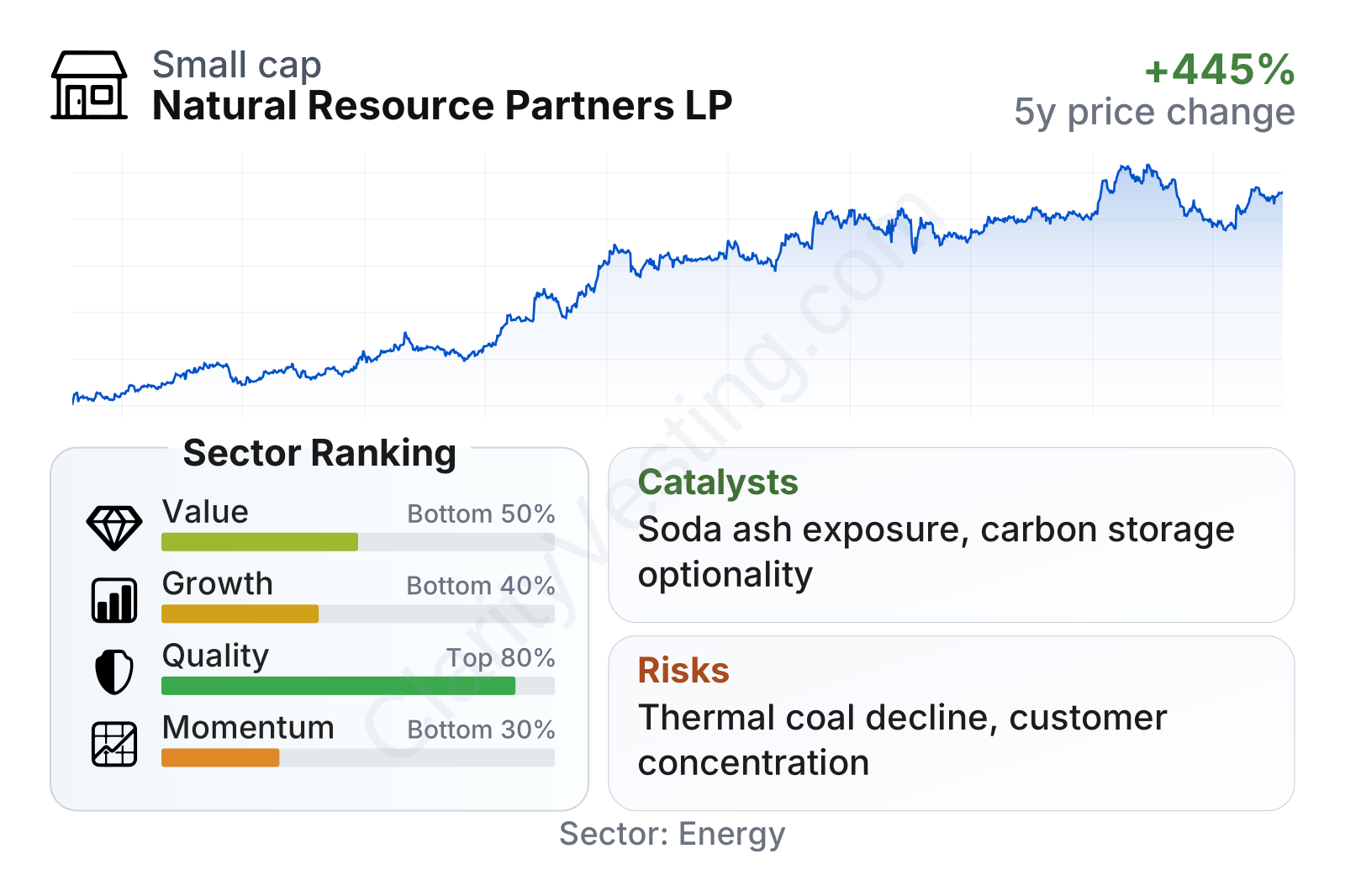
NRP is a mid-sized energy partnership with very low share-price volatility, as shown by a beta well below 1. On valuation, it does not screen as especially cheap across every measure, but free cash flow yield and operating earnings remain solid relative to the sector. The most notable part of the table is quality: profitability, returns on capital, and balance-sheet strength are clearly ahead of many peers. Growth metrics are more mixed, reflecting a mature asset base and the uneven demand outlook tied to coal.
Growth
NRP operates in a sector with two very different timelines. Thermal coal, its main exposure, is not a structural growth industry in the United States over the very long run because utilities continue shifting generation toward natural gas, renewables, and grid modernization. However, the decline has not been linear. Coal demand can remain resilient when power markets are tight, natural gas prices rise, export markets improve, or certain coal basins remain cost-competitive. That means NRP can still produce substantial cash even in a sector that is not broadly seen as secularly expanding.
The company’s strategy is logical for that backdrop. Rather than chasing production growth, it focuses on collecting royalties, preserving capital, reducing financial risk, and returning excess cash while extending the value of its asset base. That is a sensible model for a mature resource business because it limits operating complexity and allows management to benefit from production on its lands without taking the full burden of mine-level costs.
Revenue growth has been volatile over the last several years. The business benefited from a strong commodity environment earlier in the cycle, then moved into a period of declines as coal-related conditions normalized. More recently, the year-over-year change has shown signs of stabilizing, but the trend is still much weaker than in faster-growing parts of the energy sector.
Free cash flow remains one of the strongest parts of the NRP case. Even though trailing cash generation is below the earlier peak, it is still substantial for a company of this size. That supports flexibility: the partnership has been able to strengthen its balance sheet, maintain distributions, and keep optionality for new projects.
A key catalyst for future development is the company’s interest in soda ash and related trona assets through Sisecam Wyoming. Soda ash has better long-term industrial demand characteristics than thermal coal because it is used in glass, chemicals, and other manufacturing applications. NRP has also discussed carbon capture, sequestration, and other environmental-use opportunities tied to its land and pore space. These areas are still small today, but they are important because they offer a path to diversify away from pure coal dependence over time.
In recent company updates, management has continued to highlight capital allocation discipline and the long duration of its mineral portfolio. That does not create rapid growth by itself, but it does support the argument that NRP is trying to convert a finite and cyclical asset base into durable cash returns and selective new avenues of value creation.
Risks
This article is for informational purposes only and does not constitute financial advice. Some content is AI-generated. See Disclaimer


