Stock Analysis · Nurix Therapeutics Inc (NRIX)
Overview
Nurix Therapeutics is a clinical-stage biotechnology company focused on developing medicines that use the body’s natural protein-control system to treat cancer and immune-related diseases. In simple terms, its research aims to remove harmful proteins or adjust immune signals rather than only blocking them. The company’s work is built around targeted protein degradation and related drug-discovery technologies, with programs both in its own pipeline and in partnerships with larger pharmaceutical companies.
Because Nurix is still in the development stage, its revenue does not mainly come from selling approved drugs. Instead, it is generated mostly through collaboration agreements, research funding, licensing, and milestone payments tied to partnerships. That makes revenue uneven from year to year, depending on when payments are earned.
The latest full fiscal year shows a business model dominated by collaboration revenue.
- Collaboration and license revenue: approximately 100% of total revenue. This generally includes upfront payments recognized over time, research support from partners, and milestone-related revenue connected to discovery and development alliances.
- Product revenue: 0%. Nurix does not yet have a commercial product base, so there is no meaningful recurring revenue from drug sales at this stage.
- Other revenue: not meaningful based on recent public filings.
That revenue mix is important for long-term analysis. It means the company is still being valued primarily on the potential of its research platform, clinical pipeline, and partnerships rather than on established drug sales.
The financial picture shows a company spending heavily on research and development while posting recurring losses. Revenue has moved around significantly over the last few years, but R&D remains the clear center of spending, which is typical for a biotech company trying to push multiple drug candidates forward.
Key Figures
| Metric | Value | Sector ⓘ |
|---|---|---|
| Date | Oct 17, 2026 | |
| Context | ||
| Sector | Healthcare | |
| Industry | Biotechnology | |
| Market Cap ⓘ | $2.59B | |
| Beta ⓘ | 1.82 | |
Value (Cheapness) | ||
| P/E Ratio ⓘ | 9.74 | 24.79 |
| P/B Ratio ⓘ | 2.99 | 3.08 |
| FCF Yield ⓘ | 14.30% | 3.15% |
| Dividend Yield ⓘ | N/A | 1.94% |
| EBIT / EV ⓘ | 14.73% | 0.57% |
| PEG ⓘ | N/A | |
Growth (Business expansion) | ||
| Revenue Growth ⓘ | 8426.30% | 7.45% |
| RPS Growth (5Y CAGR) ⓘ | 8.72% | 8.61% |
| EPS Growth (5Y CAGR) ⓘ | -8.90% | -17.81% |
| BVPS Growth (5Y CAGR) ⓘ | -6.05% | 3.72% |
| Margin Growth (5Y Trend) ⓘ | N/A | -0.62% |
| FCF Growth (5Y CAGR) ⓘ | N/A | 1.04% |
| DPS Growth (5Y CAGR) ⓘ | N/A | 6.77% |
Quality (Business durability) | ||
| ROIC (Latest) ⓘ | -59.40% | 3.24% |
| ROA (Latest) ⓘ | 31.31% | 3.01% |
| ROIC (5Y Median) ⓘ | -41.45% | 4.60% |
| ROA (5Y Median) ⓘ | -37.27% | 1.89% |
| Net Debt / EBIT (Latest) ⓘ | -2.12 | 1.34 |
| Net Debt / EBIT (5Y Median) ⓘ | N/A | 1.84 |
| Net Debt / EBITDA (Latest) ⓘ | -2.03 | 1.00 |
| Net Debt / Assets ⓘ | -54.79% | 5.45% |
| EBITDA / Interest ⓘ | N/A | 9.64 |
| Operating Margin (Latest) ⓘ | 43.91% | 9.27% |
| Operating Margin (5Y Median) ⓘ | -354.36% | 7.38% |
| Debt to Equity (Latest) ⓘ | 6.75% | 28.58% |
| Profit Margin (Latest) ⓘ | 42.01% | 3.59% |
| Free Cash Flow (Latest) ⓘ | $369.81M | |
Momentum (Price trend) | ||
| 3Y Return ⓘ | +289.24% | +42.80% |
| 12M Return (excl. last month) ⓘ | +186.39% | +18.50% |
| 6M Return ⓘ | +47.02% | +7.57% |
| Price vs. 200-Day MA ⓘ | +26.23% | +5.12% |
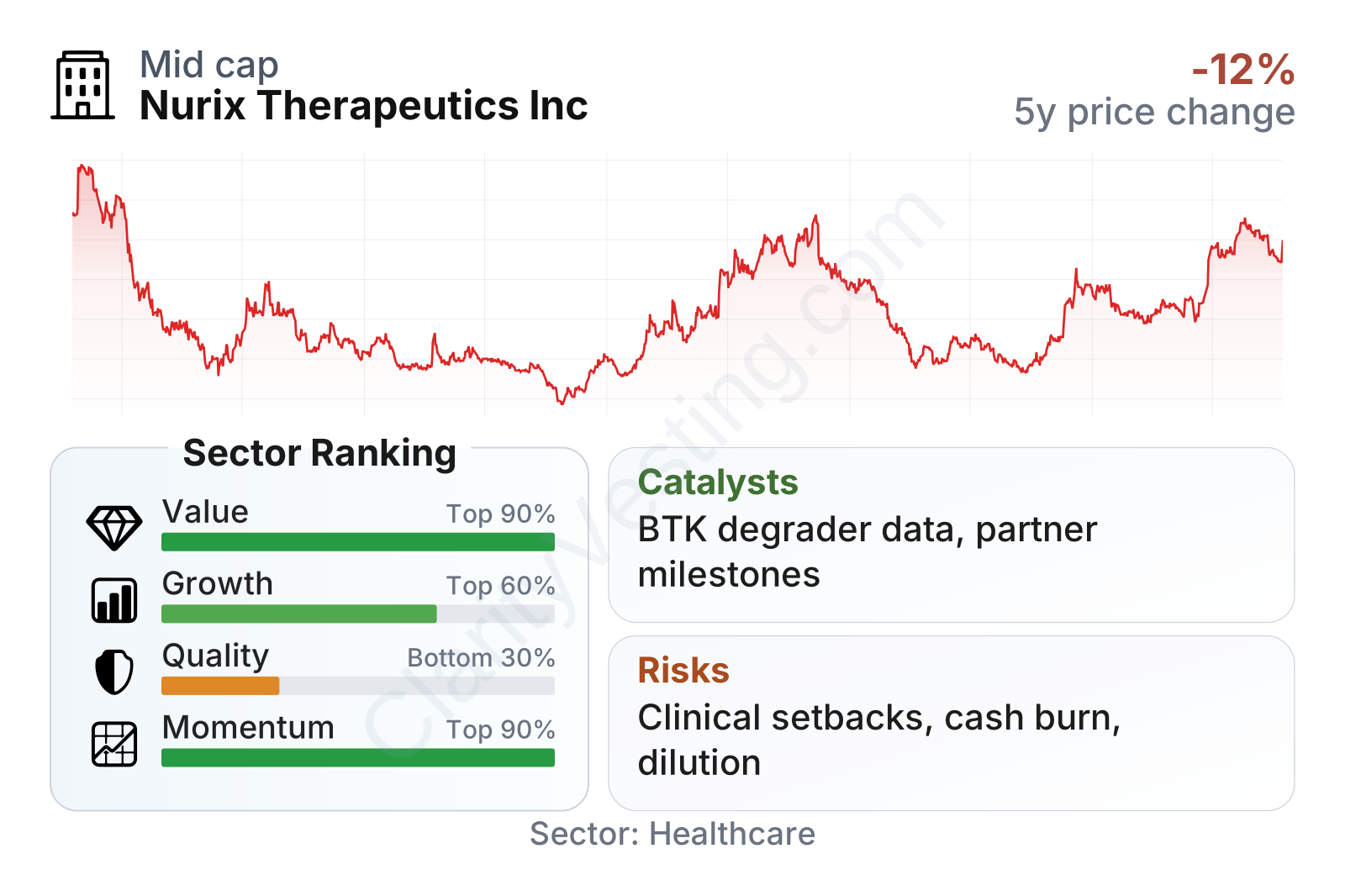
Nurix sits in the small- to mid-cap biotech range and has shown much stronger stock-price momentum than most healthcare peers over the past year and over three years. That market strength stands in sharp contrast to weak profitability and weak valuation metrics. Relative to the sector, the company ranks near the bottom on value and quality factors, mainly because it remains deeply unprofitable and burns cash, while ranking much better on momentum.
The balance sheet looks more conservative than many biotech peers on debt, which matters because drug development businesses often need financial flexibility. However, the company’s premium price-to-book ratio suggests the market is assigning considerable value to future pipeline progress rather than current earnings power.
Growth
Nurix operates in one of biotechnology’s most active areas: targeted protein degradation and precision medicines for oncology and immunology. This remains an attractive long-term segment because large drugmakers continue to invest in new ways to address disease-causing proteins that have been difficult to target with older approaches. If the science works in larger trials, the commercial opportunity can be substantial.
The company’s strategy is also coherent for future growth. It combines two paths: advancing wholly owned programs that could create large upside if successful, and partnering selected assets or technology with larger pharmaceutical groups to bring in non-dilutive funding. That structure can reduce some financing pressure while still leaving Nurix exposed to major upside from internal candidates.
Revenue growth has been highly volatile, with periods of sharp expansion followed by steep declines. That does not necessarily mean demand is weakening; for a company like Nurix, it usually reflects the timing of collaboration accounting and milestone recognition. For long-term readers, it is more useful to see revenue as lumpy rather than steadily compounding.
Free cash flow remains clearly negative and has become more negative over time, reflecting increased clinical and research spending. This is common for an advancing biotech pipeline, but it also means future growth depends on either successful partnerships, access to capital, or eventually successful late-stage development.
A major growth catalyst is the progress of the clinical pipeline, especially the company’s BTK degrader program and other oncology assets. Nurix has highlighted advancement across its wholly owned and partnered programs, and these updates matter far more than near-term accounting revenue. Positive clinical data, dose-expansion progress, new partnership milestones, or movement into later-stage studies could all materially reshape how the market views the company’s long-term revenue potential.
Recent company updates have also reinforced that larger pharmaceutical companies remain interested in Nurix’s platform. Continued collaboration activity is significant because it serves as outside validation of the technology while helping to fund development. In a research-driven biotech company, that kind of strategic backing can be a meaningful signal.
Risks
This article is for informational purposes only and does not constitute financial advice. Some content is AI-generated. See Disclaimer


