Stock Analysis · NOV Inc (NOV)
Overview
NOV Inc is a large oilfield equipment and technology company serving the global energy industry. It designs, manufactures, and services products used across the life of an oil and gas well, from drilling and well construction to production equipment and aftermarket support. In simple terms, NOV helps energy producers and contractors build wells, operate rigs, move fluids, and maintain critical equipment.
The business is organized into two main segments. Based on the latest annual reporting structure, revenue is concentrated in:
- Energy Products and Services: approximately 62% of revenue. This segment includes drill bits, downhole tools, completion tools, artificial lift, pumps, fluid handling, fiberglass systems, and a wide range of spare parts and field services.
- Energy Equipment: approximately 38% of revenue. This segment includes rig equipment, pressure control systems, cranes, winches, blowout preventers, marine and offshore equipment, and capital equipment sold to drilling contractors and offshore customers.
That mix matters because the larger products-and-services segment tends to be more recurring and less dependent on one-off large equipment orders, while the equipment segment can be more cyclical but offers stronger upside when offshore and rig investment improves.
Over the last several years, NOV’s revenue base recovered strongly from the industry downturn, and operating profit improved materially through 2024 before softening again in 2025 as margins came under pressure. The business still generates meaningful cash, but earnings remain more uneven than those of the strongest companies in the sector.
The long-term picture shows a clear rebound from the 2021 loss period: revenue and gross profit improved substantially through 2024, while operating income turned positive. However, the more recent step-down in net income shows how sensitive results remain to cycle conditions, pricing, and mix.
Key Figures
| Metric | Value | Sector ⓘ |
|---|---|---|
| Date | Oct 17, 2026 | |
| Context | ||
| Sector | Energy | |
| Industry | Oil & Gas Equipment & Services | |
| Market Cap ⓘ | $6.76B | |
| Beta ⓘ | 0.98 | |
Value (Cheapness) | ||
| P/E Ratio ⓘ | 70.22 | 15.44 |
| P/B Ratio ⓘ | 1.11 | 1.73 |
| FCF Yield ⓘ | 8.32% | 8.20% |
| Dividend Yield ⓘ | 1.75% | 3.59% |
| EBIT / EV ⓘ | 4.98% | 7.46% |
| PEG ⓘ | 0.82 | |
Growth (Business expansion) | ||
| Revenue Growth ⓘ | -2.50% | 26.90% |
| RPS Growth (5Y CAGR) ⓘ | 12.98% | 6.90% |
| EPS Growth (5Y CAGR) ⓘ | 9.39% | -15.73% |
| BVPS Growth (5Y CAGR) ⓘ | 6.73% | 6.07% |
| Margin Growth (5Y Trend) ⓘ | 8.06% | 0.58% |
| FCF Growth (5Y CAGR) ⓘ | 76.02% | 1.86% |
| DPS Growth (5Y CAGR) ⓘ | 76.84% | 16.79% |
Quality (Business durability) | ||
| ROIC (Latest) ⓘ | 1.42% | 11.40% |
| ROA (Latest) ⓘ | 0.85% | 6.06% |
| ROIC (5Y Median) ⓘ | 8.80% | 10.30% |
| ROA (5Y Median) ⓘ | 1.57% | 5.42% |
| Net Debt / EBIT (Latest) ⓘ | 2.78 | 1.64 |
| Net Debt / EBIT (5Y Median) ⓘ | 2.05 | 1.83 |
| Net Debt / EBITDA (Latest) ⓘ | 1.49 | 1.08 |
| Net Debt / Assets ⓘ | 10.38% | 17.29% |
| EBITDA / Interest ⓘ | 8.99 | 9.64 |
| Operating Margin (Latest) ⓘ | 4.84% | 16.27% |
| Operating Margin (5Y Median) ⓘ | 5.30% | 20.39% |
| Debt to Equity (Latest) ⓘ | 37.49% | 54.76% |
| Profit Margin (Latest) ⓘ | 1.10% | 8.82% |
| Free Cash Flow (Latest) ⓘ | $562.00M | |
Momentum (Price trend) | ||
| 3Y Return ⓘ | -1.27% | +67.38% |
| 12M Return (excl. last month) ⓘ | +62.97% | +49.19% |
| 6M Return ⓘ | -0.55% | +7.07% |
| Price vs. 200-Day MA ⓘ | -3.00% | +9.56% |
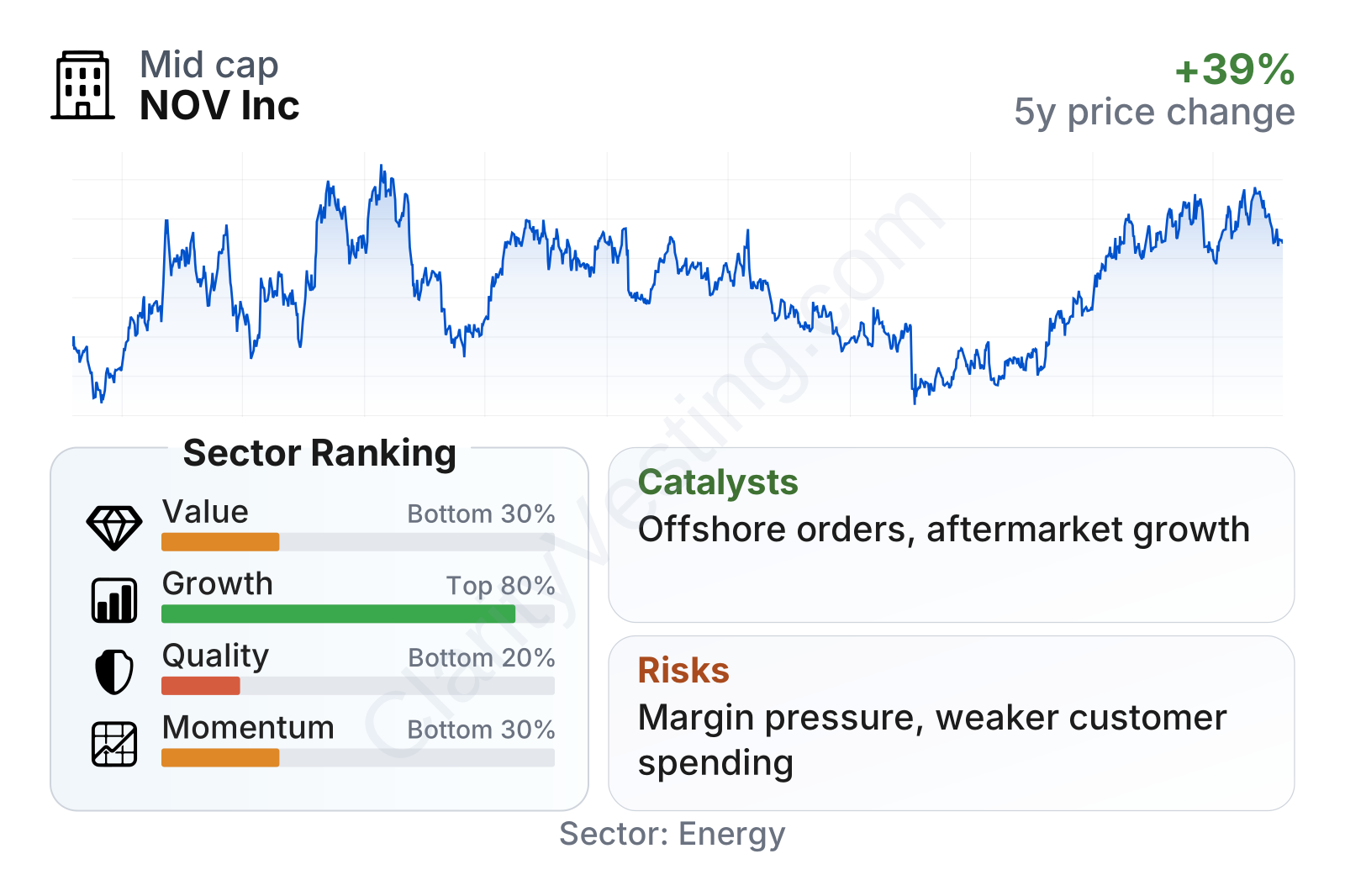
NOV is a mid-sized energy equipment company with stock volatility that is slightly below the broader market. The scorecard is mixed. Growth metrics look stronger than much of the sector over a multi-year period, especially in revenue per share, free cash flow expansion, and margin improvement from earlier lows. By contrast, quality metrics are weak: returns on capital and assets are low, and current profitability sits well below sector medians. On valuation, the picture is not obviously cheap on earnings-based measures because current earnings are depressed, although book value and cash flow measures look less demanding than the headline P/E suggests.
Growth
NOV operates in a sector with durable long-term importance, even if it is cyclical. Oil and gas producers still need replacement equipment, maintenance, productivity tools, and offshore project support, and those needs do not disappear even when commodity prices cool. The company is also exposed to international and offshore markets, which usually move on longer investment cycles than short-cycle North American activity. That can support steadier demand for certain product lines over time.
NOV’s strategy is logical for this part of the industry. Management has been emphasizing higher-value equipment, aftermarket sales, service, digital tools, automation, and capital discipline. That approach makes sense because recurring parts and service revenue is usually more resilient than large original-equipment orders alone. It also helps NOV use its broad installed base: when equipment is already in the field, spare parts, upgrades, and service work can become a durable source of business.
Recent growth has clearly slowed. After very strong year-over-year gains in 2022 and 2023, revenue growth decelerated through 2024 and turned modestly negative in 2025 and into 2026. That suggests NOV is now moving through the downshift phase of the cycle rather than a broad expansion phase. Even so, the longer five-year trend remains better than much of the sector, which indicates the company did participate meaningfully in the industry recovery.
Cash generation remains one of the more constructive parts of the thesis. Free cash flow has been volatile, which is normal in this industry, but the business moved from weak or negative levels earlier in the cycle to clearly positive cash generation more recently. Trailing free cash flow remains substantial, even after coming down from a stronger peak. That gives NOV room to support dividends, debt management, and selective investment.
A practical catalyst for future growth is offshore and international project activity. NOV has meaningful exposure to equipment and systems used in large projects, and those projects often have longer lead times and larger ticket sizes. Another catalyst is the company’s large installed base, which can support aftermarket demand even when customers postpone major new purchases. Recent company communications have also highlighted order activity, backlog support, and continued focus on productivity and service-led offerings, all of which point to a strategy centered on improving earnings quality rather than only chasing top-line expansion.
Risks
This article is for informational purposes only and does not constitute financial advice. Some content is AI-generated. See Disclaimer


