Stock Analysis · Neinor Homes S.A (NNRHF)
Overview
Neinor Homes S.A. is a Spanish residential real estate developer. In simple terms, it buys land, develops housing projects, builds homes, and then sells them. The company is focused mainly on Spain’s large housing markets and has built its model around three pillars: traditional homebuilding for sale, build-to-rent activity carried out with partners or institutional capital, and an asset-light platform business where it manages projects and earns fees without needing to own all the capital itself.
For a long-term reader, the key point is that Neinor is not a diversified global property group. It is a relatively focused housing developer tied closely to the Spanish residential market. That creates clearer exposure to one market and one need: housing supply. It also means the company’s results can move sharply depending on delivery timing, project sales, financing costs, and land investment discipline.
Based on the company’s recent business model and public disclosures, the main revenue and cash generation sources can be understood as follows:
- Residential development and home deliveries: approximately 80% to 90% of business activity in most periods. This includes the sale of completed homes to individual buyers and, in some cases, bulk sales.
- Build-to-rent and institutional residential transactions: approximately 10% to 20%. This can include selling entire developments or stabilized residential assets to institutional investors.
- Platform, management, and other fees: currently a small share of total revenue, but strategically important because it can generate earnings with lower capital intensity. This includes project management and capital-partner structures.
The broad financial flow over the last several years shows a cyclical pattern rather than a straight line. Revenue and profit declined from the very strong 2021 level through 2024, then rebounded in 2025. That matters because it shows Neinor’s earnings power can recover when project completions and sales volumes normalize, but it also confirms that this is not a smooth, subscription-like business.
The long-term pattern suggests a developer that has preserved profitability through the cycle and then improved again as volumes recovered. Cost of revenue remains the dominant outflow, which is typical in homebuilding, while the rebound in operating income and net income in 2025 indicates stronger project execution and better scale absorption after a softer period.
Key Figures
| Metric | Value | Sector ⓘ |
|---|---|---|
| Date | Oct 17, 2026 | |
| Context | ||
| Sector | Real Estate | |
| Industry | Real Estate - Development | |
| Market Cap ⓘ | $1.53B | |
| Beta ⓘ | 0.28 | |
Value (Cheapness) | ||
| P/E Ratio ⓘ | 19.77 | 17.38 |
| P/B Ratio ⓘ | 1.74 | 0.85 |
| FCF Yield ⓘ | 18.48% | 7.38% |
| Dividend Yield ⓘ | N/A | 4.85% |
| EBIT / EV ⓘ | N/A | 3.78% |
| PEG ⓘ | N/A | |
Growth (Business expansion) | ||
| Revenue Growth ⓘ | 362.80% | 5.30% |
| RPS Growth (5Y CAGR) ⓘ | -8.30% | 6.02% |
| EPS Growth (5Y CAGR) ⓘ | N/A | -11.37% |
| BVPS Growth (5Y CAGR) ⓘ | -2.34% | 0.45% |
| Margin Growth (5Y Trend) ⓘ | 7.43% | -0.22% |
| FCF Growth (5Y CAGR) ⓘ | -1.79% | 5.40% |
| DPS Growth (5Y CAGR) ⓘ | 39.54% | 5.02% |
Quality (Business durability) | ||
| ROIC (Latest) ⓘ | N/A | 5.69% |
| ROE (Latest) ⓘ | 13.64% | 7.56% |
| ROA (Latest) ⓘ | 5.17% | 2.85% |
| ROIC (5Y Median) ⓘ | 7.79% | 4.22% |
| ROE (5Y Median) ⓘ | 10.31% | 6.03% |
| ROA (5Y Median) ⓘ | 5.14% | 2.44% |
| Net Debt / EBIT (Latest) ⓘ | 6.49 | 7.59 |
| Net Debt / EBIT (5Y Median) ⓘ | 2.00 | 8.40 |
| Net Debt / EBITDA (Latest) ⓘ | 6.06 | 5.27 |
| Net Debt / Assets ⓘ | 28.21% | 37.76% |
| EBITDA / Interest ⓘ | N/A | 4.10 |
| Operating Margin (Latest) ⓘ | 10.41% | 35.29% |
| Operating Margin (5Y Median) ⓘ | 20.48% | 37.31% |
| Debt to Equity (Latest) ⓘ | 146.05% | 88.87% |
| Profit Margin (Latest) ⓘ | 10.73% | 19.61% |
| Free Cash Flow (Latest) ⓘ | $282.81M | |
Momentum (Price trend) | ||
| 3Y Return ⓘ | +109.79% | +30.75% |
| 12M Return (excl. last month) ⓘ | +10.19% | +4.36% |
| 6M Return ⓘ | +2.78% | -2.52% |
| Price vs. 200-Day MA ⓘ | +2.43% | -2.34% |
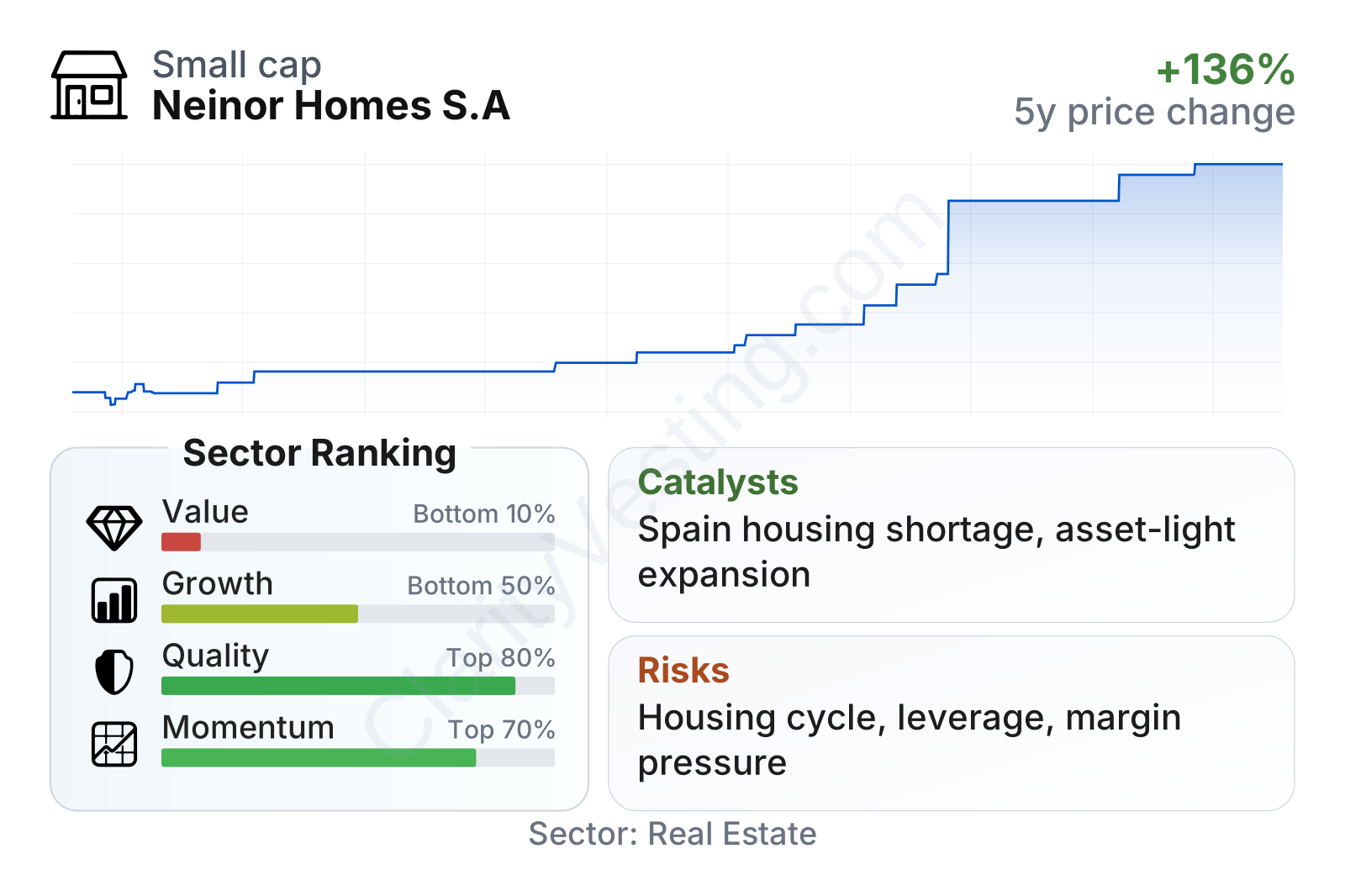
Neinor stands out as a mid-sized listed developer with unusually strong recent revenue growth, solid returns on equity and assets relative to much of the sector, and very high free cash flow generation. At the same time, the table points to a mixed profile: valuation metrics are not especially cheap versus the sector, leverage is meaningful, and longer-term growth trends still look weaker than the latest year suggests. In other words, recent operating momentum improved faster than the full five-year record.
The stock price has risen sharply since late 2021, with especially strong appreciation through 2025 and into 2026. That performance indicates the market has already recognized part of the company’s operational recovery and cash generation strength, so the discussion increasingly shifts from turnaround recognition to whether the business can sustain this level of execution.
Growth
Neinor operates in a sector that still has a credible long-term demand base. Spain has faced structural housing supply constraints in several urban and economically active regions, while household formation, migration, and affordability pressures continue to support the need for new homes. That does not remove the cycle, but it does mean the underlying market need is real.
The company’s strategy makes sense if judged against that backdrop. Neinor has increasingly emphasized capital rotation, partnerships, and fee-based or asset-light activity instead of relying only on balance-sheet-heavy land development. For a homebuilder, that is important because it can reduce the amount of capital tied up in projects while preserving pipeline visibility and operating scale.
Revenue per share shows why the current phase needs to be read carefully. The medium-term record is not consistently upward: the measure fell meaningfully between 2021 and 2024 before recovering in 2025. So the latest growth surge looks more like a rebound from a lower base than evidence of a long uninterrupted expansion path. The positive reading is that the company has already demonstrated it can rebuild volume after a downcycle.
A notable catalyst is the company’s ability to monetize its land bank and development platform without always carrying all projects on its own balance sheet. If management continues to attract institutional partners for rental housing or co-investment structures, Neinor could support growth while moderating capital needs. Another useful catalyst is the company’s proven capacity to generate cash from deliveries: free cash flow has been strong, which gives room for debt management, land investment, and shareholder distributions when conditions allow.
The dividend trend also signals a stronger operating phase. Payments have been volatile, which is normal for a cyclical developer, but the direction in the last two years has been clearly upward. That does not make the payout stable in the same way as a utility or consumer staple, yet it does underline that the business has recently been converting projects into distributable cash at a healthy rate.
Recent corporate communications have also highlighted continued focus on portfolio recycling, partnerships, and a pipeline aligned with Spanish housing demand. The main opportunity in that strategy is straightforward: if supply remains tight and financing conditions improve gradually, Neinor could benefit from both stronger homebuyer demand and better economics on project starts.
Risks
This article is for informational purposes only and does not constitute financial advice. Some content is AI-generated. See Disclaimer


