Stock Analysis · NNN REIT Inc (NNN)
Overview
NNN REIT Inc is a real estate investment trust focused on single-tenant retail properties in the United States. In simple terms, it buys freestanding commercial buildings and leases them to tenants under long contracts, usually structured as triple-net leases. Under that model, the tenant typically pays property taxes, insurance, and maintenance, which helps keep the landlord’s operating costs relatively predictable.
The company’s portfolio is built around everyday retail and service locations rather than malls or office towers. Its tenants generally operate businesses such as convenience stores, automotive services, restaurants, and other necessity-oriented retail categories. That matters because many of these locations are designed to stay relevant even when consumer habits shift.
NNN REIT’s revenue comes overwhelmingly from rental income generated by its property portfolio. Based on recent company disclosures, the business is highly concentrated in lease revenue, with only a small contribution from other real-estate-related items.
- Rental revenue from retail properties: approximately 95% to 99% of total revenue. This is the core business and includes base rent from long-term leases across the company’s single-tenant portfolio.
- Earned lease-related income and other real estate revenue: approximately 1% to 5%. This can include items such as percentage rent, settlement income, or other property-related amounts that are not the main recurring rent stream.
The business model is straightforward: acquire properties at yields above its cost of capital, keep occupancy high, sign long leases with rent escalators, and recycle capital when needed. Over the last several years, revenue and operating income have trended upward, while margins have remained strong, which is typical of an efficiently run net-lease platform.
The long-term financial picture points to steady top-line expansion and durable profitability. Revenue has increased from the low $700 million range to above $900 million over the past five years, while operating income has also advanced. One unusual 2025 flow breakdown appears distorted by accounting presentation, so the broader trend is more useful than that single year detail.
Key Figures
| Metric | Value | Sector ⓘ |
|---|---|---|
| Date | Nov 14, 2026 | |
| Context | ||
| Sector | Real Estate | |
| Industry | REIT - Retail | |
| Market Cap ⓘ | $8.03B | |
| Beta ⓘ | 0.75 | |
Value (Cheapness) | ||
| P/E Ratio ⓘ | 19.81 | 18.10 |
| P/B Ratio ⓘ | 1.72 | 1.62 |
| FCF Yield ⓘ | 0.13% | 5.78% |
| Dividend Yield ⓘ | 5.80% | 4.71% |
| EBIT / EV ⓘ | 4.70% | 4.93% |
| PEG ⓘ | 4.79 | |
Growth (Business expansion) | ||
| Revenue Growth ⓘ | 8.50% | 5.70% |
| RPS Growth (5Y CAGR) ⓘ | 4.35% | 5.87% |
| EPS Growth (5Y CAGR) ⓘ | 0.42% | -3.35% |
| BVPS Growth (5Y CAGR) ⓘ | 1.24% | 0.24% |
| Margin Growth (5Y Trend) ⓘ | 5.00% | -0.69% |
| FCF Growth (5Y CAGR) ⓘ | 4.08% | 5.81% |
| DPS Growth (5Y CAGR) ⓘ | 1.90% | 5.00% |
Quality (Business durability) | ||
| ROIC (Latest) ⓘ | 5.10% | 5.18% |
| ROE (Latest) ⓘ | 8.87% | 7.66% |
| ROA (Latest) ⓘ | 4.17% | 3.09% |
| ROIC (5Y Median) ⓘ | 3.91% | 4.21% |
| ROE (5Y Median) ⓘ | 8.87% | 6.04% |
| ROA (5Y Median) ⓘ | 4.27% | 2.43% |
| Net Debt / EBIT (Latest) ⓘ | 8.15 | 7.49 |
| Net Debt / EBIT (5Y Median) ⓘ | 8.11 | 8.41 |
| Net Debt / EBITDA (Latest) ⓘ | 5.57 | 5.31 |
| Net Debt / Assets ⓘ | 51.36% | 38.16% |
| EBITDA / Interest ⓘ | 4.18 | 4.20 |
| Operating Margin (Latest) ⓘ | 62.95% | 34.29% |
| Operating Margin (5Y Median) ⓘ | 63.92% | 37.26% |
| Debt to Equity (Latest) ⓘ | 109.72% | 90.28% |
| Profit Margin (Latest) ⓘ | 40.89% | 18.55% |
| Free Cash Flow (Latest) ⓘ | $10.52M | |
Momentum (Price trend) | ||
| 3Y Return ⓘ | +28.96% | +33.76% |
| 12M Return (excl. last month) ⓘ | +2.21% | +1.92% |
| 6M Return ⓘ | -3.18% | -1.15% |
| Price vs. 200-Day MA ⓘ | -4.42% | 0.00% |
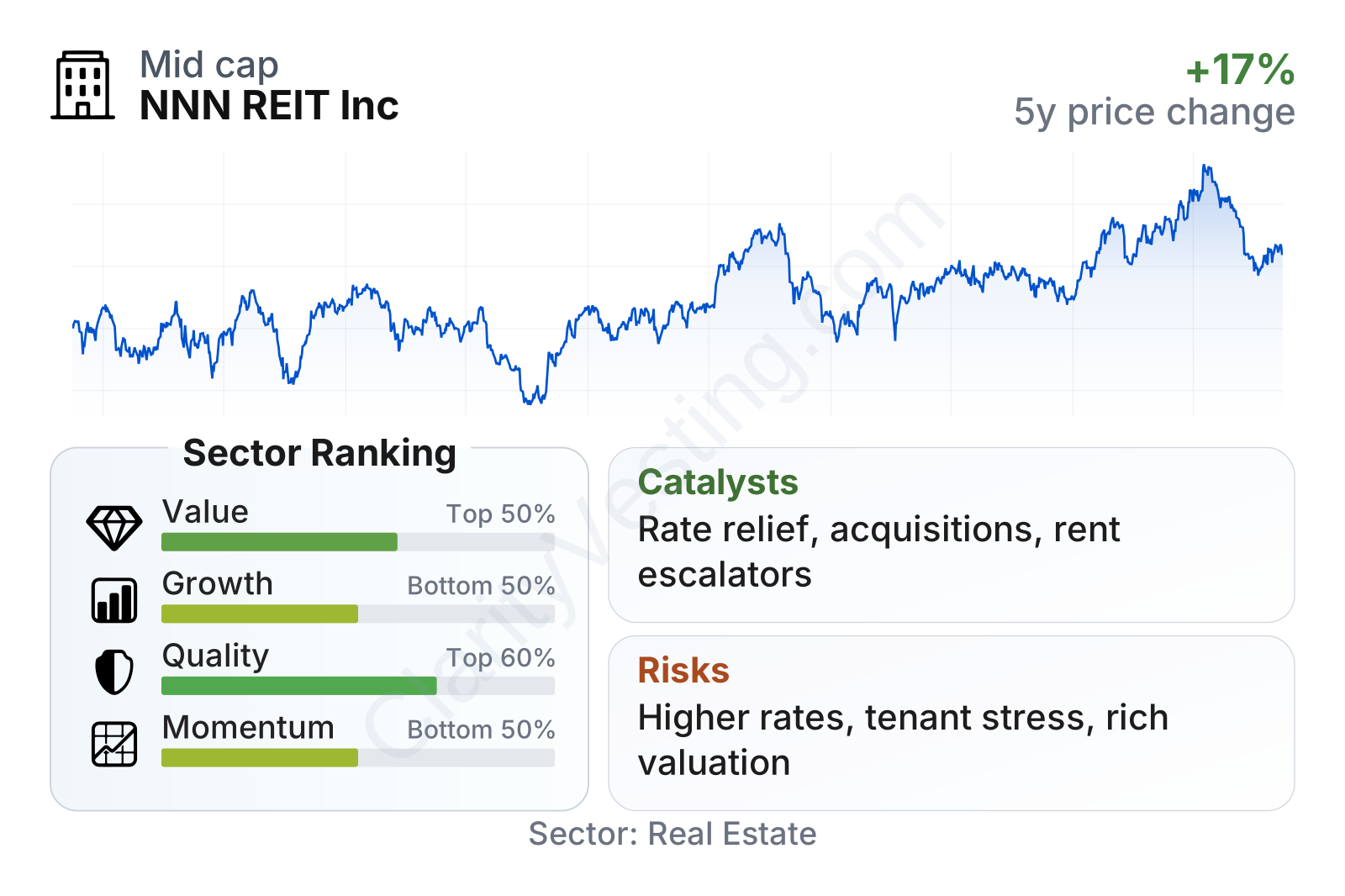
NNN REIT is a mid-sized public REIT with a market value around $8 billion and a stock volatility level below the broader market, reflected in a beta under 1. On valuation, it trades slightly above the sector median on earnings and clearly above the sector median on book value. On income, the dividend yield is notably higher than the sector median, while operating profitability and asset efficiency are better than many real estate peers. Growth metrics are more mixed: recent annual revenue growth is solid, but the longer five-year growth pace is more modest relative to the sector.
The stock price has generally moved upward since late 2023, with stronger momentum into 2026, although recent shorter-term trading has been softer than the sector median. That combination suggests the market recognizes the company’s stability, but not necessarily as a high-growth name.
Growth
NNN REIT operates in a part of commercial real estate that still has a clear place in the economy: net-leased, freestanding retail properties occupied by tenants serving daily consumer needs. This is not the fastest-growing corner of real estate, but it can be durable. Demand is supported by businesses that need physical locations, especially convenience, fuel, auto service, value retail, and food service. These formats often remain relevant even as e-commerce grows, because they depend on proximity, quick transactions, or in-person service.
The company’s strategy for future expansion is sensible and easy to follow. It aims to grow through disciplined property acquisitions, long lease terms, diversification across tenants and industries, and contractual rent increases. For a net-lease REIT, that approach can create slow but consistent compounding rather than rapid expansion.
Revenue per share has moved upward year after year, which is an encouraging sign for a REIT because it shows that growth has not relied only on issuing more shares. The five-year annualized increase is in the mid-single-digit range, steady rather than spectacular, and consistent with the company’s conservative profile.
Dividend per share has also risen gradually, though at a slower pace than revenue. That points to a business that is still expanding its cash-generating base, but is also balancing shareholder distributions with funding needs and balance-sheet discipline. NNN REIT is well known for a long record of annual dividend increases, and that consistency remains one of its most visible operating strengths.
A key catalyst is the interest-rate backdrop. Net-lease REITs are sensitive to borrowing costs and property cap rates. If financing conditions become more favorable, acquisition spreads can improve and property values can stabilize or rise. Another catalyst is continued acquisition activity in fragmented retail real estate, where scale, access to capital, and underwriting experience can help established operators add properties on attractive terms.
Recent company updates have also highlighted ongoing investment activity and portfolio management rather than a dramatic strategic pivot. That is typical for NNN REIT: the opportunity is less about a transformational event and more about continued execution in a market where many smaller property owners cannot match its capital access or leasing expertise.
Risks
This article is for informational purposes only and does not constitute financial advice. Some content is AI-generated. See Disclaimer