Stock Analysis · Nine Entertainment Co. Holdings Limited (NNMTF)
Overview
Nine Entertainment Co. Holdings Limited is an Australian media company with a broad portfolio across free-to-air television, streaming and video-on-demand, publishing, and digital marketplaces. Its best-known assets include the Nine television network, the streaming platform Stan, major metro newspapers such as The Sydney Morning Herald, The Age, and Australian Financial Review, and a controlling interest in Domain, a property listings business. In practical terms, Nine earns money by selling advertising, charging subscription fees, licensing content, and collecting digital marketplace revenue.
Based on the company’s latest annual reporting, revenue is spread across several business lines rather than one single engine. The mix can shift from year to year, but the broad ranking is:
- Broadcast television and video: approximately 35% to 40% of group revenue. This includes free-to-air TV advertising, affiliated regional arrangements, and related video activities.
- Publishing: approximately 25% to 30%. This includes print and digital publishing revenue from subscriptions, advertising, and related publishing products.
- Streaming and subscription video: approximately 15% to 20%. This is mainly Stan, including subscription revenue and add-on services such as sports packages.
- Digital marketplaces: approximately 10% to 15%. This is largely Domain, where revenue comes from residential, commercial, and agent-related listings and services.
- Radio and other media activities: generally a smaller share of revenue, including audio advertising and related operations.
This diversification matters because Nine is not purely dependent on one format such as print newspapers or traditional television. However, most of the group still sits inside advertising-driven media, which means economic conditions and ad demand remain very important.
The profit flow over recent years shows a business with meaningful revenue scale but uneven earnings conversion. Revenue has stayed in a fairly narrow range, while operating income and net income have moved around much more sharply. That pattern suggests the main question is not size, but how efficiently the company can turn audience reach and content assets into durable profit.
Key Figures
| Metric | Value | Sector ⓘ |
|---|---|---|
| Date | Oct 31, 2026 | |
| Context | ||
| Sector | Communication Services | |
| Industry | Entertainment | |
| Market Cap ⓘ | $893.74M | |
| Beta ⓘ | 0.86 | |
Value (Cheapness) | ||
| P/E Ratio ⓘ | 13.39 | 18.47 |
| FCF Yield ⓘ | 54.28% | 14.23% |
| Dividend Yield ⓘ | 13.31% | 2.78% |
| EBIT / EV ⓘ | N/A | 4.73% |
| PEG ⓘ | N/A | |
Growth (Business expansion) | ||
| Revenue Growth ⓘ | 11.30% | 6.10% |
| RPS Growth (5Y CAGR) ⓘ | -3.43% | 4.57% |
| EPS Growth (5Y CAGR) ⓘ | 43.90% | -17.96% |
| Margin Growth (5Y Trend) ⓘ | -7.70% | 1.32% |
| FCF Growth (5Y CAGR) ⓘ | -25.00% | 5.75% |
| DPS Growth (5Y CAGR) ⓘ | 46.21% | 5.19% |
Quality (Business durability) | ||
| ROIC (Latest) ⓘ | N/A | 9.19% |
| ROIC (5Y Median) ⓘ | 12.02% | 8.24% |
| Net Debt / EBIT (Latest) ⓘ | 2.90 | 1.92 |
| Net Debt / EBIT (5Y Median) ⓘ | 2.37 | 2.88 |
| Net Debt / EBITDA (Latest) ⓘ | 2.12 | 1.22 |
| Net Debt / Assets ⓘ | 43.03% | 18.63% |
| EBITDA / Interest ⓘ | 6.97 | 8.36 |
| Operating Margin (Latest) ⓘ | 11.15% | 15.68% |
| Operating Margin (5Y Median) ⓘ | 12.51% | 13.39% |
| Debt to Equity (Latest) ⓘ | 141.22% | 59.65% |
| Profit Margin (Latest) ⓘ | 23.25% | 8.74% |
| Free Cash Flow (Latest) ⓘ | $485.12M | |
Momentum (Price trend) | ||
| 3Y Return ⓘ | -10.31% | +46.16% |
| 12M Return (excl. last month) ⓘ | +88.17% | +1.26% |
| 6M Return ⓘ | -38.32% | 0.00% |
| Price vs. 200-Day MA ⓘ | -25.46% | +0.87% |
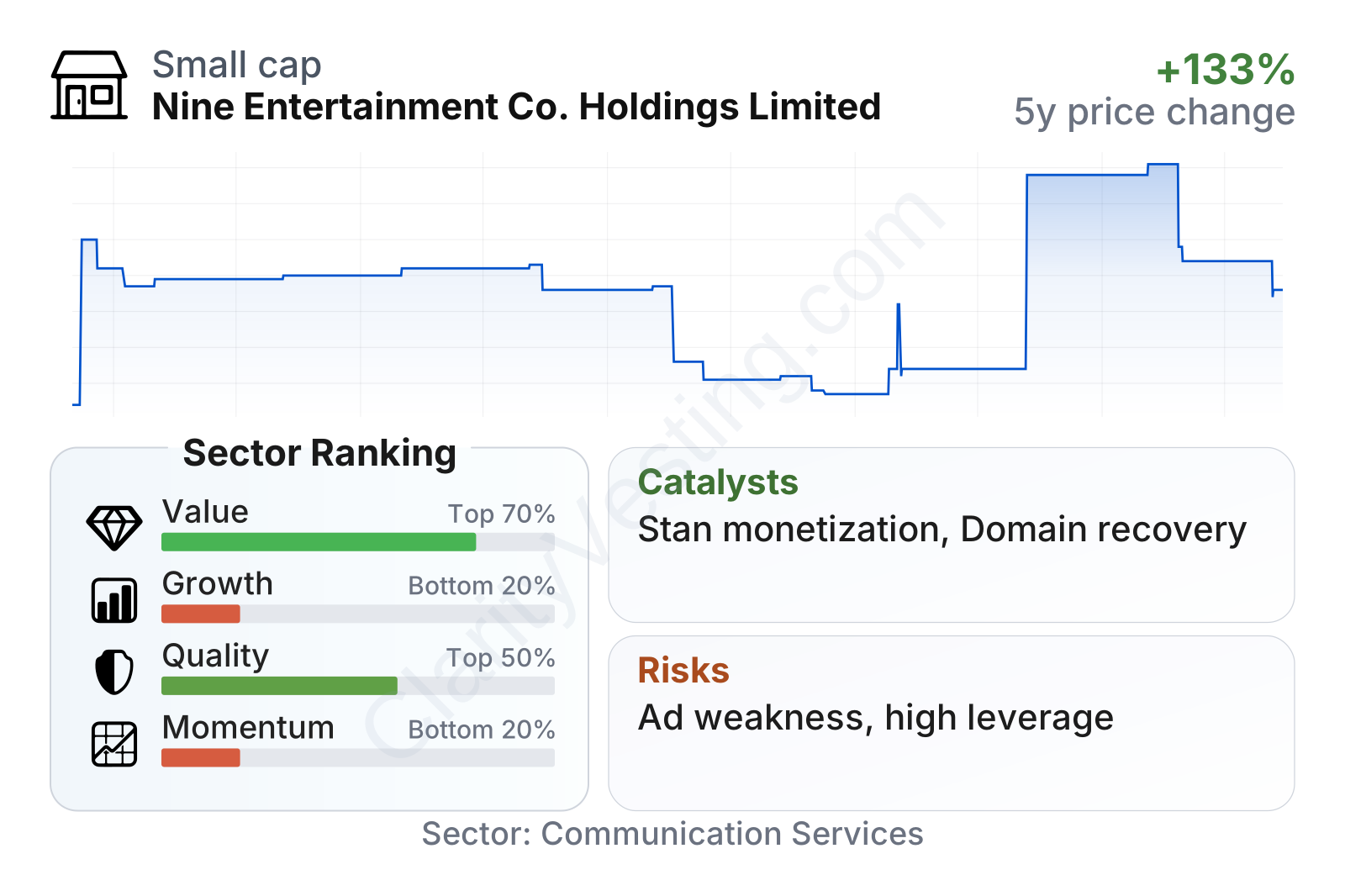
Nine currently looks inexpensive on simple valuation measures, with a price-to-earnings ratio below the sector median and unusually high free cash flow yield and dividend yield. On quality, the picture is more mixed: historical returns on invested capital have been solid, but leverage is clearly above many sector peers. Growth indicators are the weakest area overall. Recent year-over-year revenue growth has been positive, yet the longer-term record for revenue per share, free cash flow, and margins has been less consistent. Share-price behavior also reflects that uneven profile, with a strong rebound over the past year offset by weaker medium-term momentum.
The company is relatively small by public-market standards, and its beta below 1 suggests the stock has not been more volatile than the broader market in a simple statistical sense. Still, the underlying business can remain cyclical because advertising and discretionary media spending tend to swing with economic conditions.
Growth
Nine operates in a sector that is growing in some areas and shrinking in others. Streaming, digital subscriptions, and online marketplaces remain attractive long-term categories, while free-to-air television and print advertising face structural pressure. That makes Nine a transition business rather than a pure growth company. The long-term opportunity depends on whether the faster-moving digital operations can offset the drag from legacy media.
Its strategy is logical on paper. The company has premium local brands, national audience reach, a subscription video platform, and a property marketplace. These assets give it multiple paths to growth: increasing digital subscriptions in publishing, expanding Stan’s paid offering, improving advertising yield through cross-platform sales, and benefiting from any recovery in housing-related activity through Domain.
A major potential catalyst is the continued monetization of premium sports and entertainment content through Stan and Nine’s broader video ecosystem. Exclusive content can support subscriptions and strengthen advertising pricing. Another opportunity is deeper digital monetization of publishing audiences, especially because well-known financial and metropolitan news brands tend to have stronger pricing power than general-interest outlets. If Australia’s property market remains active, Domain can also become a meaningful contributor to group improvement.
Recent corporate developments have also pointed toward portfolio reshaping and sharper capital allocation. That matters because Nine’s collection of assets has often led the market to value the group as a complex package rather than as a set of distinct franchises. Any move that makes earnings quality clearer, reduces complexity, or highlights stronger-performing assets could improve how the market assesses the business.
Risks
This article is for informational purposes only and does not constitute financial advice. Some content is AI-generated. See Disclaimer


