Stock Analysis · Navios Maritime Partners LP Unit (NMM)
Overview
Navios Maritime Partners LP is a shipping company that owns and operates vessels used to move goods around the world. Its fleet spans three main markets: dry bulk, containerships, and tankers. In simple terms, that means it transports raw materials such as iron ore, coal, and grain; carries containerized consumer and industrial goods; and moves crude oil or refined petroleum products. The partnership structure is less important for most long-term readers than the business reality: NMM is essentially a diversified owner of income-producing ships.
The company’s revenue mainly comes from chartering its vessels to customers under contracts that can range from short-term market exposure to longer fixed arrangements. Based on the latest annual filing and fleet mix, the revenue base appears broadly diversified across shipping segments, with dry bulk remaining the largest contributor, followed by containerships and tankers.
- Dry bulk: approximately 45% to 55% of revenue. This includes transporting commodities such as iron ore, coal, grain, bauxite, and fertilizer.
- Containerships: approximately 25% to 35% of revenue. This business serves liner operators that move containerized manufactured goods and retail products.
- Tankers: approximately 15% to 25% of revenue. This includes vessels carrying crude oil and refined petroleum products.
That mix matters because it reduces dependence on one single freight market. Dry bulk and tankers are cyclical and can swing sharply with global trade and commodity demand, while containership charters can offer more visibility when vessels are locked into longer contracts. Over the last several years, Navios Maritime Partners has grown into a much broader platform through acquisitions and fleet expansion, giving it scale across multiple cargo types.
Operationally, the business model is straightforward: acquire vessels, finance them with a mix of debt and equity, charter them out, collect hire revenue, pay operating costs and interest, and try to generate cash above those obligations. Recent results show revenue has stayed above $1.3 billion annually, while profitability has remained strong even as earnings have moderated from earlier peak conditions. That points to a company that is still benefiting from a larger fleet and contract coverage, even if shipping markets are no longer as favorable as they were at the cycle high.
The long-term trend is notable: revenue expanded materially from 2021 through 2025, while net income and operating income remained solidly positive throughout the period. Profitability has come down from the exceptionally strong levels seen earlier in the cycle, but the company still converts a meaningful share of revenue into earnings compared with many industrial businesses.
Key Figures
| Metric | Value | Sector ⓘ |
|---|---|---|
| Date | Oct 10, 2026 | |
| Context | ||
| Sector | Industrials | |
| Industry | Marine Shipping | |
| Market Cap ⓘ | $2.64B | |
| Beta ⓘ | 1.05 | |
Value (Cheapness) | ||
| P/E Ratio ⓘ | 6.06 | 22.32 |
| P/B Ratio ⓘ | 0.73 | 1.98 |
| FCF Yield ⓘ | 13.41% | 6.34% |
| Dividend Yield ⓘ | 0.26% | 1.95% |
| EBIT / EV ⓘ | 14.49% | 4.71% |
| PEG ⓘ | 2.18 | |
Growth (Business expansion) | ||
| Revenue Growth ⓘ | 25.20% | 9.25% |
| RPS Growth (5Y CAGR) ⓘ | 9.46% | 7.75% |
| EPS Growth (5Y CAGR) ⓘ | -13.79% | -13.37% |
| BVPS Growth (5Y CAGR) ⓘ | 9.50% | 6.12% |
| Margin Growth (5Y Trend) ⓘ | -46.43% | 0.81% |
| FCF Growth (5Y CAGR) ⓘ | N/A | 11.01% |
| DPS Growth (5Y CAGR) ⓘ | -0.43% | 9.48% |
Quality (Business durability) | ||
| ROIC (Latest) ⓘ | 19.28% | 10.70% |
| ROA (Latest) ⓘ | 7.33% | 5.38% |
| ROIC (5Y Median) ⓘ | 16.50% | 9.26% |
| ROA (5Y Median) ⓘ | 8.46% | 4.94% |
| Net Debt / EBIT (Latest) ⓘ | 3.92 | 2.08 |
| Net Debt / EBIT (5Y Median) ⓘ | 3.33 | 2.29 |
| Net Debt / EBITDA (Latest) ⓘ | 2.37 | 1.43 |
| Net Debt / Assets ⓘ | 33.71% | 19.34% |
| EBITDA / Interest ⓘ | 7.06 | 9.54 |
| Operating Margin (Latest) ⓘ | 36.37% | 10.34% |
| Operating Margin (5Y Median) ⓘ | 43.41% | 10.29% |
| Debt to Equity (Latest) ⓘ | 68.59% | 65.52% |
| Profit Margin (Latest) ⓘ | 30.27% | 6.63% |
| Free Cash Flow (Latest) ⓘ | $354.34M | |
Momentum (Price trend) | ||
| 3Y Return ⓘ | +305.97% | +61.33% |
| 12M Return (excl. last month) ⓘ | +92.54% | +14.82% |
| 6M Return ⓘ | +31.83% | +3.53% |
| Price vs. 200-Day MA ⓘ | +25.97% | +0.88% |
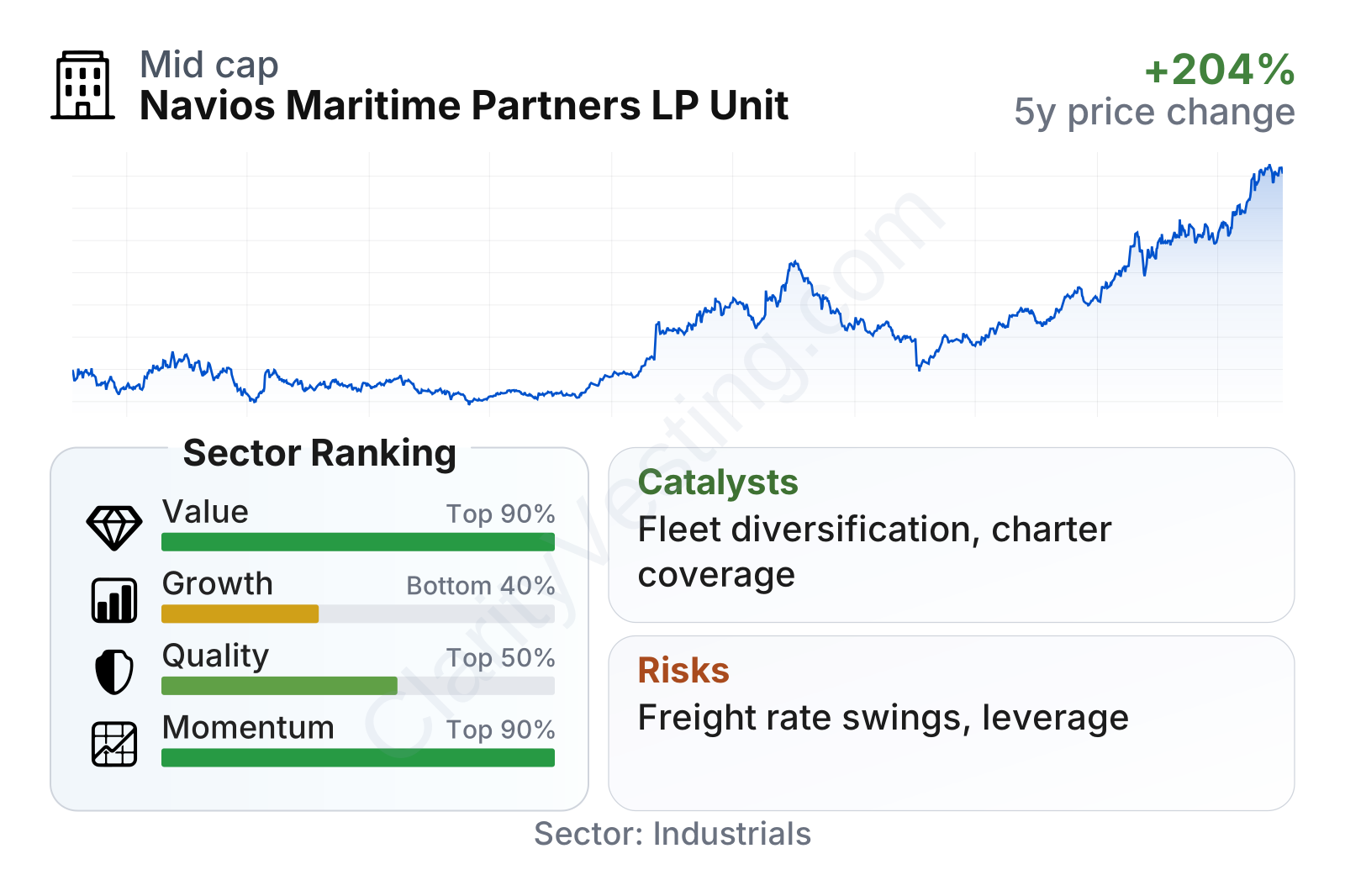
NMM stands out as a mid-sized public shipping company with a market value in the low single-digit billions and a stock that has shown strong momentum over the last one-, three-, and five-year periods. The table points to an unusual combination: very low valuation multiples, above-average profitability, and cash generation that is strong relative to its market value. At the same time, growth metrics are less convincing on a multi-year margin trend basis, which reflects the normal boom-and-correction pattern of shipping rather than a smooth expansion profile.
The quality picture is mixed but generally solid. Returns on capital and assets are comfortably above sector medians, showing that the fleet has been productive. However, leverage remains meaningful, so the balance sheet is not as conservative as the strongest industrial peers. In other words, NMM looks financially productive, but not low-risk.
Growth
Shipping is not a classic secular growth sector in the way software or digital infrastructure can be. It is cyclical, tied to global trade, commodity flows, energy demand, and vessel supply. That said, Navios Maritime Partners is positioned in parts of maritime transport that remain structurally necessary. The world still needs ships to move grain, metals, energy, and containers, and replacing old fleets requires very large capital commitments. This creates room for well-capitalized operators to benefit when vessel supply stays disciplined.
NMM’s strategy makes sense for future growth mainly because it is diversified across major shipping segments and has demonstrated an ability to expand its fleet while preserving strong operating margins. The company has also used charter coverage to reduce part of the volatility that pure spot-market operators face. That does not eliminate cyclicality, but it can smooth cash flows and improve planning.
Recent revenue growth has reaccelerated after a softer period. The latest year-over-year growth rate is above 25%, which is well ahead of the broader sector median. That rebound suggests a better revenue environment, contributions from vessel additions, or both. For a shipping company, a renewed upswing after a flat or declining patch is important because it can signal improving charter utilization and pricing.
Free cash flow has been volatile, which is normal in asset-heavy shipping because vessel purchases and financing decisions can create large swings from one period to another. Even so, the latest trailing figure is strongly positive, and the company’s free-cash-flow yield is well above the sector median. That gives NMM more flexibility to pay down debt, renew its fleet, or pursue additional fleet optimization.
A practical catalyst for future expansion is vessel supply discipline across parts of global shipping. New shipbuilding capacity is constrained, environmental rules are tightening, and financing large fleet growth has become more selective. Those conditions can support freight rates and secondhand vessel values when trade demand is healthy. NMM also benefits from operating in three different shipping markets rather than relying on only one freight cycle.
Recent company updates have continued to highlight fleet management, contracted revenue visibility, and capital allocation discipline. For long-term analysis, the most relevant takeaway is not a single headline but the broader pattern: the company has built a larger, more diversified fleet and still produces substantial earnings and cash flow despite a less favorable backdrop than the post-pandemic peak.
Risks
This article is for informational purposes only and does not constitute financial advice. Some content is AI-generated. See Disclaimer