Stock Analysis · NMI Holdings Inc (NMIH)
Overview
NMI Holdings Inc. is a private mortgage insurer. Its main job is to protect lenders when homebuyers make a small down payment and then default on their mortgage. In simple terms, the company helps banks and mortgage originators make more loans while reducing part of the credit risk on those loans. NMI operates primarily in the U.S. housing finance market through its insurance subsidiaries.
The business is fairly focused. Most revenue comes from insurance premiums tied to mortgage insurance policies already in force, with additional income from investment earnings on the company’s portfolio and smaller contributions from other insurance-related items such as fees and policy cancellations. Based on the company’s recent annual reporting structure, the revenue mix is approximately:
- Net premiums earned: about 80% to 85% — recurring premium income from insuring residential mortgages.
- Net investment income: about 10% to 15% — income generated from investing the company’s capital and float, mainly in fixed-income securities.
- Other revenue and gains: about 3% to 8% — includes items such as fee income, ceded reinsurance impacts, and other underwriting-related items.
This concentrated model makes NMI easier to understand than many diversified financial companies: its results are driven mainly by the size and quality of its insured mortgage portfolio, the level of new insurance written, claim experience, and returns on invested assets.
The company’s financial profile over the last several years shows a favorable pattern: revenue has steadily expanded, operating income has remained very strong, and net income has moved higher as the insured portfolio matured. Expenses have stayed relatively contained compared with revenue growth, which helps explain why profitability has remained unusually high for a financial business of this size.
Key Figures
| Metric | Value | Sector ⓘ |
|---|---|---|
| Date | Oct 24, 2026 | |
| Context | ||
| Sector | Financial Services | |
| Industry | Insurance - Specialty | |
| Market Cap ⓘ | $3.07B | |
| Beta ⓘ | 0.56 | |
Value (Cheapness) | ||
| P/E Ratio ⓘ | 8.03 | 12.46 |
| P/B Ratio ⓘ | 1.17 | 1.25 |
| FCF Yield ⓘ | 14.40% | 9.82% |
| Dividend Yield ⓘ | N/A | 2.94% |
| EBIT / EV ⓘ | 15.22% | 8.11% |
| PEG ⓘ | 1.66 | |
Growth (Business expansion) | ||
| Revenue Growth ⓘ | 8.10% | 9.10% |
| RPS Growth (5Y CAGR) ⓘ | 12.42% | 12.31% |
| EPS Growth (5Y CAGR) ⓘ | -6.27% | -6.97% |
| BVPS Growth (5Y CAGR) ⓘ | 10.78% | 5.02% |
| Margin Growth (5Y Trend) ⓘ | 7.22% | -4.00% |
| FCF Growth (5Y CAGR) ⓘ | 7.10% | 4.71% |
| DPS Growth (5Y CAGR) ⓘ | N/A | 8.92% |
Quality (Business durability) | ||
| ROIC (Latest) ⓘ | 13.79% | 9.18% |
| ROE (Latest) ⓘ | 15.15% | 13.93% |
| ROA (Latest) ⓘ | 10.24% | 1.57% |
| ROIC (5Y Median) ⓘ | 15.69% | 7.80% |
| ROE (5Y Median) ⓘ | 16.71% | 12.15% |
| ROA (5Y Median) ⓘ | 11.41% | 1.28% |
| Net Debt / EBIT (Latest) ⓘ | 0.65 | 1.02 |
| Net Debt / EBIT (5Y Median) ⓘ | 0.72 | 0.72 |
| Net Debt / EBITDA (Latest) ⓘ | 0.63 | 0.88 |
| Operating Margin (Latest) ⓘ | 73.26% | 22.30% |
| Operating Margin (5Y Median) ⓘ | 76.84% | 24.50% |
| Debt to Equity (Latest) ⓘ | 15.45% | 59.34% |
| Profit Margin (Latest) ⓘ | 54.10% | 26.42% |
| Free Cash Flow (Latest) ⓘ | $441.61M | |
Momentum (Price trend) | ||
| 3Y Return ⓘ | +55.39% | +95.73% |
| 12M Return (excl. last month) ⓘ | +9.25% | +17.30% |
| 6M Return ⓘ | +3.00% | +6.07% |
| Price vs. 200-Day MA ⓘ | +3.40% | +5.36% |
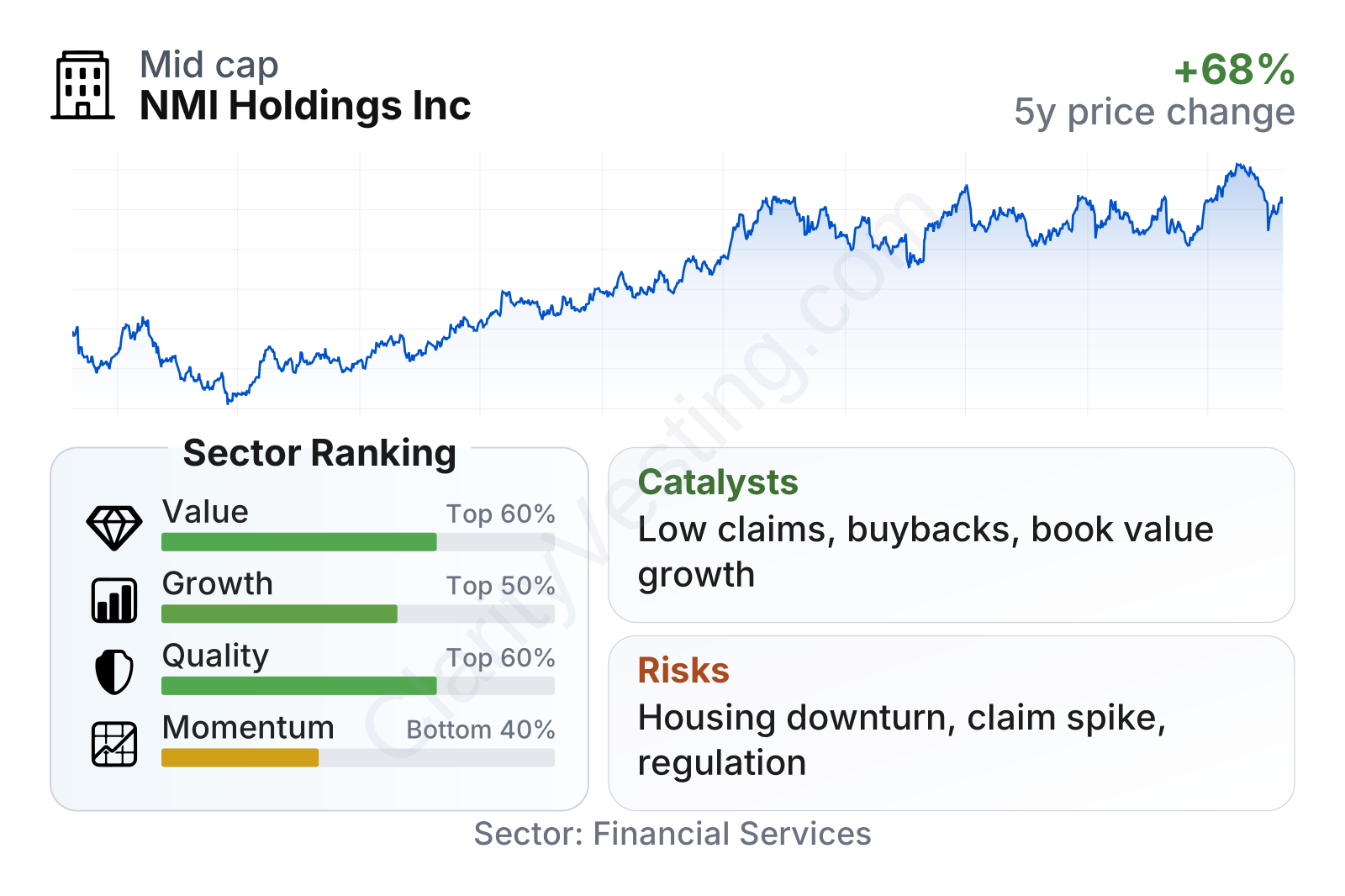
NMI is a mid-sized financial company with a market value around $3 billion and a relatively low beta, which suggests the shares have been less volatile than the broader market. On valuation, the earnings multiple sits below the sector median, while the price-to-book ratio is also slightly below the sector median. Cash generation looks solid, and operating profitability stands out as notably stronger than many peers.
The factor mix is interesting. Value, growth, and quality all rank in the upper part of the sector, while momentum is weaker. That combination often reflects a business with strong fundamentals that has not fully matched the recent share-price performance of stronger-trending peers. Over the last few years, the stock has still moved up meaningfully, but the path has been uneven, with sharp advances followed by pullbacks.
Growth
NMI operates in a sector that tends to grow over long periods with U.S. household formation, home purchases, and the ongoing need for low-down-payment mortgages. Private mortgage insurance is not a fast-changing technology market, but it can still be an attractive niche when underwriting is disciplined and the housing market remains active. Growth usually comes from writing new insurance, keeping persistency high on existing policies, and earning investment income on a larger capital base.
NMI’s strategy appears coherent for this type of business. It has stayed focused on credit performance, capital efficiency, and relationships with mortgage lenders. The company also uses reinsurance to manage risk and protect capital, which can support future capacity for writing additional business. That matters because mortgage insurance companies need to balance growth with regulatory and rating-agency capital requirements.
Earnings growth has been strong in recent years on an absolute basis, with annual EPS rising from the low-$2 range in 2021 to nearly $5 in 2025. Even where shorter-term comparisons can flatten as the cycle matures, the broader direction remains favorable and reflects both portfolio growth and strong loss performance.
Book value per share has also increased materially, moving from roughly $22 in 2021 to nearly $33 in 2025. For insurers and lender-protection businesses, book value growth is an important signal because it shows whether retained earnings are steadily building the company’s capital base over time.
A meaningful catalyst is the quality of the post-pandemic mortgage vintages insured across the industry. Much of NMI’s portfolio was written under tighter underwriting standards than those seen before the 2008 housing crisis, and borrowers often entered loans with stronger credit profiles. If credit remains stable and unemployment does not rise sharply, that can support low claims and sustained profitability. Another support is interest income: higher yields on invested assets can help insurers even when mortgage origination volumes are softer.
Recent company reporting has also pointed to continued capital generation and active share repurchases, which can lift per-share results even if top-line growth moderates. In a slower origination environment, that kind of disciplined capital allocation can become an important part of the long-term return profile.
Risks
This article is for informational purposes only and does not constitute financial advice. Some content is AI-generated. See Disclaimer


