Stock Analysis · Netlist Inc (NLST)
Overview
Netlist is a small technology company focused on memory and storage products used in servers, cloud infrastructure, artificial intelligence systems, and other data-intensive computing environments. In simple terms, it works around high-performance memory modules and related intellectual property. The business has two distinct sides: selling physical memory products and licensing patented technology.
The company’s operating history shows that product sales are still the dominant source of revenue, while patent-related income can be meaningful but tends to be uneven from period to period. Based on recent annual results and company disclosures, the business mix appears to be concentrated as follows:
- Product revenue: approximately 90% to 100% of annual revenue in most recent periods. This includes memory modules and storage products sold to customers in enterprise and specialized computing markets.
- Licensing and other revenue: approximately 0% to 10% in normal periods, but this can jump sharply when legal settlements, license agreements, or related payments occur. This line mainly reflects the monetization of Netlist’s patent portfolio.
That revenue structure is important for long-term readers because it means Netlist is not a pure software-like royalty business. The core business still depends heavily on hardware-related sales, where margins are usually lower and competition is tougher. At the same time, the patent portfolio is a major part of why the company attracts market attention, because successful licensing outcomes can have an outsized impact on earnings and valuation.
From a cost perspective, the business has historically carried a very high cost of revenue, which leaves only a thin gross profit buffer before legal, administrative, and development expenses. Over the last several years, revenue has moved up and down sharply, while selling and administrative expenses have remained heavy. That helps explain why even periods of stronger sales have not reliably translated into sustained profitability.
The longer-term pattern shows a business that has rebuilt revenue after a deep slump, but where profitability still depends on improving product economics and, potentially, extracting more value from intellectual property.
Key Figures
| Metric | Value | Sector ⓘ |
|---|---|---|
| Date | Oct 03, 2026 | |
| Context | ||
| Sector | Technology | |
| Industry | Electronics & Computer Distribution | |
| Market Cap ⓘ | $1.92B | |
| Beta ⓘ | 1.53 | |
Value (Cheapness) | ||
| P/E Ratio ⓘ | N/A | 29.95 |
| FCF Yield ⓘ | -0.81% | 4.22% |
| Dividend Yield ⓘ | N/A | 1.30% |
| EBIT / EV ⓘ | 0.02% | 2.83% |
| PEG ⓘ | 5.36 | |
Growth (Business expansion) | ||
| Revenue Growth ⓘ | 163.40% | 15.80% |
| RPS Growth (5Y CAGR) ⓘ | -0.19% | 8.55% |
| EPS Growth (5Y CAGR) ⓘ | N/A | -11.72% |
| Margin Growth (5Y Trend) ⓘ | N/A | 0.39% |
| FCF Growth (5Y CAGR) ⓘ | N/A | 9.72% |
| DPS Growth (5Y CAGR) ⓘ | N/A | 7.73% |
Quality (Business durability) | ||
| ROIC (Latest) ⓘ | 4.88% | 9.36% |
| ROIC (5Y Median) ⓘ | -107.72% | 8.32% |
| Net Debt / EBIT (Latest) ⓘ | N/A | 0.50 |
| Net Debt / EBIT (5Y Median) ⓘ | N/A | 0.46 |
| Net Debt / EBITDA (Latest) ⓘ | N/A | 0.28 |
| Net Debt / Assets ⓘ | N/A | 3.44% |
| EBITDA / Interest ⓘ | N/A | 12.67 |
| Operating Margin (Latest) ⓘ | 0.12% | 9.81% |
| Operating Margin (5Y Median) ⓘ | -20.73% | 8.50% |
| Debt to Equity (Latest) ⓘ | N/A | 33.33% |
| Profit Margin (Latest) ⓘ | 0.24% | 7.15% |
| Free Cash Flow (Latest) ⓘ | -$15.58M | |
Momentum (Price trend) | ||
| 3Y Return ⓘ | +149.08% | +49.46% |
| 12M Return (excl. last month) ⓘ | +680.00% | +16.51% |
| 6M Return ⓘ | +290.65% | +24.29% |
| Price vs. 200-Day MA ⓘ | +113.39% | +4.74% |
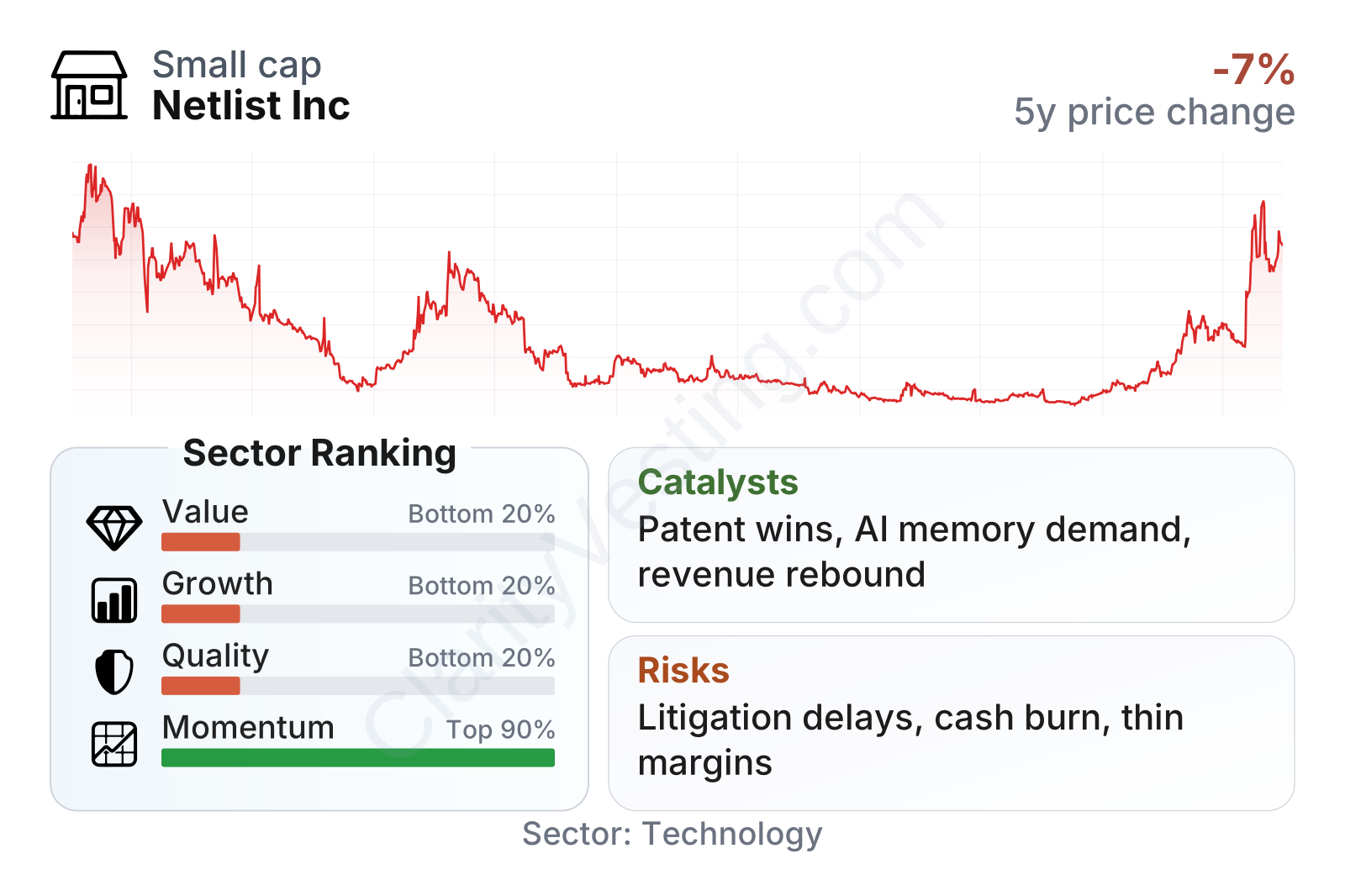
Netlist is a small-cap company with a stock that has been highly volatile. Price momentum has been exceptionally strong recently, far above the sector median, but that strength stands next to weak underlying value and growth factor rankings in the broader technology universe. The most notable contrast in the latest metrics is this: the market has rewarded improving expectations, while the company’s financial base still looks fragile. Free cash flow remains negative, profit margin is only slightly positive on a trailing basis, and valuation ratios based on earnings are of limited use because profits have only recently moved close to breakeven.
Growth
Netlist operates in a market with real long-term demand drivers. Memory and storage remain essential to cloud computing, AI servers, enterprise data centers, and higher-performance computing systems. As workloads become more data-heavy, the need for faster and more efficient memory solutions should continue to expand. So the sector itself is attractive, even if individual suppliers can experience sharp swings.
Netlist’s strategy also makes sense on paper. It combines product sales with a patent licensing angle, giving the company two possible paths to create value. If product revenue scales with better margins, that would strengthen the operating business. If litigation or licensing efforts convert into recurring agreements, that could improve profitability much faster than hardware sales alone normally would.
Recent revenue growth has been dramatic on a year-over-year basis, with the latest readings far above the sector median. However, the company’s history shows that this growth has not been smooth. It has moved from periods of steep contraction to periods of triple-digit recovery. For long-term analysis, that makes the current rebound encouraging but not yet conclusive. The main question is not whether revenue can spike, but whether the business can sustain sales without falling back into another contraction phase.
Cash generation remains the main area where the growth case is not yet fully supported. Free cash flow has stayed negative, although the outflow has improved from worse levels seen earlier. That suggests the business is moving in a better direction, but it has not yet reached the point where growth clearly funds itself.
A major catalyst remains Netlist’s patent enforcement and licensing activity. The company has spent years pursuing claims involving large memory industry players, and positive legal or settlement developments can materially change expectations for future cash inflows. This is one of the clearest reasons the stock can react so strongly to news: a favorable court outcome or licensing agreement can alter the earnings profile much faster than normal operating progress would.
Another potential opportunity is broader demand tied to AI infrastructure. As memory bandwidth and performance become more important in advanced server workloads, companies with specialized memory know-how may find more room in high-value niches, even if they are not among the largest suppliers.
Risks
This article is for informational purposes only and does not constitute financial advice. Some content is AI-generated. See Disclaimer