Stock Analysis · Nektar Therapeutics (NKTR)
Overview
Nektar Therapeutics is a biotechnology company focused on creating new medicines by modifying molecules with its chemistry platform, especially in immunology and inflammation. In simple terms, it is trying to design drugs that work longer, reach the right tissues more effectively, or produce a more useful biological response than standard versions. The company has spent years in oncology and immunology, but its current long-term focus is centered more clearly on immune-related diseases, with rezpegaldesleukin, often shortened to REZPEG, becoming the main development asset.
Unlike a large pharmaceutical company, Nektar does not currently rely on a broad portfolio of marketed products. Its revenue mainly comes from collaboration payments, manufacturing and supply arrangements, royalties, and license-related income connected to past partnerships. That makes the business less predictable than a company with large recurring product sales.
Based on recent annual results, the revenue mix appears concentrated in a small number of categories:
- Collaboration and license revenue: approximately 70% to 80%
These amounts generally come from recognizing payments tied to partnership agreements, development support, and rights granted to other companies. - Royalty revenue: approximately 15% to 25%
This includes royalties from partnered products or programs where Nektar retains an economic interest without fully commercializing the drug itself. - Manufacturing and other revenue: approximately 5% to 10%
This covers supply-related activity and smaller miscellaneous sources.
This structure matters because it shows Nektar is still largely a development-stage biotech rather than an established commercial drug company. Revenue can remain meaningful from partnerships, but the real long-term value depends on whether its pipeline advances into larger clinical and commercial opportunities.
The financial flow over the last several years shows a company that has significantly reduced operating expenses from earlier peak levels, especially in research and administration, but has not yet translated that cost reset into profitability. Revenue has been relatively modest and uneven, while losses remain substantial.
Key Figures
| Metric | Value | Sector ⓘ |
|---|---|---|
| Date | Oct 17, 2026 | |
| Context | ||
| Sector | Healthcare | |
| Industry | Biotechnology | |
| Market Cap ⓘ | $1.26B | |
| Beta ⓘ | 1.27 | |
Value (Cheapness) | ||
| P/E Ratio ⓘ | N/A | 24.79 |
| P/B Ratio ⓘ | 1.38 | 3.08 |
| FCF Yield ⓘ | -18.58% | 3.15% |
| Dividend Yield ⓘ | N/A | 1.94% |
| EBIT / EV ⓘ | -9.89% | 0.57% |
| PEG ⓘ | 0.31 | |
Growth (Business expansion) | ||
| Revenue Growth ⓘ | -9.30% | 7.45% |
| RPS Growth (5Y CAGR) ⓘ | -20.84% | 8.61% |
| EPS Growth (5Y CAGR) ⓘ | -43.19% | -17.81% |
| BVPS Growth (5Y CAGR) ⓘ | -44.37% | 3.72% |
| Margin Growth (5Y Trend) ⓘ | N/A | -0.62% |
| FCF Growth (5Y CAGR) ⓘ | -16.42% | 1.04% |
| DPS Growth (5Y CAGR) ⓘ | N/A | 6.77% |
Quality (Business durability) | ||
| ROIC (Latest) ⓘ | -25.45% | 3.24% |
| ROA (Latest) ⓘ | -22.50% | 3.01% |
| ROIC (5Y Median) ⓘ | -74.12% | 4.60% |
| ROA (5Y Median) ⓘ | -40.29% | 1.89% |
| Net Debt / EBIT (Latest) ⓘ | N/A | 1.34 |
| Net Debt / EBIT (5Y Median) ⓘ | N/A | 1.84 |
| Net Debt / EBITDA (Latest) ⓘ | N/A | 1.00 |
| Net Debt / Assets ⓘ | 8.84% | 5.45% |
| EBITDA / Interest ⓘ | N/A | 9.64 |
| Operating Margin (Latest) ⓘ | -247.17% | 9.27% |
| Operating Margin (5Y Median) ⓘ | -278.42% | 7.38% |
| Debt to Equity (Latest) ⓘ | 15.05% | 28.58% |
| Profit Margin (Latest) ⓘ | -287.84% | 3.59% |
| Free Cash Flow (Latest) ⓘ | -$234.05M | |
Momentum (Price trend) | ||
| 3Y Return ⓘ | +377.17% | +42.80% |
| 12M Return (excl. last month) ⓘ | +35.97% | +18.50% |
| 6M Return ⓘ | -54.67% | +7.57% |
| Price vs. 200-Day MA ⓘ | -42.12% | +5.12% |
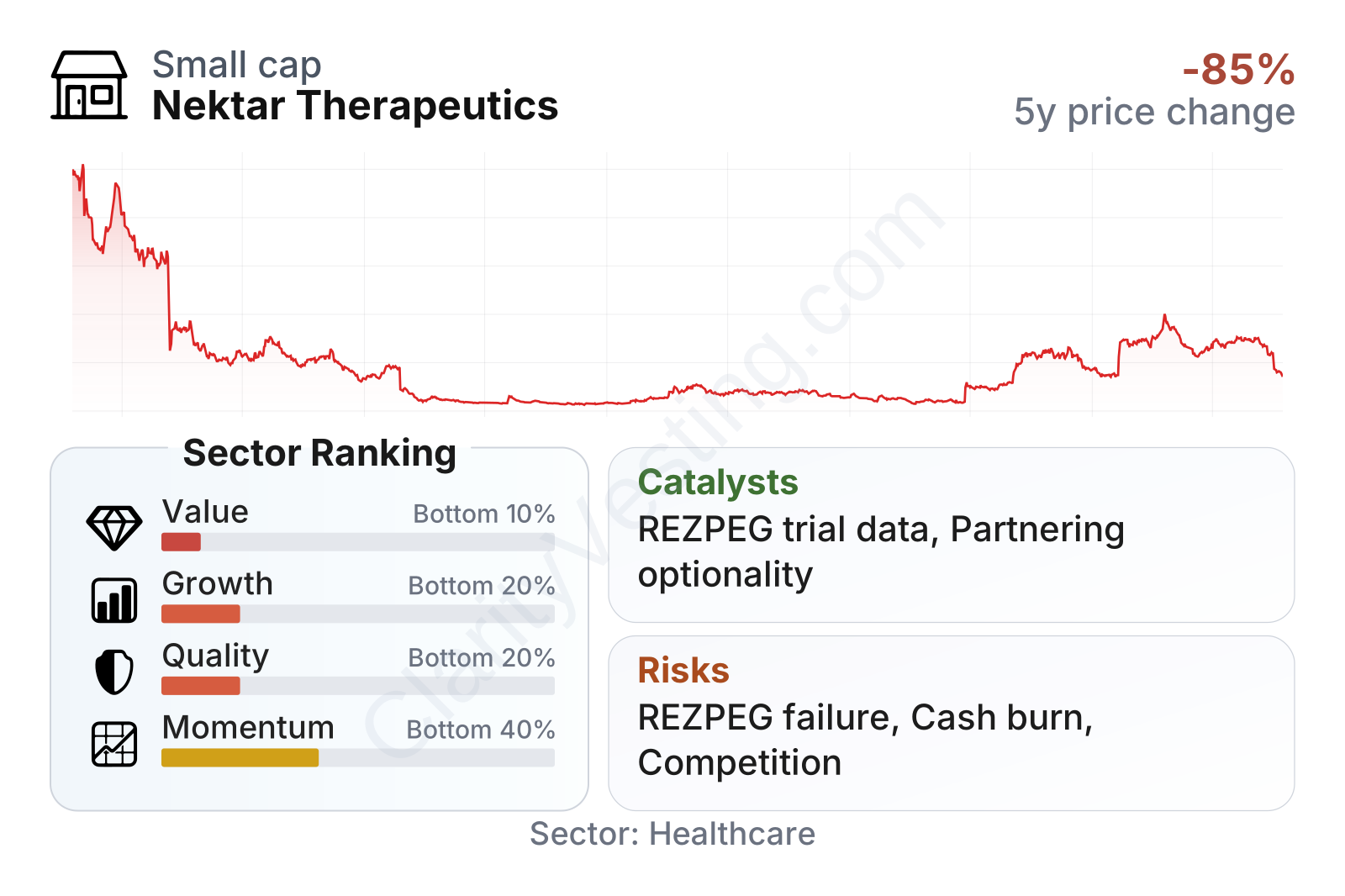
Nektar is a mid-sized biotechnology company by market value, and its share price history has been extremely volatile. The stock has gone through a major collapse from 2021 levels, followed by sharp rebounds, which is typical of biotech names driven by clinical expectations rather than stable earnings. In the broader factor picture, valuation appears optically inexpensive on book value, but that is offset by weak profitability, negative cash generation, and below-sector growth and quality metrics. Momentum has been stronger than many healthcare peers over longer periods, but recent trading has been choppier.
Growth
Biotechnology remains a sector with meaningful long-term growth potential because successful drugs can create very large revenue streams and address major unmet medical needs. Within biotech, immunology is one of the more attractive areas because chronic inflammatory diseases often require long treatment duration, large patient populations, and continued innovation beyond older biologic drugs. That gives Nektar a relevant market backdrop if its lead programs show strong clinical results.
Nektar’s current strategy is more focused than it was a few years ago. After setbacks in prior programs, management has narrowed attention to REZPEG in autoimmune and inflammatory diseases. Strategically, that makes sense: a smaller company usually needs one clear lead asset, disciplined spending, and a development plan targeted at indications where differentiation can be measured in trials. If REZPEG demonstrates compelling efficacy with a manageable safety profile, the company could move from being valued mainly on cash and pipeline optionality to being valued on a more defined commercial pathway.
Revenue trends have been inconsistent. There was some stabilization and improvement through parts of 2023 and 2024, but 2025 showed a steep contraction, and the latest year-over-year reading remains negative. That pattern reinforces that current revenue is not a clean indicator of operating momentum, because it depends heavily on collaboration accounting rather than a steadily expanding product franchise.
Cash generation is still a central issue. Free cash flow remains clearly negative, and while losses have improved from the worst levels seen earlier in the decade, the company is still consuming capital rather than producing it. For a biotech, that is not unusual before commercialization, but it does mean that future value creation depends much more on clinical progress than on current financial performance.
The most important catalyst is clinical execution. Public company updates in 2026 have kept attention on REZPEG development, including progress in atopic dermatitis and broader immunology opportunities. Positive mid-stage or late-stage data can be transformative in biotech because it improves the odds of approval, strengthens partnership discussions, and can expand the number of diseases a drug may eventually target. In Nektar’s case, a strong result from REZPEG would likely matter far more than small changes in quarterly revenue.
Risks
This article is for informational purposes only and does not constitute financial advice. Some content is AI-generated. See Disclaimer


