Stock Analysis · Nickel Mines Limited (NICMF)
Overview
Nickel Mines Limited is an Australian mining and downstream processing company focused on nickel, a metal used heavily in stainless steel and increasingly in electric vehicle batteries. Its assets are concentrated in Indonesia, which has become one of the most important places in the world for nickel production. The company has built its business mainly through ownership stakes in rotary kiln electric furnace, or RKEF, operations that produce nickel pig iron, and it has also expanded into higher-value nickel matte production that is more relevant for battery materials.
The business model is relatively simple: Nickel Mines partners with large Chinese-backed industrial groups operating in Indonesia, contributes capital to projects, and earns its share of production and profits from those assets. This has allowed the company to grow faster than many traditional miners because it does not need to build every operation entirely on its own. At the same time, that structure ties performance closely to partner execution, Indonesian policy, and nickel market conditions.
Based on recent annual reporting, revenue is overwhelmingly tied to nickel products, with smaller contributions from by-products and other operating items. A practical breakdown is:
- Nickel pig iron and related nickel products: approximately 85% to 95% of revenue. This is the core earnings engine and is mainly linked to stainless steel demand and nickel pricing.
- Nickel matte and battery-chain related intermediate products: approximately 5% to 15%. This reflects the company’s move into products that can serve the electric vehicle supply chain more directly.
- By-products and other revenue: low single-digit share. This can include smaller contributions associated with processing outputs and ancillary items, but it is not a major driver of the business.
The financial flow over the past few years shows a company that scaled revenue very quickly, but with profitability becoming much more volatile as nickel prices weakened and financing costs rose. That matters because the long-term case depends not just on producing more nickel, but on doing so with margins that remain healthy through the commodity cycle.
The broad trend is clear: revenue expanded sharply from 2021 to 2023 as production capacity grew, but profit conversion weakened materially in 2024 and 2025. Higher costs and much heavier interest expense have taken a larger share of operating gains, which is a central issue when assessing the company today.
Key Figures
| Metric | Value | Sector ⓘ |
|---|---|---|
| Date | Oct 24, 2026 | |
| Context | ||
| Sector | Basic Materials | |
| Industry | Other Industrial Metals & Mining | |
| Market Cap ⓘ | $2.13B | |
| Beta ⓘ | 1.04 | |
Value (Cheapness) | ||
| P/E Ratio ⓘ | N/A | 16.92 |
| P/B Ratio ⓘ | 1.02 | 1.66 |
| FCF Yield ⓘ | 6.93% | 5.83% |
| Dividend Yield ⓘ | N/A | 2.07% |
| EBIT / EV ⓘ | 3.35% | 6.38% |
| PEG ⓘ | N/A | |
Growth (Business expansion) | ||
| Revenue Growth ⓘ | 13.10% | 11.25% |
| RPS Growth (5Y CAGR) ⓘ | 11.27% | 4.49% |
| EPS Growth (5Y CAGR) ⓘ | N/A | -15.24% |
| BVPS Growth (5Y CAGR) ⓘ | -1.47% | 5.49% |
| Margin Growth (5Y Trend) ⓘ | -21.52% | -1.54% |
| FCF Growth (5Y CAGR) ⓘ | -16.54% | 0.37% |
| DPS Growth (5Y CAGR) ⓘ | -39.27% | 5.91% |
Quality (Business durability) | ||
| ROIC (Latest) ⓘ | N/A | 9.59% |
| ROA (Latest) ⓘ | -4.24% | 4.92% |
| ROIC (5Y Median) ⓘ | 9.95% | 7.91% |
| ROA (5Y Median) ⓘ | 5.29% | 3.92% |
| Net Debt / EBIT (Latest) ⓘ | 7.95 | 1.36 |
| Net Debt / EBIT (5Y Median) ⓘ | 1.90 | 1.69 |
| Net Debt / EBITDA (Latest) ⓘ | 2.59 | 0.93 |
| Net Debt / Assets ⓘ | 23.50% | 13.69% |
| EBITDA / Interest ⓘ | 1.58 | 12.38 |
| Operating Margin (Latest) ⓘ | 3.47% | 13.24% |
| Operating Margin (5Y Median) ⓘ | 10.66% | 11.82% |
| Debt to Equity (Latest) ⓘ | 58.46% | 40.30% |
| Profit Margin (Latest) ⓘ | -0.90% | 6.38% |
| Free Cash Flow (Latest) ⓘ | $147.91M | |
Momentum (Price trend) | ||
| 3Y Return ⓘ | +8.91% | +73.47% |
| 12M Return (excl. last month) ⓘ | +10.85% | +27.59% |
| 6M Return ⓘ | -32.09% | -4.02% |
| Price vs. 200-Day MA ⓘ | -23.25% | -0.65% |
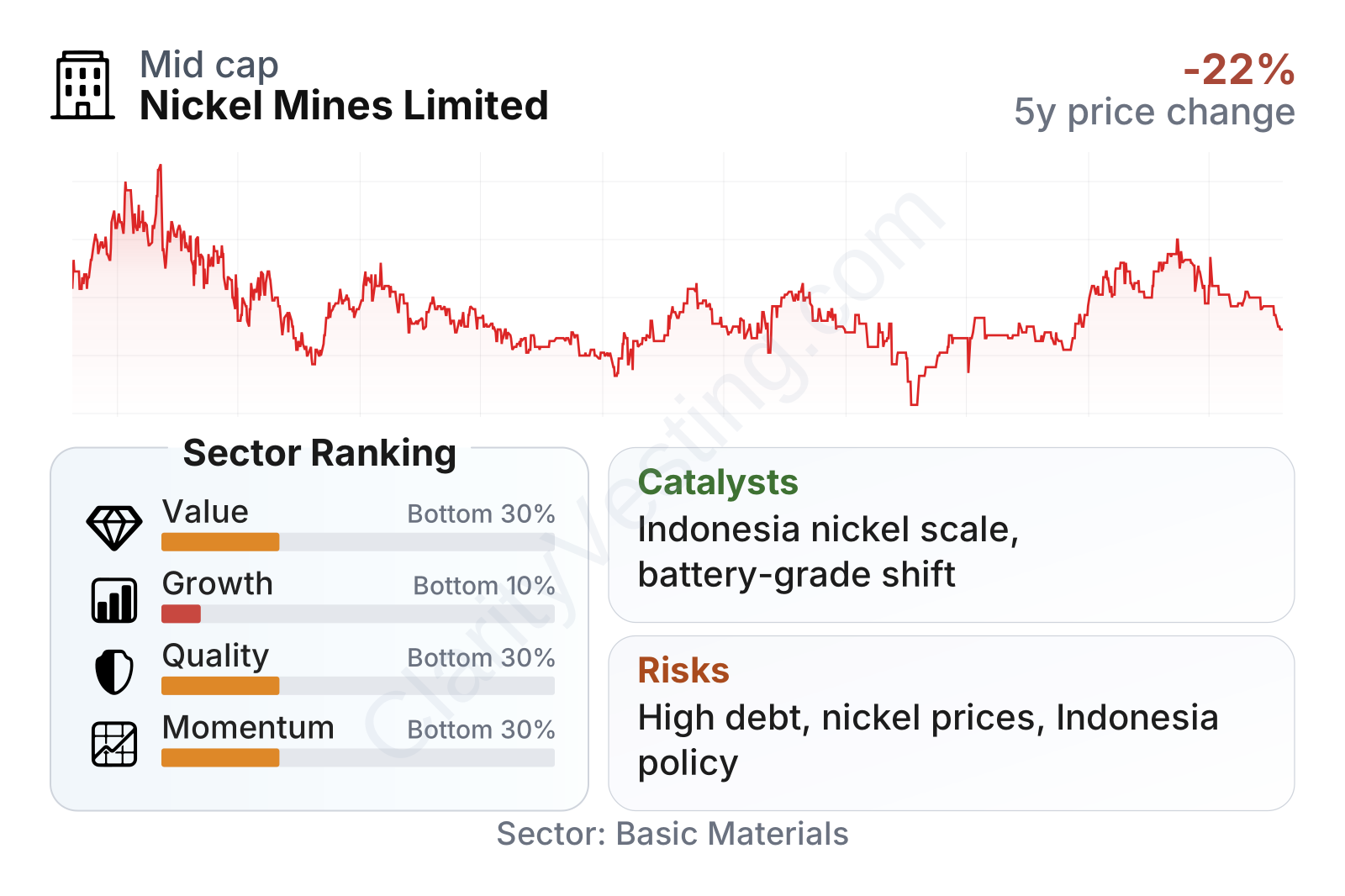
Nickel Mines sits in the mid-cap range and its share price history has been volatile, which is typical for a miner exposed to a single major commodity. The stock has recovered from prior lows, but recent momentum has been weaker than the broader materials sector, and it remains below its long-term trend line.
The valuation picture is mixed rather than obviously cheap. The price-to-book ratio is below the sector median, and free cash flow yield is around the sector median, which suggests the market is not assigning an aggressive valuation to the asset base. However, earnings-based measures are less flattering because current profitability is under pressure.
On growth, the company still shows respectable top-line expansion over one year and a strong five-year revenue-per-share record. The problem is that this growth has not translated cleanly into better recent margins, book value growth, or free cash flow growth. Quality indicators also point to strain: return on assets is negative, leverage is above sector norms, and interest coverage is thin. In other words, the company has grown output and scale, but its current financial resilience looks weaker than the better-positioned peers in the sector.
Growth
Nickel remains part of a structurally important market. Stainless steel is still the largest source of demand, while batteries add a second long-term demand engine, even if battery chemistry trends can shift over time. Indonesia has become the center of new nickel supply, and Nickel Mines is positioned directly inside that expansion zone. That geographic positioning is one of the company’s strongest growth arguments.
The strategy also has a clear industrial logic. Rather than remaining only a producer of lower-value nickel units, the company has been trying to move further into processing and battery-linked intermediates. If executed well, that can support better product mix, closer links to electric vehicle supply chains, and a larger role in a market that increasingly values downstream capability rather than just ore extraction.
A second important catalyst is operating scale. The company has repeatedly increased its exposure to producing assets through acquisitions and project participation inside integrated Indonesian industrial parks. That can create economies of scale in logistics, processing, and infrastructure. In mining, size often matters because fixed costs can be spread across larger output volumes.
Recent company communications have continued to emphasize optimization, ramp-up of downstream assets, and a stronger focus on battery-material relevance. If nickel prices stabilize or improve from depressed levels, the operational leverage could be meaningful because the company already has a large production base. In that scenario, revenue growth would not need to come only from new projects; improved pricing and better margins could also contribute.
The main point for long-term analysis is that Nickel Mines operates in a sector with genuine long-range relevance, but the path is cyclical. The opportunity is tied to global nickel demand and Indonesia’s role in supply. The company’s growth plan makes strategic sense, yet it depends on whether downstream expansion ultimately produces more durable profits rather than simply more volume.
Risks
This article is for informational purposes only and does not constitute financial advice. Some content is AI-generated. See Disclaimer


