Stock Analysis · Nicolet Bankshares Inc (NIC)
Overview
Nicolet Bankshares Inc. is the holding company for Nicolet National Bank, a regional bank based in Wisconsin. It focuses on traditional community banking: taking deposits, making loans, offering treasury and cash-management services to businesses, and providing wealth management and retirement plan services. Its footprint is centered on Wisconsin, Michigan, and parts of Minnesota, giving it a strong presence in Upper Midwest markets where local relationships still matter in banking.
For a bank, revenue does not work like it does for an industrial or retail company. The main driver is usually the spread between what the bank earns on loans and securities and what it pays on deposits and borrowings. Nicolet’s revenue mix is therefore led by net interest income, with fee-based businesses adding diversification.
The main sources of revenue appear to be:
- Net interest income: approximately 80% to 90% of total revenue in recent periods. This is the income earned from commercial loans, commercial real estate loans, residential real estate loans, agricultural lending, and investment securities, after funding costs.
- Wealth management and fiduciary fees: a mid-single to low-double-digit share depending on the period. This includes trust, investment management, retirement plan, and related advisory services.
- Service charges and other bank fees: a smaller but recurring contribution. This generally includes deposit account fees, treasury management, card-related income, and loan-related charges.
- Mortgage banking, insurance-related commissions, and other noninterest income: usually the smallest bucket and more variable from quarter to quarter.
Nicolet has also grown through acquisitions, which has increased its asset base and expanded its customer reach. That matters because a regional bank can create value not only by opening branches, but also by absorbing smaller institutions and then spreading fixed costs across a larger balance sheet.
The long-term operating picture has improved meaningfully since 2021. Total revenue has more than doubled over that period, while net income also moved materially higher despite a difficult bank environment in 2023. Another notable point is that operating profitability has stayed healthy even as funding costs rose.
The business has become much larger over the last several years, with revenue and earnings expanding faster than operating expenses. That suggests recent growth has not been purely cosmetic; scale appears to be helping efficiency as well.
Key Figures
| Metric | Value | Sector ⓘ |
|---|---|---|
| Date | Oct 24, 2026 | |
| Context | ||
| Sector | Financial Services | |
| Industry | Banks - Regional | |
| Market Cap ⓘ | $3.47B | |
| Beta ⓘ | 0.64 | |
Value (Cheapness) | ||
| P/E Ratio ⓘ | 17.99 | 12.46 |
| P/B Ratio ⓘ | 1.16 | 1.25 |
| FCF Yield ⓘ | 5.05% | 9.82% |
| Dividend Yield ⓘ | 0.83% | 2.94% |
| EBIT / EV ⓘ | 6.36% | 8.11% |
| PEG ⓘ | 1.92 | |
Growth (Business expansion) | ||
| Revenue Growth ⓘ | 69.20% | 9.10% |
| RPS Growth (5Y CAGR) ⓘ | 13.72% | 12.31% |
| EPS Growth (5Y CAGR) ⓘ | 6.79% | -6.97% |
| BVPS Growth (5Y CAGR) ⓘ | 0.50% | 5.02% |
| Margin Growth (5Y Trend) ⓘ | -0.10% | -4.00% |
| FCF Growth (5Y CAGR) ⓘ | 15.20% | 4.71% |
| DPS Growth (5Y CAGR) ⓘ | -54.48% | 8.92% |
Quality (Business durability) | ||
| ROIC (Latest) ⓘ | 8.17% | 9.18% |
| ROE (Latest) ⓘ | 10.09% | 13.93% |
| ROA (Latest) ⓘ | 1.45% | 1.57% |
| ROIC (5Y Median) ⓘ | 8.48% | 7.80% |
| ROE (5Y Median) ⓘ | 10.11% | 12.15% |
| ROA (5Y Median) ⓘ | 1.15% | 1.28% |
| Net Debt / EBIT (Latest) ⓘ | 10.06 | 1.02 |
| Net Debt / EBIT (5Y Median) ⓘ | -2.81 | 0.72 |
| Net Debt / EBITDA (Latest) ⓘ | -1.82 | 0.88 |
| Operating Margin (Latest) ⓘ | 37.07% | 22.30% |
| Operating Margin (5Y Median) ⓘ | 33.83% | 24.50% |
| Debt to Equity (Latest) ⓘ | 4.15% | 59.34% |
| Profit Margin (Latest) ⓘ | 30.33% | 26.42% |
| Free Cash Flow (Latest) ⓘ | $175.30M | |
Momentum (Price trend) | ||
| 3Y Return ⓘ | +156.87% | +95.73% |
| 12M Return (excl. last month) ⓘ | +27.34% | +17.30% |
| 6M Return ⓘ | +19.30% | +6.07% |
| Price vs. 200-Day MA ⓘ | +9.30% | +5.36% |
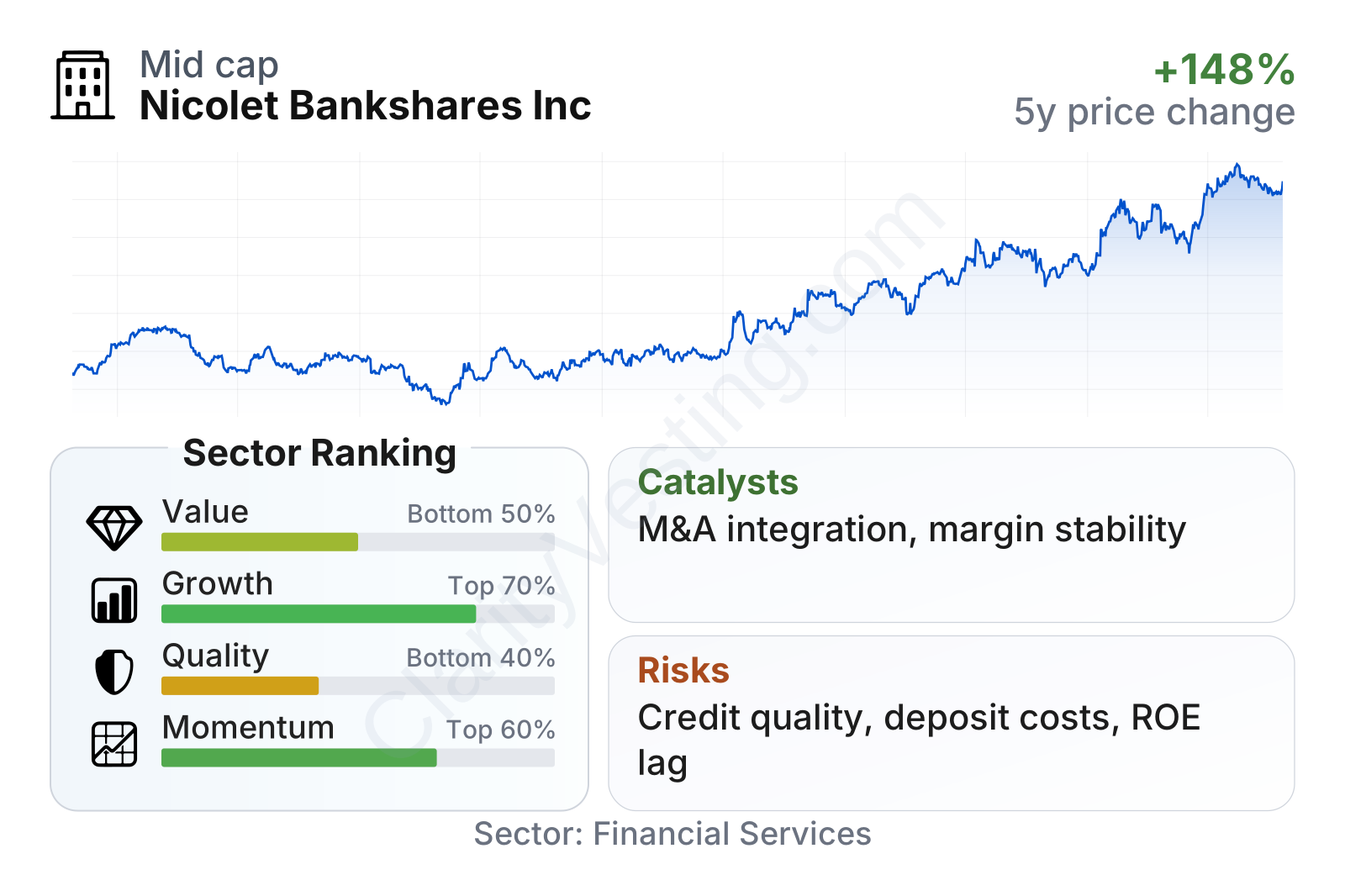
Nicolet sits in the mid-cap range for a regional bank and has shown relatively low share-price volatility, with a beta well below 1. The factor profile is mixed: growth and momentum rank better than much of the sector, while value looks less compelling on earnings-based measures and quality is weaker than the industry median on returns such as ROE and ROA. In simple terms, the market is recognizing the company’s expansion and stock performance, but it is not treating the shares like a bargain on current earnings.
The stock’s multi-year climb has been strong, especially after the 2023 regional bank stress period. That recovery points to confidence in the franchise, integration progress, and earnings resilience rather than to income appeal, since the dividend yield remains far below the sector median.
Growth
Regional banking is not a high-growth industry in the way software or semiconductors can be, but well-run banks can still compound value for years through loan growth, market-share gains, acquisitions, fee income expansion, and disciplined underwriting. Nicolet operates in a mature sector, yet its specific markets still offer room for consolidation. Community and regional banks continue to face scale pressure from regulation, technology spending, and deposit competition, which can create acquisition opportunities for stronger players.
Nicolet’s strategy is sensible for that environment. It combines local commercial banking relationships with selective acquisitions and a growing fee-based platform. The wealth and retirement services businesses are especially important because they can deepen customer ties and make revenue less dependent on interest rates alone.
Earnings per share have generally trended upward over the last several years, with a setback in 2023 followed by a sharp rebound in 2024 and 2025. That pattern fits what many banks experienced as deposit costs rose quickly after rates increased. The key point is that Nicolet did not stay stuck at the lower level; profitability recovered.
Book value per share fell sharply in 2022, then rebuilt over the following years. For banks, book value matters because it reflects the capital base supporting lending activity. The recovery after 2022 suggests balance-sheet rebuilding rather than long-term erosion, although the five-year compounding rate remains modest compared with many peers.
A strong recent catalyst has been acquisition-led expansion. Nicolet completed larger bank combinations over the past few years, which helped lift assets, deposits, and earnings power. When integration goes well, this can produce a better efficiency ratio, a larger commercial lending platform, and more room to spread technology and compliance costs.
Another growth support is the interest-rate backdrop. If loan yields remain healthy while deposit pricing stabilizes, net interest margin can benefit. At the same time, if rates eventually move lower, pressure on borrowers with floating-rate debt could ease, potentially supporting credit quality and new loan demand. Neither outcome removes risk, but both can create a better operating environment than the one banks faced during the most intense funding-cost reset.
Recent operating momentum also stands out. Revenue growth has been far ahead of the sector median, and free cash flow growth over five years has also outpaced many peers. That does not mean every year will look this strong, but it does show Nicolet has recently been operating from a position of expansion rather than stagnation.
Risks
This article is for informational purposes only and does not constitute financial advice. Some content is AI-generated. See Disclaimer


