Stock Analysis · New Hope Corporation Ltd (NHPEF)
Overview
New Hope Corporation Ltd is an Australian coal producer focused on thermal coal, the type mainly used for electricity generation. The company owns and operates coal mines, sells coal to export and domestic customers, and also has related activities such as port access, rail logistics exposure, and project development. Its core operations are in Queensland and New South Wales, and its earnings are tied largely to how much coal it sells, the prices it receives, and the cost of extracting and transporting each ton.
For a simple long-term view, this is not a diversified energy company. It is primarily a coal business, which means the investment case depends heavily on coal market conditions, mine life, production discipline, and regulation. Public company materials describe a portfolio centered on producing and marketing thermal coal, with development options that can extend output over time.
The main revenue sources are concentrated and can be understood as follows:
- Thermal coal sales: approximately 90%+ of revenue. This includes export coal shipments and domestic supply agreements from the company’s operating mines.
- Other mining and related revenue: low single-source contribution without precise public breakout. This can include ancillary services, infrastructure-related arrangements, and other smaller operating items.
- Investment and non-operating income: limited contribution. This is not the main driver of the business and tends to be much less important than coal production and realized coal prices.
Revenue has stayed around the same broad level in the last three reported years, but profitability has clearly compressed from the unusually strong coal-price period. The operating picture has shifted from very high margins in 2022 and 2023 to much slimmer earnings in 2026, showing how strongly this business responds to commodity prices and cost inflation.
The business still converts a meaningful share of sales into operating profit, but the direction has weakened. Revenue has been relatively steady since 2024, while gross profit, operating income, and net income have fallen sharply from peak conditions. That suggests price normalization and cost pressure matter more here than simple sales volume.
Key Figures
| Metric | Value | Sector ⓘ |
|---|---|---|
| Date | Oct 17, 2026 | |
| Context | ||
| Sector | Energy | |
| Industry | Thermal Coal | |
| Market Cap ⓘ | $3.60B | |
| Beta ⓘ | -0.44 | |
Value (Cheapness) | ||
| P/E Ratio ⓘ | 32.38 | 15.44 |
| P/B Ratio ⓘ | 1.45 | 1.73 |
| FCF Yield ⓘ | 17.52% | 8.20% |
| Dividend Yield ⓘ | 9.52% | 3.59% |
| EBIT / EV ⓘ | N/A | 7.46% |
| PEG ⓘ | N/A | |
Growth (Business expansion) | ||
| Revenue Growth ⓘ | 25.90% | 26.90% |
| RPS Growth (5Y CAGR) ⓘ | -6.47% | 6.90% |
| EPS Growth (5Y CAGR) ⓘ | N/A | -15.73% |
| BVPS Growth (5Y CAGR) ⓘ | 5.52% | 6.07% |
| Margin Growth (5Y Trend) ⓘ | -40.51% | 0.58% |
| FCF Growth (5Y CAGR) ⓘ | N/A | 1.86% |
| DPS Growth (5Y CAGR) ⓘ | -7.09% | 16.79% |
Quality (Business durability) | ||
| ROIC (Latest) ⓘ | N/A | 11.40% |
| ROA (Latest) ⓘ | 16.72% | 6.06% |
| ROIC (5Y Median) ⓘ | 28.99% | 10.30% |
| ROA (5Y Median) ⓘ | 14.18% | 5.42% |
| Net Debt / EBIT (Latest) ⓘ | -0.11 | 1.64 |
| Net Debt / EBIT (5Y Median) ⓘ | -0.33 | 1.83 |
| Net Debt / EBITDA (Latest) ⓘ | -0.07 | 1.08 |
| Net Debt / Assets ⓘ | -2.64% | 17.29% |
| EBITDA / Interest ⓘ | 23.53 | 9.64 |
| Operating Margin (Latest) ⓘ | 25.99% | 16.27% |
| Operating Margin (5Y Median) ⓘ | 39.98% | 20.39% |
| Debt to Equity (Latest) ⓘ | 14.89% | 54.76% |
| Profit Margin (Latest) ⓘ | 9.11% | 8.82% |
| Free Cash Flow (Latest) ⓘ | $631.58M | |
Momentum (Price trend) | ||
| 3Y Return ⓘ | +73.26% | +67.38% |
| 12M Return (excl. last month) ⓘ | +68.59% | +49.19% |
| 6M Return ⓘ | +23.67% | +7.07% |
| Price vs. 200-Day MA ⓘ | +29.09% | +9.56% |
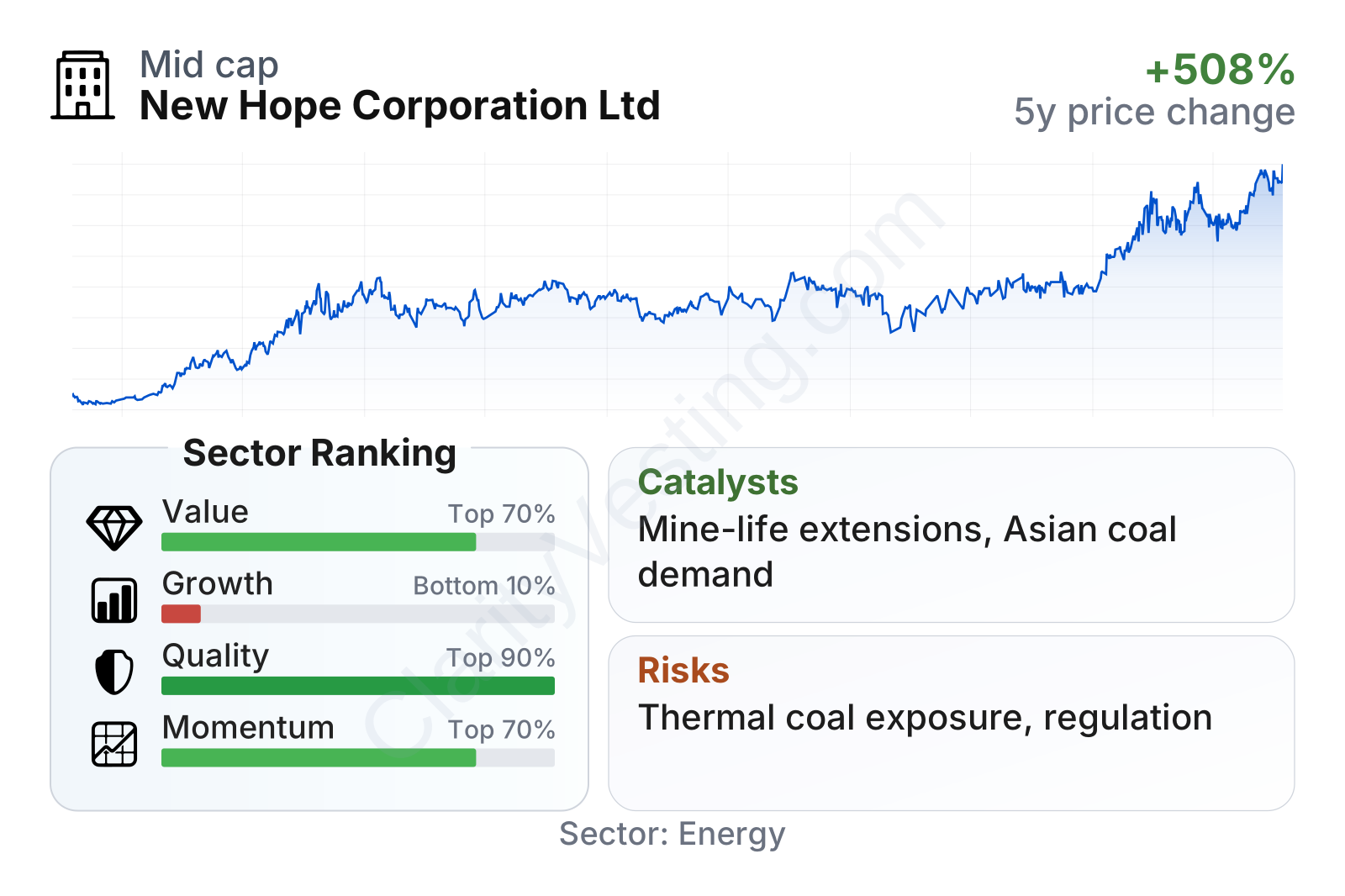
New Hope is a mid-sized coal producer with an unusual mix of strengths and weaknesses. On quality, it stands out: returns on assets are well above the sector median, operating margins are still better than many peers, and balance-sheet leverage is very low. Net debt metrics are negative, which usually means the company is holding more cash than debt on a net basis. Interest coverage is also strong, so the financial structure looks conservative.
On value, the picture is mixed. The earnings multiple is above the sector median, which can make the stock look less cheap on a headline basis. At the same time, free-cash-flow yield and dividend yield are much stronger than typical sector levels, pointing to substantial cash generation relative to the current market value. Book value is also not stretched compared with peers.
Growth is the weakest part of the profile. Recent year-over-year revenue growth has been decent, but the longer five-year record is softer, with revenue per share declining and operating margins trending down from exceptional earlier levels. Momentum has been better, with the share price well above its longer-term average and a strong move over the past year, although long-term operating growth does not look as strong as recent market performance.
Growth
New Hope operates in a sector with a split long-term outlook. Thermal coal faces structural pressure in many developed markets because utilities and governments continue shifting toward lower-emission power generation. That is a real headwind over a long investment horizon. However, the picture is not uniform globally. Coal demand remains more durable in parts of Asia where power affordability, grid reliability, and domestic energy security still support ongoing imports. For a producer like New Hope, this means the sector is not a broad secular growth market, but it can still offer periods of strong cash generation when supply stays tight and Asian demand holds up.
The company’s strategy is sensible within that context. It has focused on operating established assets, maintaining a strong balance sheet, returning cash when conditions allow, and progressing mine-life extensions and development options rather than pursuing a highly leveraged expansion model. That approach matters in a cyclical commodity business because it lowers the chance that the company is forced into weak decisions during downturns.
A meaningful catalyst is reserve and production visibility. Long-life assets and approved or advancing project pathways can support continued shipments even if individual mines mature. Another catalyst is any tightening in seaborne thermal coal supply, whether from underinvestment, permitting delays, or disruptions among competitors. In those periods, producers with export capacity and existing infrastructure can benefit quickly.
Recent public company updates have also highlighted continued operating activity across key mines and project development work tied to future output continuity. For long-term analysis, the most significant opportunity is not rapid transformation into a new business line; it is the ability to preserve profitable production, extend mine life, and keep generating cash in a market where reliable supply can still command attractive pricing.
Risks
This article is for informational purposes only and does not constitute financial advice. Some content is AI-generated. See Disclaimer


