Stock Analysis · National Health Investors Inc (NHI)
Overview
National Health Investors Inc. is a healthcare real estate investment trust, or REIT. In simple terms, it owns healthcare-related properties and collects rent or interest income from operators that run the facilities. Its portfolio is focused on senior housing and skilled nursing, with additional exposure to other healthcare property types and real estate loans.
The company’s business model is built around long-duration healthcare demand rather than direct medical operations. NHI generally does not run the facilities itself. Instead, it provides the real estate and financing, while tenants and operators handle resident care, staffing, and day-to-day operations. That structure can create relatively steady cash generation when properties are well occupied and tenants remain financially healthy.
Based on recent company filings, revenue is mainly generated from the following sources:
- Rental income from senior housing properties: the largest source, coming from properties such as independent living, assisted living, and memory care communities operated by third parties.
- Rental income from skilled nursing facilities: another major source tied to nursing and post-acute care properties leased to operators.
- Interest income from mortgage and other notes receivable: income earned when NHI finances healthcare real estate rather than owning it outright.
- Other healthcare real estate income: includes smaller contributions from specialty hospitals, medical office-related assets, entrance fee communities, and other structured healthcare real estate arrangements.
In broad terms, senior housing appears to represent the largest economic exposure in the portfolio, followed by skilled nursing, with loans and smaller specialty categories making up the balance. The mix matters because private-pay senior housing is usually tied more to demographics and occupancy trends, while skilled nursing can be more influenced by government reimbursement and operator cost pressures.
NHI remains a mid-sized healthcare REIT, large enough to be diversified across operators and property types, but still much smaller than the biggest names in the sector. That can make execution, tenant selection, and balance sheet discipline especially important.
The long-term picture shows revenue and operating income generally moving higher from 2022 through 2025, with margins staying strong. Some 2025 line items appear unusually distorted compared with prior years, so the clearest takeaway is the broader trend: the company has rebuilt earnings power after the weaker 2022 period and continues to convert a large share of revenue into operating profit.
Key Figures
| Metric | Value | Sector ⓘ |
|---|---|---|
| Date | Oct 17, 2026 | |
| Context | ||
| Sector | Real Estate | |
| Industry | REIT - Healthcare Facilities | |
| Market Cap ⓘ | $3.23B | |
| Beta ⓘ | 0.52 | |
Value (Cheapness) | ||
| P/E Ratio ⓘ | 18.98 | 17.38 |
| P/B Ratio ⓘ | 2.05 | 0.85 |
| FCF Yield ⓘ | 7.31% | 7.38% |
| Dividend Yield ⓘ | 5.63% | 4.85% |
| EBIT / EV ⓘ | 4.91% | 3.78% |
| PEG ⓘ | 4.76 | |
Growth (Business expansion) | ||
| Revenue Growth ⓘ | 33.80% | 5.30% |
| RPS Growth (5Y CAGR) ⓘ | 5.35% | 6.02% |
| EPS Growth (5Y CAGR) ⓘ | N/A | -11.37% |
| BVPS Growth (5Y CAGR) ⓘ | -0.77% | 0.45% |
| Margin Growth (5Y Trend) ⓘ | -1.26% | -0.22% |
| FCF Growth (5Y CAGR) ⓘ | 1.10% | 5.40% |
| DPS Growth (5Y CAGR) ⓘ | -2.55% | 5.02% |
Quality (Business durability) | ||
| ROIC (Latest) ⓘ | 7.37% | 5.69% |
| ROE (Latest) ⓘ | 11.05% | 7.56% |
| ROA (Latest) ⓘ | 5.90% | 2.85% |
| ROIC (5Y Median) ⓘ | 5.56% | 4.22% |
| ROE (5Y Median) ⓘ | 9.96% | 6.03% |
| ROA (5Y Median) ⓘ | 5.25% | 2.44% |
| Net Debt / EBIT (Latest) ⓘ | 5.61 | 7.59 |
| Net Debt / EBIT (5Y Median) ⓘ | 5.86 | 8.40 |
| Net Debt / EBITDA (Latest) ⓘ | 3.97 | 5.27 |
| Net Debt / Assets ⓘ | 42.31% | 37.76% |
| EBITDA / Interest ⓘ | 5.51 | 4.10 |
| Operating Margin (Latest) ⓘ | 51.54% | 35.29% |
| Operating Margin (5Y Median) ⓘ | 53.61% | 37.31% |
| Debt to Equity (Latest) ⓘ | 81.74% | 88.87% |
| Profit Margin (Latest) ⓘ | 38.28% | 19.61% |
| Free Cash Flow (Latest) ⓘ | $235.71M | |
Momentum (Price trend) | ||
| 3Y Return ⓘ | +53.70% | +30.75% |
| 12M Return (excl. last month) ⓘ | -7.92% | +4.36% |
| 6M Return ⓘ | -20.99% | -2.52% |
| Price vs. 200-Day MA ⓘ | -12.56% | -2.34% |
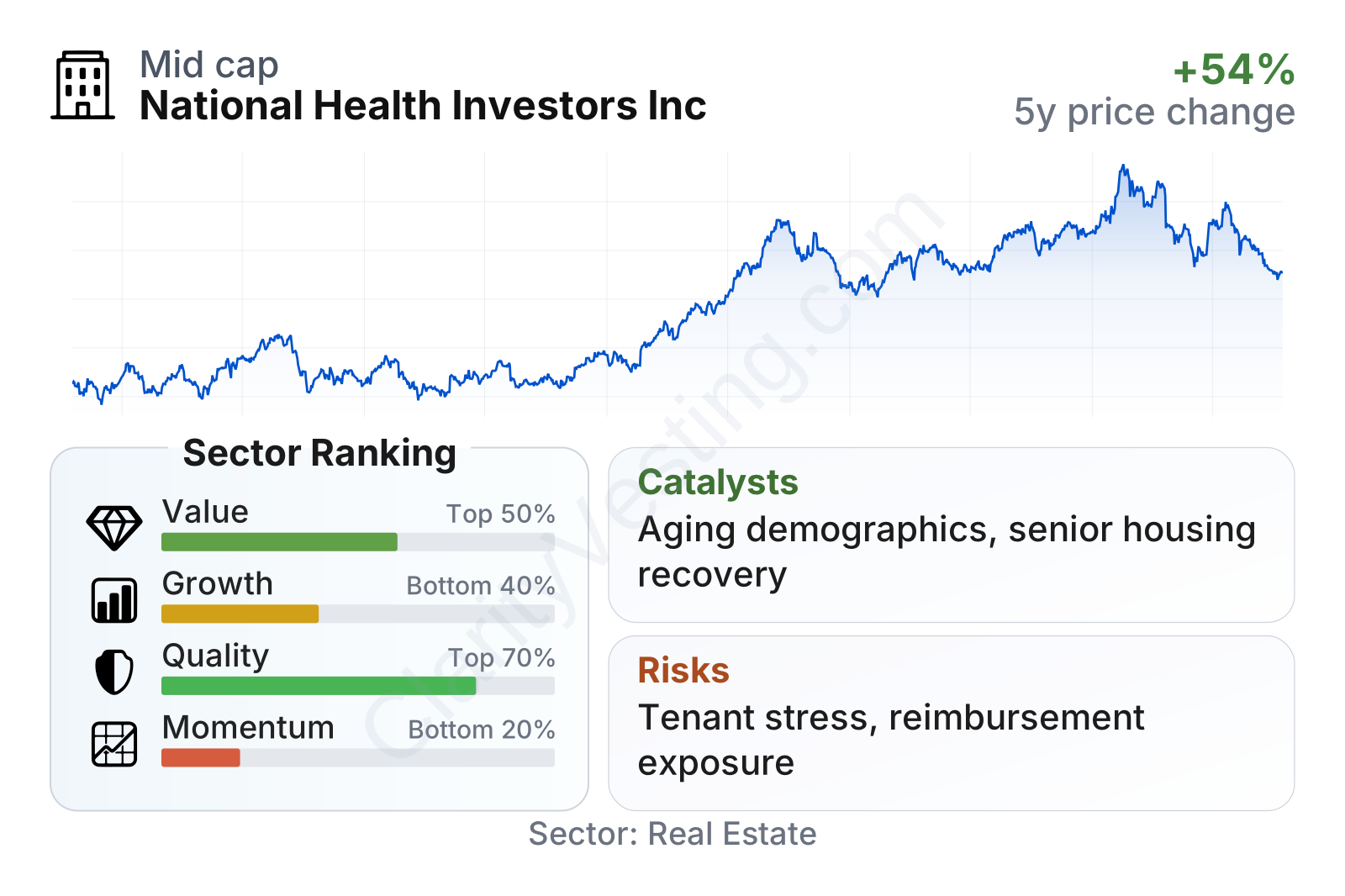
NHI combines solid profitability with moderate valuation signals. Quality metrics stand out: returns on assets, equity, and invested capital are all above sector medians, while leverage is below many peers on net debt to EBITDA. The weaker areas are growth and recent market momentum. Revenue has recently accelerated, but the longer five-year pattern is more modest, and dividend growth has not kept pace with many healthcare REIT peers.
The stock price trend over the last several years has been strong overall despite a recent pullback. That combination often reflects a company that has already regained market confidence, but is now being judged more carefully on whether operating gains can continue.
Growth
NHI operates in a sector with favorable long-term demand drivers. An aging U.S. population should support need for senior housing, assisted living, memory care, and skilled nursing over time. That does not guarantee smooth results each year, but the demographic backdrop is one of the clearest supports for healthcare real estate.
The company’s strategy is also fairly logical for this environment. NHI focuses on partnering with operators, recycling capital, using selective acquisitions and loans, and keeping a manageable balance sheet rather than chasing growth at any cost. For a healthcare REIT, that approach can be more durable than relying heavily on aggressive debt-funded expansion.
Revenue per share has moved upward over the past several years, with a dip in 2022 followed by recovery and continued improvement. That matters because it suggests that recent growth has not come only from issuing more shares; the business has also been generating more revenue on a per-share basis.
The dividend record is more mixed. The annual dividend per share declined from 2021 levels and has only partly stabilized since then. Even so, the current yield remains above the sector median, which shows that income is still a meaningful part of the company’s profile, but the slower dividend progression suggests management remains cautious.
One important catalyst is the ongoing normalization in senior housing operations across the industry. As occupancy improves and rent coverage strengthens for operators, landlords like NHI can benefit through steadier collections, lease restructurings on better terms, and additional investment opportunities. Another potential support is the company’s ability to originate loans or acquire properties when smaller owners or stressed operators need capital.
Recent company updates have also pointed to continued portfolio management activity, including investments, tenant transitions, and efforts to improve rent coverage and operator quality. For NHI, these items are especially relevant because future performance depends less on dramatic innovation and more on disciplined allocation of capital into properties and operators that can withstand labor, reimbursement, and occupancy swings.
Risks
This article is for informational purposes only and does not constitute financial advice. Some content is AI-generated. See Disclaimer


