Stock Analysis · Ingevity Corp (NGVT)
Overview
Ingevity is a specialty chemicals company that develops performance materials used in transportation, industrial, and pavement-related applications. Its products are designed to solve practical problems such as reducing vehicle emissions, improving fuel efficiency, controlling vapor emissions, and helping roads last longer. The company has historically been closely tied to the automotive market, especially through activated carbon products used in gasoline vapor emission control systems.
Based on its recent annual reporting structure, Ingevity’s revenue comes mainly from two operating segments.
- Performance Materials: about 55% to 60% of revenue in recent years. This segment includes activated carbon products used in automotive emission-control systems, as well as other engineered carbons and related materials.
- Performance Chemicals: about 40% to 45% of revenue in recent years. This business includes specialty chemicals largely serving pavement technologies and industrial applications, including products used in asphalt and road construction.
The business mix matters because it combines a relatively established automotive emissions franchise with a more cyclical chemicals portfolio tied to infrastructure and industrial demand. Over the last several years, sales reached a high point in 2023 before dropping meaningfully in 2024 and again in 2025, while profitability was pressured much more sharply than revenue. Costs of goods sold have come down with lower sales, but operating income and net income have been far more volatile, showing that the company’s earnings power is still recovering rather than steadily expanding.
The long-term pattern shows a business that can still produce solid gross profit, but earnings below that line have become less stable because of weaker volumes, restructuring effects, and higher financing burden. That makes segment quality and balance-sheet repair especially important to the long-term case.
Key Figures
| Metric | Value | Sector ⓘ |
|---|---|---|
| Date | Oct 17, 2026 | |
| Context | ||
| Sector | Basic Materials | |
| Industry | Specialty Chemicals | |
| Market Cap ⓘ | $2.41B | |
| Beta ⓘ | 1.14 | |
Value (Cheapness) | ||
| P/E Ratio ⓘ | 98.70 | 16.90 |
| P/B Ratio ⓘ | 53.24 | 1.65 |
| FCF Yield ⓘ | 6.43% | 5.76% |
| Dividend Yield ⓘ | N/A | 2.13% |
| EBIT / EV ⓘ | 2.59% | 6.30% |
| PEG ⓘ | 2.41 | |
Growth (Business expansion) | ||
| Revenue Growth ⓘ | -5.20% | 11.10% |
| RPS Growth (5Y CAGR) ⓘ | -1.84% | 4.49% |
| EPS Growth (5Y CAGR) ⓘ | -17.74% | -13.47% |
| BVPS Growth (5Y CAGR) ⓘ | -53.00% | 5.51% |
| Margin Growth (5Y Trend) ⓘ | -21.32% | -1.54% |
| FCF Growth (5Y CAGR) ⓘ | 9.61% | 0.37% |
| DPS Growth (5Y CAGR) ⓘ | -26.19% | 6.08% |
Quality (Business durability) | ||
| ROIC (Latest) ⓘ | 4.91% | 9.26% |
| ROA (Latest) ⓘ | 3.20% | 4.91% |
| ROIC (5Y Median) ⓘ | 3.63% | 7.70% |
| ROA (5Y Median) ⓘ | -0.20% | 3.86% |
| Net Debt / EBIT (Latest) ⓘ | 12.19 | 1.40 |
| Net Debt / EBIT (5Y Median) ⓘ | 4.54 | 1.70 |
| Net Debt / EBITDA (Latest) ⓘ | 5.87 | 0.95 |
| Net Debt / Assets ⓘ | 74.07% | 13.69% |
| EBITDA / Interest ⓘ | 2.88 | 12.34 |
| Operating Margin (Latest) ⓘ | 8.05% | 13.20% |
| Operating Margin (5Y Median) ⓘ | 4.92% | 11.80% |
| Debt to Equity (Latest) ⓘ | 2636.03% | 40.56% |
| Profit Margin (Latest) ⓘ | 4.65% | 6.43% |
| Free Cash Flow (Latest) ⓘ | $154.90M | |
Momentum (Price trend) | ||
| 3Y Return ⓘ | +73.66% | +68.89% |
| 12M Return (excl. last month) ⓘ | +17.37% | +30.21% |
| 6M Return ⓘ | -8.39% | -4.16% |
| Price vs. 200-Day MA ⓘ | -0.79% | -1.27% |
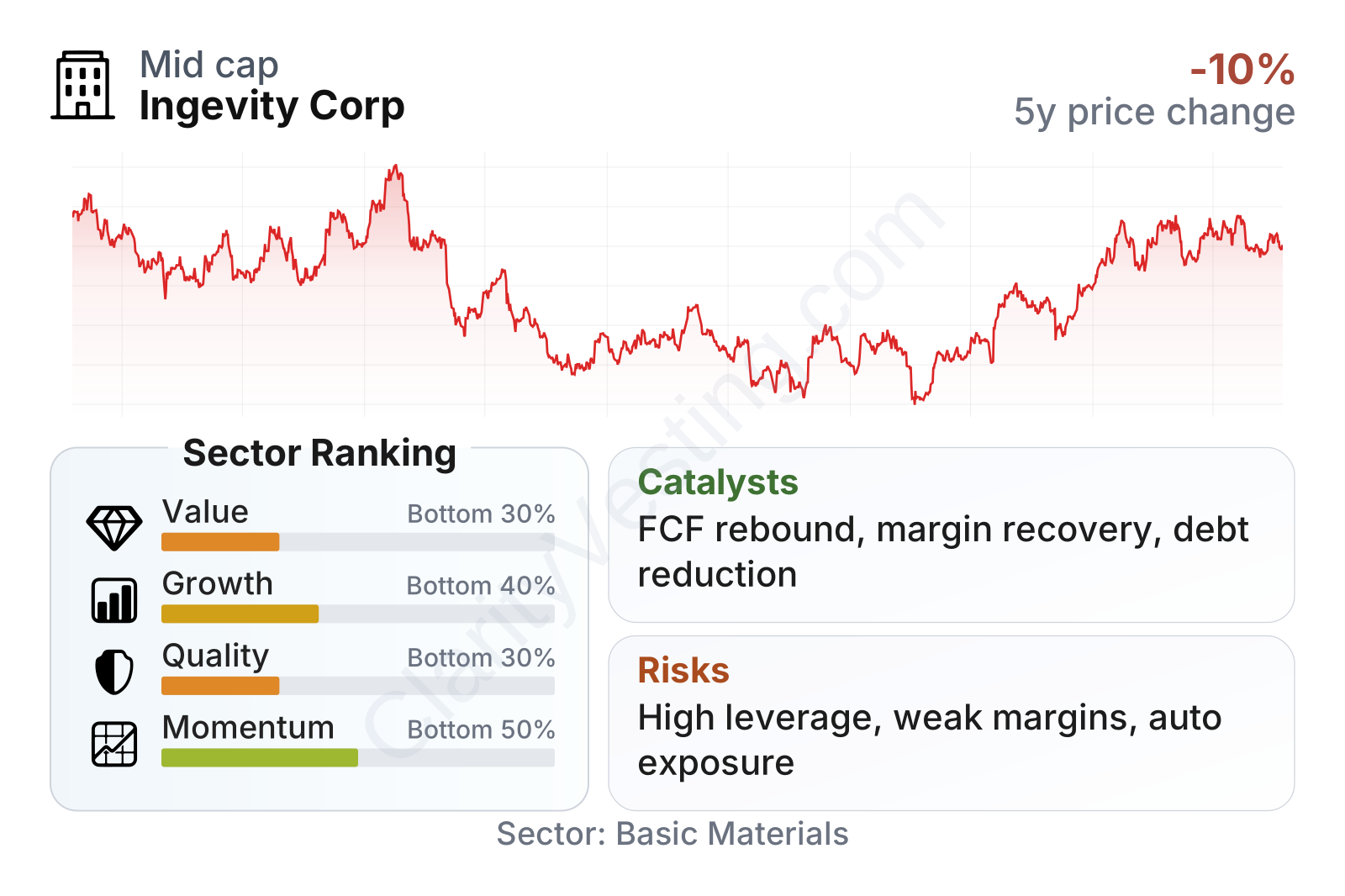
Ingevity is a mid-sized specialty chemicals company with a stock that has been noticeably volatile over the last several years. The factor breakdown is mixed, but the overall picture leans weak relative to much of the Basic Materials sector. Value metrics look unattractive on earnings and book value, while growth and quality both rank in the lower part of the peer group. One brighter point is cash generation: free cash flow yield is around the sector median to slightly better, and longer-term free cash flow growth has held up better than revenue or earnings trends. That suggests the market is weighing current operational strain against the company’s ability to still generate cash.
Growth
Ingevity operates in parts of the specialty chemicals market that still have long-term relevance, but the growth profile is not especially straightforward. The company’s automotive emissions products serve a mature market rather than a high-growth one, yet that niche can remain durable because evaporative emission regulations still require technical performance and validated supply relationships. Its pavement technologies and industrial chemicals can benefit from infrastructure activity, roadway maintenance, and demand for higher-performance materials, but those areas also tend to move with broader industrial cycles.
The company’s strategy is centered less on rapid expansion and more on improving mix, protecting its technical positions, and restoring profitability after a difficult stretch. That approach makes sense given recent results. Ingevity does not need a dramatic new market to improve; it needs steadier execution, better margins, and continued debt reduction. If management can improve utilization and pricing discipline while focusing on higher-value applications, even modest sales stabilization could have an outsized effect on earnings.
Revenue momentum has clearly been under pressure. After strong growth in 2022, sales turned negative in late 2023 and remained negative through 2024, 2025, and into 2026. That does not support a near-term high-growth narrative. However, the pattern also suggests the business has been cycling through a prolonged downturn rather than a single bad quarter, so any normalization in end markets could become meaningful for comparisons.
Cash generation has been a more constructive part of the picture. Free cash flow dipped materially in 2024, then improved again, with a strong rebound by early 2026. That matters because it gives the company more flexibility to reduce leverage, support restructuring, and absorb earnings volatility. For a business in recovery mode, sustained cash flow improvement is often a more important milestone than headline revenue growth.
A practical catalyst is the company’s continued emphasis on operational improvement and portfolio focus. If automotive demand remains stable and pavement-related demand improves alongside public infrastructure spending, Ingevity has room to recover from depressed profitability. The most significant recent opportunity is not a single breakthrough product but the possibility of earnings normalization after several years of disruption.
Risks
This article is for informational purposes only and does not constitute financial advice. Some content is AI-generated. See Disclaimer


