Stock Analysis · Anglo American PLC (NGLOY)
Overview
Anglo American PLC is a global mining company that produces raw materials used in steelmaking, construction, transportation, agriculture, and electrification. Its portfolio is spread across copper, iron ore, metallurgical coal, diamonds, platinum group metals, nickel, manganese, and crop nutrients. In recent years, management has been reshaping the business to focus more on metals with stronger long-term demand, especially copper and high-quality iron ore, while reducing exposure to businesses viewed as less strategic.
The company’s revenue is driven mainly by commodity sales, so the mix changes from year to year depending on production levels and market prices. Based on recent annual reporting, the main revenue sources are approximately the following:
- Copper: about 25%–30% — mined copper used in power networks, electric vehicles, renewable energy systems, and industrial equipment.
- Iron ore: about 20%–25% — primarily premium iron ore products from Kumba Iron Ore in South Africa and Minas-Rio in Brazil, used in steelmaking.
- Platinum group metals: about 15%–20% — platinum, palladium, rhodium, and related metals used in automotive catalysts, jewelry, and industrial applications.
- Diamonds: about 10%–15% — through De Beers, covering rough diamond mining and trading.
- Metallurgical coal: about 10%–15% — coal used mainly in steel production.
- Nickel, manganese, and other products: under 10% each — smaller but potentially useful exposures to battery materials and steel-related inputs.
This mix matters because copper and premium iron ore generally fit better with long-term trends such as electrification and cleaner steelmaking, while diamonds and platinum group metals have faced more uneven demand patterns.
The recent financial flow shows a business that once produced very strong profits at the commodity peak, but then went through a sharp earnings reset as revenue fell, operating income narrowed, and bottom-line results turned negative. That helps explain why the market now looks at Anglo American less as a steady compounder and more as a large, cyclical miner in the middle of a portfolio transition.
Key Figures
| Metric | Value | Sector ⓘ |
|---|---|---|
| Date | Oct 17, 2026 | |
| Context | ||
| Sector | Basic Materials | |
| Industry | Other Industrial Metals & Mining | |
| Market Cap ⓘ | $58.89B | |
| Beta ⓘ | 0.95 | |
Value (Cheapness) | ||
| P/E Ratio ⓘ | N/A | 16.90 |
| P/B Ratio ⓘ | 5.24 | 1.65 |
| FCF Yield ⓘ | 6.77% | 5.76% |
| Dividend Yield ⓘ | 0.71% | 2.13% |
| EBIT / EV ⓘ | 7.20% | 6.30% |
| PEG ⓘ | 3.02 | |
Growth (Business expansion) | ||
| Revenue Growth ⓘ | 10.90% | 11.10% |
| RPS Growth (5Y CAGR) ⓘ | -16.14% | 4.49% |
| EPS Growth (5Y CAGR) ⓘ | N/A | -13.47% |
| BVPS Growth (5Y CAGR) ⓘ | -17.18% | 5.51% |
| Margin Growth (5Y Trend) ⓘ | -21.55% | -1.54% |
| FCF Growth (5Y CAGR) ⓘ | -37.27% | 0.37% |
| DPS Growth (5Y CAGR) ⓘ | -44.59% | 6.08% |
Quality (Business durability) | ||
| ROIC (Latest) ⓘ | 6.89% | 9.26% |
| ROA (Latest) ⓘ | -11.37% | 4.91% |
| ROIC (5Y Median) ⓘ | 4.22% | 7.70% |
| ROA (5Y Median) ⓘ | 0.42% | 3.86% |
| Net Debt / EBIT (Latest) ⓘ | 1.76 | 1.40 |
| Net Debt / EBIT (5Y Median) ⓘ | 2.36 | 1.70 |
| Net Debt / EBITDA (Latest) ⓘ | 0.89 | 0.95 |
| Net Debt / Assets ⓘ | 14.57% | 13.69% |
| EBITDA / Interest ⓘ | 6.05 | 12.34 |
| Operating Margin (Latest) ⓘ | 11.53% | 13.20% |
| Operating Margin (5Y Median) ⓘ | 20.12% | 11.80% |
| Debt to Equity (Latest) ⓘ | 100.59% | 40.56% |
| Profit Margin (Latest) ⓘ | -13.94% | 6.43% |
| Free Cash Flow (Latest) ⓘ | $3.99B | |
Momentum (Price trend) | ||
| 3Y Return ⓘ | +79.18% | +68.89% |
| 12M Return (excl. last month) ⓘ | +51.30% | +30.21% |
| 6M Return ⓘ | +9.75% | -4.16% |
| Price vs. 200-Day MA ⓘ | +7.81% | -1.27% |
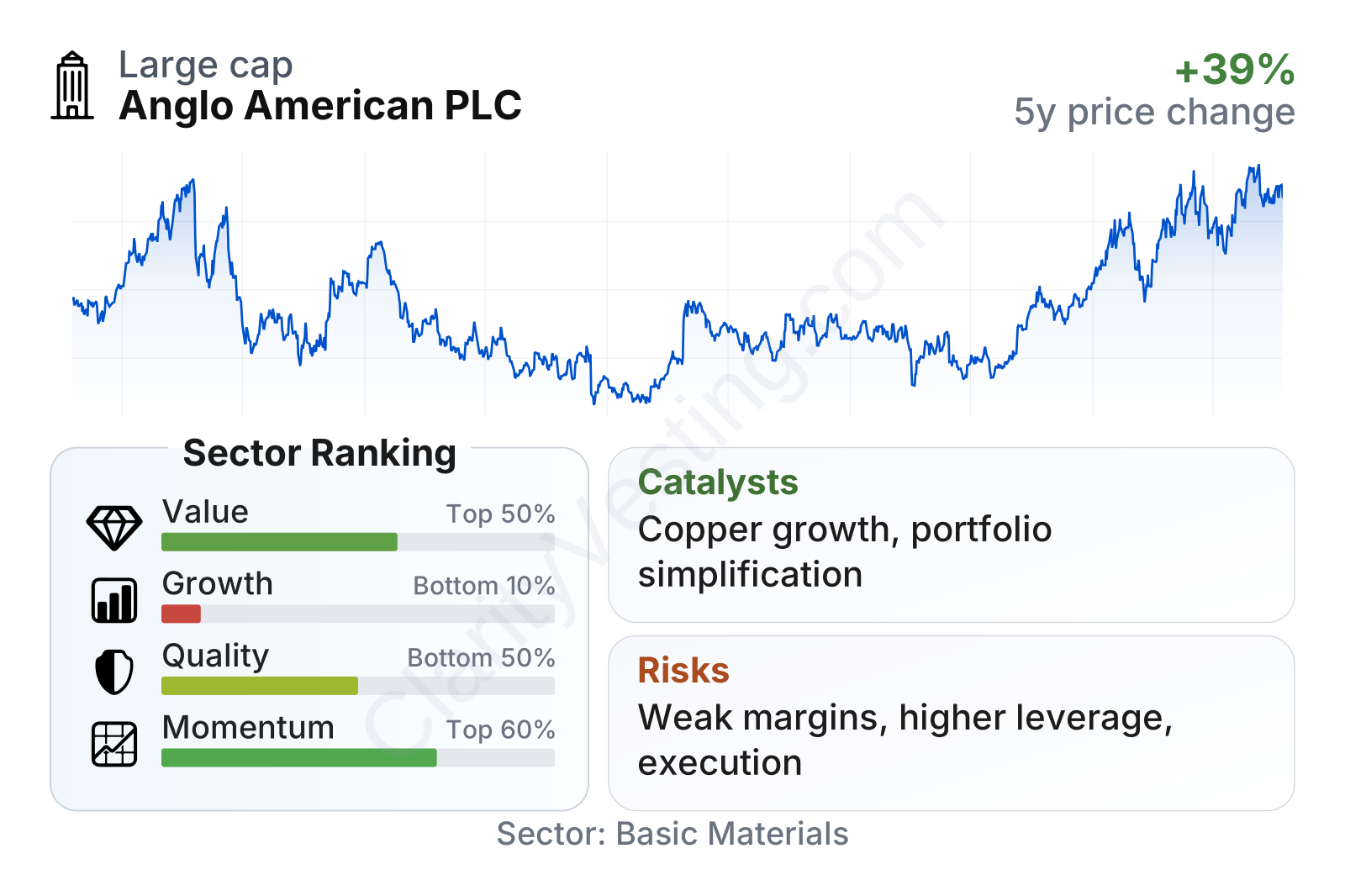
Anglo American is a very large mining group with share-price volatility close to the broader market, but its operating results are much more cyclical than a typical large-cap company. The stock’s recent momentum has been strong relative to many peers, while the underlying fundamental profile is more mixed. Valuation measures sit around the better half of the sector, supported by free cash flow yield and EBIT-to-enterprise-value, but growth and quality indicators are weaker. That combination suggests the market is giving credit to recovery potential rather than rewarding a consistently strong track record.
Growth
Mining is not a uniform growth sector. Some commodities are tied to mature or declining uses, while others benefit from structural demand increases. Anglo American’s most important growth exposure is copper, which is widely expected to see rising demand over the next decade because of power grid expansion, data centers, electric vehicles, and renewable energy infrastructure. Crop nutrients also represent a potential future leg of growth if the company advances its fertilizer-related projects, although that business is still much smaller than the core mining operations.
Management’s strategy broadly makes industrial sense. The company has been repositioning toward copper and iron ore while pursuing disposals or separations in selected assets. This should make the business simpler and more focused on materials with stronger long-term demand visibility. The strategic logic is clear: copper has attractive supply-demand fundamentals, and high-grade iron ore can benefit from steelmakers seeking productivity and lower emissions intensity.
The challenge is that the recent revenue path has been weak. After the post-pandemic peak, sales contracted repeatedly, reflecting both lower commodity prices and a more difficult production environment. So while the end-market opportunity is real, the company still needs to convert that opportunity into steadier delivered growth.
Free cash flow remains an important offset to the softer growth record. Anglo American has continued to produce meaningful cash generation on a trailing basis, which gives it room to fund projects, maintain operations, and continue reshaping the portfolio. In a capital-intensive industry, that matters. A miner can have weak accounting earnings in a downcycle but still preserve strategic flexibility if cash generation remains solid.
A major catalyst remains the company’s copper pipeline, especially its large South American assets. Quellaveco in Peru is an important modern copper mine that can support production for decades, and Los Bronces in Chile offers optionality if operational and permitting conditions improve. Another visible catalyst is the company’s broader restructuring effort, including moves to simplify the portfolio and emphasize businesses that may command stronger market interest over time.
Recent developments also point to a significant opportunity in corporate repositioning. Anglo American has been under pressure to unlock value from its asset base, and the response has been a sharper focus on streamlining the group. If execution is successful, the company could emerge as a more concentrated copper-and-iron-ore miner with less exposure to slower or more volatile segments.
Risks
This article is for informational purposes only and does not constitute financial advice. Some content is AI-generated. See Disclaimer


