Stock Analysis · NGL Energy Partners LP (NGL)
Overview
NGL Energy Partners LP is a midstream energy company. In simple terms, it sits between oil and gas production and end customers. Its assets move, store, treat, and market energy-related products. The partnership is especially active in water solutions for oil producers, liquids logistics, and crude oil logistics. Its network includes pipelines, disposal wells, storage terminals, rail facilities, trucking, and other infrastructure that supports drilling and production activity.
Based on the company’s fiscal 2026 annual filing, revenue is spread across three main operating segments, with Water Solutions and Crude Oil Logistics now carrying much more of the earnings profile than their revenue share alone would suggest. By reported revenue, the mix is approximately:
- Liquids Logistics — about 58%: marketing, storage, transportation, and distribution of natural gas liquids, refined products, renewable fuels, and crude-related products.
- Crude Oil Logistics — about 26%: gathering, transportation, storage, terminaling, and marketing of crude oil.
- Water Solutions — about 16%: produced water gathering, transportation, treatment, recycling, disposal, and related services for oil and gas operators, mainly in key shale basins.
That revenue mix does not tell the whole economic story. Liquids Logistics is the biggest source of sales, but lower-margin commodity marketing can make revenue look large without producing equally large profits. Water Solutions tends to be more fee-based and infrastructure-driven, which is often more important for cash generation and business quality than headline sales alone.
Another visible trend in recent years is that total revenue has fallen sharply from earlier peaks while gross profit has held up much better. That usually means the company has been relying less on low-margin barrels and more on services and operations with better economics per dollar of sales, even though net income remains uneven because interest expense is still heavy.
Key Figures
| Metric | Value | Sector ⓘ |
|---|---|---|
| Date | Oct 17, 2026 | |
| Context | ||
| Sector | Energy | |
| Industry | Oil & Gas Midstream | |
| Market Cap ⓘ | $1.86B | |
| Beta ⓘ | 0.84 | |
Value (Cheapness) | ||
| P/E Ratio ⓘ | N/A | 15.44 |
| P/B Ratio ⓘ | 155.59 | 1.73 |
| FCF Yield ⓘ | 11.29% | 8.20% |
| Dividend Yield ⓘ | N/A | 3.59% |
| EBIT / EV ⓘ | 8.11% | 7.46% |
| PEG ⓘ | 8.06 | |
Growth (Business expansion) | ||
| Revenue Growth ⓘ | 59.10% | 26.90% |
| RPS Growth (5Y CAGR) ⓘ | -20.18% | 6.90% |
| EPS Growth (5Y CAGR) ⓘ | N/A | -15.73% |
| BVPS Growth (5Y CAGR) ⓘ | -74.59% | 6.07% |
| Margin Growth (5Y Trend) ⓘ | 1.49% | 0.58% |
| FCF Growth (5Y CAGR) ⓘ | 22.86% | 1.86% |
| DPS Growth (5Y CAGR) ⓘ | 190.23% | 16.79% |
Quality (Business durability) | ||
| ROIC (Latest) ⓘ | 12.35% | 11.40% |
| ROA (Latest) ⓘ | -4.02% | 6.06% |
| ROIC (5Y Median) ⓘ | 1.92% | 10.30% |
| ROA (5Y Median) ⓘ | -2.74% | 5.42% |
| Net Debt / EBIT (Latest) ⓘ | 7.76 | 1.64 |
| Net Debt / EBIT (5Y Median) ⓘ | 29.76 | 1.83 |
| Net Debt / EBITDA (Latest) ⓘ | 4.86 | 1.08 |
| Net Debt / Assets ⓘ | 81.06% | 17.29% |
| EBITDA / Interest ⓘ | 2.71 | 9.64 |
| Operating Margin (Latest) ⓘ | 12.38% | 16.27% |
| Operating Margin (5Y Median) ⓘ | 2.39% | 20.39% |
| Debt to Equity (Latest) ⓘ | 10374.86% | 54.76% |
| Profit Margin (Latest) ⓘ | -3.76% | 8.82% |
| Free Cash Flow (Latest) ⓘ | $209.56M | |
Momentum (Price trend) | ||
| 3Y Return ⓘ | +256.42% | +67.38% |
| 12M Return (excl. last month) ⓘ | +198.62% | +49.19% |
| 6M Return ⓘ | +12.28% | +7.07% |
| Price vs. 200-Day MA ⓘ | +1.79% | +9.56% |
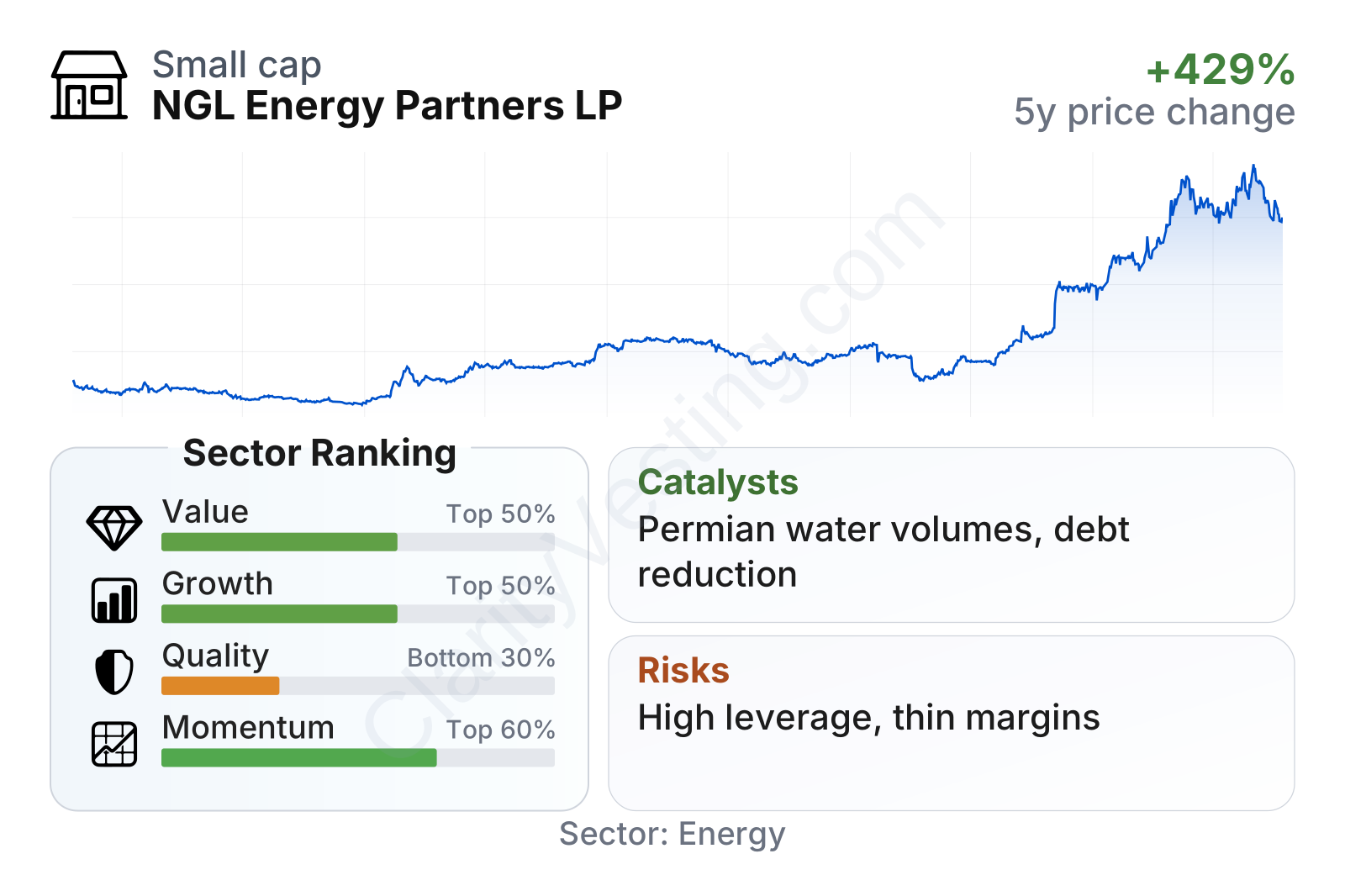
NGL is a small-to-mid-sized public energy company with a market value around the low single-digit billions of dollars. The stock has shown very strong price momentum over the last one to three years, clearly ahead of much of the energy sector, but the fundamental profile is more mixed. On valuation, free cash flow yield and EBIT relative to enterprise value look solid versus the sector median. On growth, recent revenue and cash flow trends have improved. On quality, leverage and profitability remain the weak points, which is why the company still screens below average overall despite better recent operating performance.
Growth
NGL operates in parts of the energy system that remain relevant even as commodity prices move up and down. Water handling in particular is tied to long-life shale production. Oil producers in basins such as the Permian need gathering, recycling, and disposal infrastructure every day, not just during new well drilling booms. That gives this segment an attractive long-term backdrop because produced water volumes often keep rising as fields mature.
The partnership’s strategy has also become easier to understand than it was a few years ago. Management has increasingly emphasized businesses with stronger margins and recurring infrastructure use, especially Water Solutions, while continuing to manage the liquids and crude segments for cash generation. That direction makes strategic sense for long-term business stability because fee-based services are usually less volatile than pure commodity exposure.
Revenue growth has been volatile, which is normal for a company with marketing and commodity-linked activities. The latest year-over-year rebound is strong, but the longer pattern is uneven, so growth should be viewed through margins and cash generation rather than revenue alone. A better sign is that free cash flow has improved meaningfully over time despite swings in sales.
Free cash flow has recovered from earlier lows and is now running at a level that matters for balance-sheet repair. That is one of the clearest positive signals in the current setup. If sustained, this gives NGL more room to reduce debt, refinance on better terms over time, and support the underlying equity value without needing large top-line expansion.
A notable catalyst in the current period is the continued importance of water infrastructure in the Permian Basin. This is one of the most active U.S. oil regions, and producers increasingly value integrated water systems because they lower trucking needs, improve operating efficiency, and help address environmental and disposal constraints. NGL already has established assets in this market, so incremental producer activity can flow into existing systems without requiring the same level of spending as a brand-new platform.
Recent company communications have also focused on debt reduction, operational execution, and refinancing progress. For a leveraged midstream business, that matters as much as volume growth. In this case, the path to a stronger company is not only more barrels or more water volumes, but turning current assets into steadier cash and using that cash to simplify the capital structure.
Risks
This article is for informational purposes only and does not constitute financial advice. Some content is AI-generated. See Disclaimer


