Stock Analysis · NovaGold Resources Inc (NG)
Overview
NovaGold Resources is a gold development company rather than a producing miner. Its main asset is a 50% interest in the Donlin Gold project in Alaska, one of the largest undeveloped gold deposits in the world. The other 50% is owned by Barrick. NovaGold also holds a smaller interest in Ambler Metals, which is focused on the Upper Kobuk Mineral Projects in Alaska. Because the company is still in the development stage, its value today is tied much more to the future potential of its mineral assets than to current operating profits.
At this stage, NovaGold does not have meaningful recurring operating revenue from selling gold. Recent annual filings show essentially no revenue, which is typical for a company advancing large mining projects before production begins. Its financial profile is therefore driven by project spending, corporate costs, financing arrangements, and the changing estimated value of its long-life assets.
The economic exposure is concentrated in a small number of assets.
- Donlin Gold project: approximately the overwhelming majority of asset value and strategic focus. This project includes a large undeveloped gold resource, permitting work, engineering updates, and long-term development planning.
- Ambler Metals interest: a smaller minority contribution to overall value. This exposure is tied to copper and other metals in Alaska through a separate venture structure.
- Cash and short-term investments: an important financial resource for funding studies, permitting, and corporate overhead while the company remains pre-revenue.
What stands out most is that NovaGold is not currently a diversified mining operator. It is primarily a single-project company built around a very large future mine opportunity. That can create major upside if the project advances successfully, but it also means the business depends heavily on one asset, one jurisdictional path, and one long development timeline.
The operating flow highlights the current business model clearly: there is essentially no revenue, while corporate expenses and interest costs continue to produce annual losses. Losses widened notably in the latest annual period, showing that the company’s near-term economics still depend on balance sheet strength and project progress rather than on operating cash generation.
Key Figures
| Metric | Value | Sector ⓘ |
|---|---|---|
| Date | Oct 17, 2026 | |
| Context | ||
| Sector | Basic Materials | |
| Industry | Gold | |
| Market Cap ⓘ | $2.91B | |
| Beta ⓘ | 2.35 | |
Value (Cheapness) | ||
| P/E Ratio ⓘ | N/A | 16.90 |
| P/B Ratio ⓘ | 7.06 | 1.65 |
| FCF Yield ⓘ | -1.57% | 5.76% |
| Dividend Yield ⓘ | N/A | 2.13% |
| EBIT / EV ⓘ | -0.94% | 6.30% |
| PEG ⓘ | 1.34 | |
Growth (Business expansion) | ||
| Revenue Growth ⓘ | N/A | 11.10% |
| RPS Growth (5Y CAGR) ⓘ | N/A | 4.49% |
| EPS Growth (5Y CAGR) ⓘ | -12.73% | -13.47% |
| BVPS Growth (5Y CAGR) ⓘ | 16.65% | 5.51% |
| Margin Growth (5Y Trend) ⓘ | N/A | -1.54% |
| FCF Growth (5Y CAGR) ⓘ | N/A | 0.37% |
| DPS Growth (5Y CAGR) ⓘ | N/A | 6.08% |
Quality (Business durability) | ||
| ROIC (Latest) ⓘ | -1.28% | 9.26% |
| ROA (Latest) ⓘ | -20.12% | 4.91% |
| ROIC (5Y Median) ⓘ | -19.65% | 7.70% |
| ROA (5Y Median) ⓘ | -32.00% | 3.86% |
| Net Debt / EBIT (Latest) ⓘ | N/A | 1.40 |
| Net Debt / EBIT (5Y Median) ⓘ | N/A | 1.70 |
| Net Debt / EBITDA (Latest) ⓘ | N/A | 0.95 |
| Net Debt / Assets ⓘ | 5.54% | 13.69% |
| EBITDA / Interest ⓘ | N/A | 12.34 |
| Operating Margin (Latest) ⓘ | N/A | 13.20% |
| Operating Margin (5Y Median) ⓘ | N/A | 11.80% |
| Debt to Equity (Latest) ⓘ | 46.00% | 40.56% |
| Profit Margin (Latest) ⓘ | N/A | 6.43% |
| Free Cash Flow (Latest) ⓘ | -$45.62M | |
Momentum (Price trend) | ||
| 3Y Return ⓘ | +64.81% | +68.89% |
| 12M Return (excl. last month) ⓘ | +4.48% | +30.21% |
| 6M Return ⓘ | -38.50% | -4.16% |
| Price vs. 200-Day MA ⓘ | -26.31% | -1.27% |
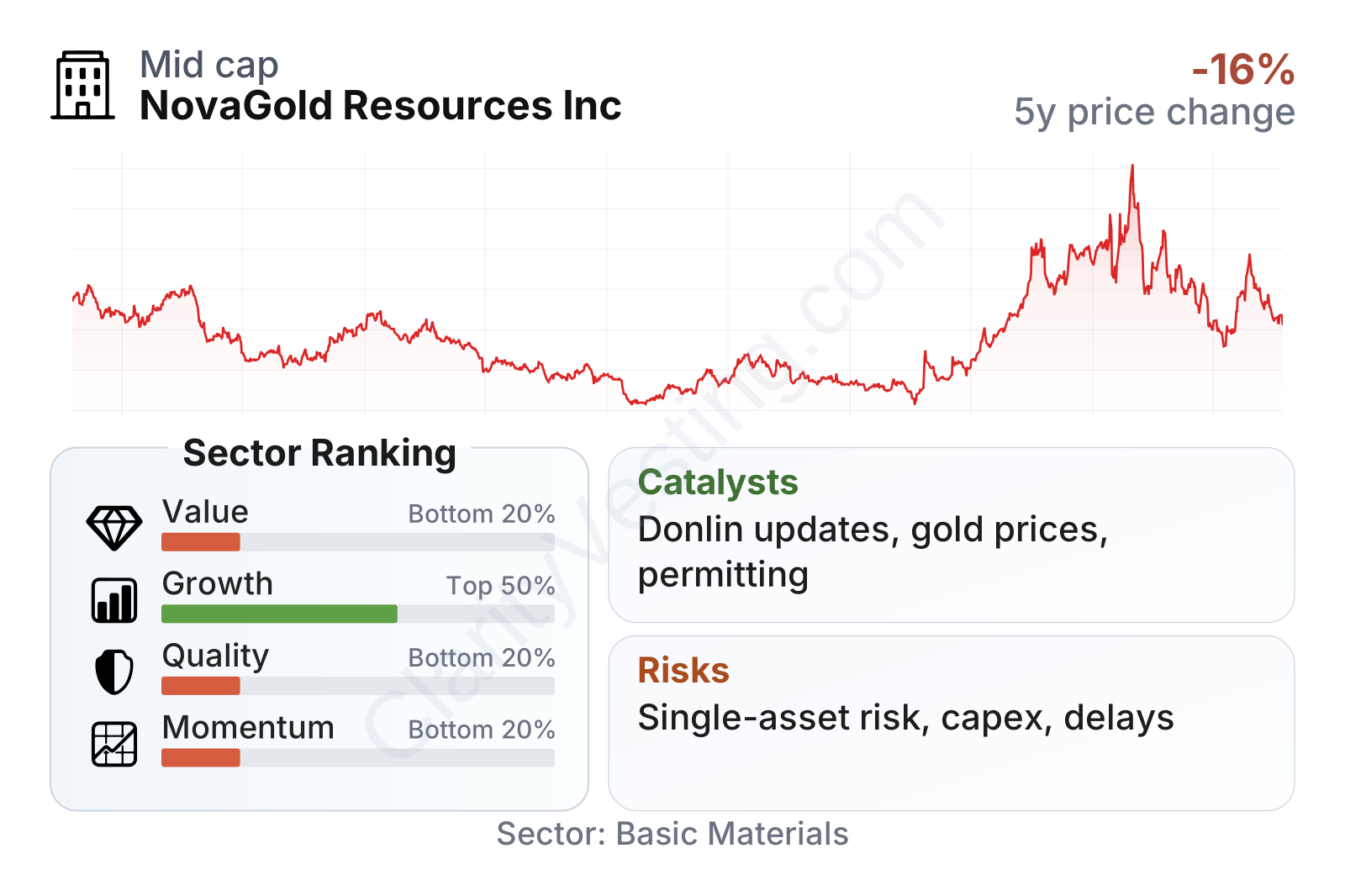
NovaGold sits in the mid-cap range and shows unusually high share-price volatility, with a beta well above 2. The factor mix is also very uneven. Growth-related measures look better than quality and value measures, largely because book value has compounded well over time and the company has preserved strategic optionality around Donlin. By contrast, quality metrics are weak because the company is still loss-making and does not generate operating returns. Value metrics also screen poorly, with a price-to-book ratio far above the sector median and negative cash flow-based measures.
The stock-price history reinforces that this is a high-expectation name. The shares have been highly cyclical over the last several years, with sharp rallies and equally sharp pullbacks. That pattern is common for pre-production mining companies whose valuation moves with gold prices, financing expectations, permitting milestones, and changing views on whether the core project will eventually be built.
Growth
NovaGold is tied to a sector with durable long-term relevance. Gold remains important as a store of value, a reserve asset for central banks, and a portfolio hedge during inflation or geopolitical uncertainty. For development-stage companies, a stronger gold-price environment can have an outsized effect because it can improve the economics of large undeveloped deposits and make financing more realistic. In that sense, NovaGold has exposure to a favorable long-term theme even though it is not yet participating through production revenue.
The company’s strategy is straightforward: preserve ownership in a world-class deposit, continue technical and permitting work, and advance Donlin in a way that improves confidence in its future economics. That strategy makes sense for a business of this type. Donlin’s appeal is its scale, long mine life potential, and location in Alaska rather than in a high-conflict jurisdiction. If engineering, permitting, and cost planning continue to improve, the project could become more relevant to larger industry players over time.
Revenue growth is not meaningful yet because NovaGold is still pre-production. The lack of sales is not a sign of commercial decline; it reflects the fact that the company is still in the asset-development phase. For long-term analysis, project advancement matters much more than year-over-year revenue.
Free cash flow has remained negative, which is normal for a company funding studies, permitting, and overhead without producing metal. The important point is not the absence of current cash generation, but whether spending is moving the core asset closer to a clearer development path. Public updates in 2026 continued to focus on Donlin technical work, optimization efforts, and maintaining project momentum with its partner.
A meaningful catalyst is any step that reduces uncertainty around Donlin. That can include updated technical work, better clarity on capital intensity, permitting progress, infrastructure planning, stronger gold prices, or a broader strategic move involving its partner structure. Because Donlin is such a large deposit, even incremental derisking can materially affect how the market views NovaGold.
Risks
This article is for informational purposes only and does not constitute financial advice. Some content is AI-generated. See Disclaimer


