Stock Analysis · National Fuel Gas Company (NFG)
Overview
National Fuel Gas Company is a diversified energy company with a structure that is unusual in today’s U.S. energy market. Instead of relying on only one activity, it combines natural gas production with midstream gathering, pipeline transportation, gas storage, and regulated utility distribution. In practical terms, it both produces natural gas and moves it through infrastructure to homes, businesses, and industrial users, mainly in the Northeast and Appalachian regions.
This mix matters because it gives the company exposure to both commodity-driven earnings and more stable regulated or fee-based income. Its upstream business is centered on natural gas development in the Appalachian Basin, especially in Pennsylvania. Its downstream and utility businesses include interstate pipelines, storage assets, and a local gas utility serving customers in western New York and northwestern Pennsylvania.
Based on the company’s latest annual reporting structure, revenue is primarily tied to its Exploration and Production segment, while the rest comes from utility and infrastructure operations. The ranking below is the clearest simple way to understand where the money comes from:
- Exploration and Production: approximately 70% to 80% of consolidated revenue. This includes natural gas and oil production, with revenue heavily influenced by commodity prices and production volumes.
- Utility: approximately 10% to 15% of revenue. This covers natural gas sales and distribution to residential, commercial, and industrial customers in its service territory.
- Pipeline and Storage: approximately 5% to 10% of revenue. This includes interstate pipeline transportation and underground storage services, generally supported by contracts and regulated tariffs.
- Gathering: approximately 3% to 7% of revenue. This business connects producing wells to larger pipeline systems and earns fees for moving gas through gathering networks.
The overall financial flow shows a business that can swing with the energy cycle, but one that also benefits from meaningful infrastructure and utility earnings. A notable recent feature is the rebound after a weak 2024 period, with profitability and operating income recovering strongly into 2025.
Key Figures
| Metric | Value | Sector ⓘ |
|---|---|---|
| Date | Oct 17, 2026 | |
| Context | ||
| Sector | Energy | |
| Industry | Oil & Gas Integrated | |
| Market Cap ⓘ | $7.71B | |
| Beta ⓘ | 0.41 | |
Value (Cheapness) | ||
| P/E Ratio ⓘ | 11.29 | 15.44 |
| P/B Ratio ⓘ | 1.91 | 1.73 |
| FCF Yield ⓘ | 2.88% | 8.20% |
| Dividend Yield ⓘ | 2.71% | 3.59% |
| EBIT / EV ⓘ | 10.63% | 7.46% |
| PEG ⓘ | 1.55 | |
Growth (Business expansion) | ||
| Revenue Growth ⓘ | 1.10% | 26.90% |
| RPS Growth (5Y CAGR) ⓘ | 7.05% | 6.90% |
| EPS Growth (5Y CAGR) ⓘ | 1.74% | -15.73% |
| BVPS Growth (5Y CAGR) ⓘ | 14.87% | 6.07% |
| Margin Growth (5Y Trend) ⓘ | 1.47% | 0.58% |
| FCF Growth (5Y CAGR) ⓘ | 47.25% | 1.86% |
| DPS Growth (5Y CAGR) ⓘ | 3.81% | 16.79% |
Quality (Business durability) | ||
| ROIC (Latest) ⓘ | 11.94% | 11.40% |
| ROA (Latest) ⓘ | 7.04% | 6.06% |
| ROIC (5Y Median) ⓘ | 10.99% | 10.30% |
| ROA (5Y Median) ⓘ | 5.90% | 5.42% |
| Net Debt / EBIT (Latest) ⓘ | 2.24 | 1.64 |
| Net Debt / EBIT (5Y Median) ⓘ | 3.38 | 1.83 |
| Net Debt / EBITDA (Latest) ⓘ | 1.53 | 1.08 |
| Net Debt / Assets ⓘ | 22.31% | 17.29% |
| EBITDA / Interest ⓘ | 10.26 | 9.64 |
| Operating Margin (Latest) ⓘ | 41.62% | 16.27% |
| Operating Margin (5Y Median) ⓘ | 35.85% | 20.39% |
| Debt to Equity (Latest) ⓘ | 90.92% | 54.76% |
| Profit Margin (Latest) ⓘ | 26.86% | 8.82% |
| Free Cash Flow (Latest) ⓘ | $222.27M | |
Momentum (Price trend) | ||
| 3Y Return ⓘ | +60.92% | +67.38% |
| 12M Return (excl. last month) ⓘ | -6.17% | +49.19% |
| 6M Return ⓘ | -10.74% | +7.07% |
| Price vs. 200-Day MA ⓘ | -3.73% | +9.56% |
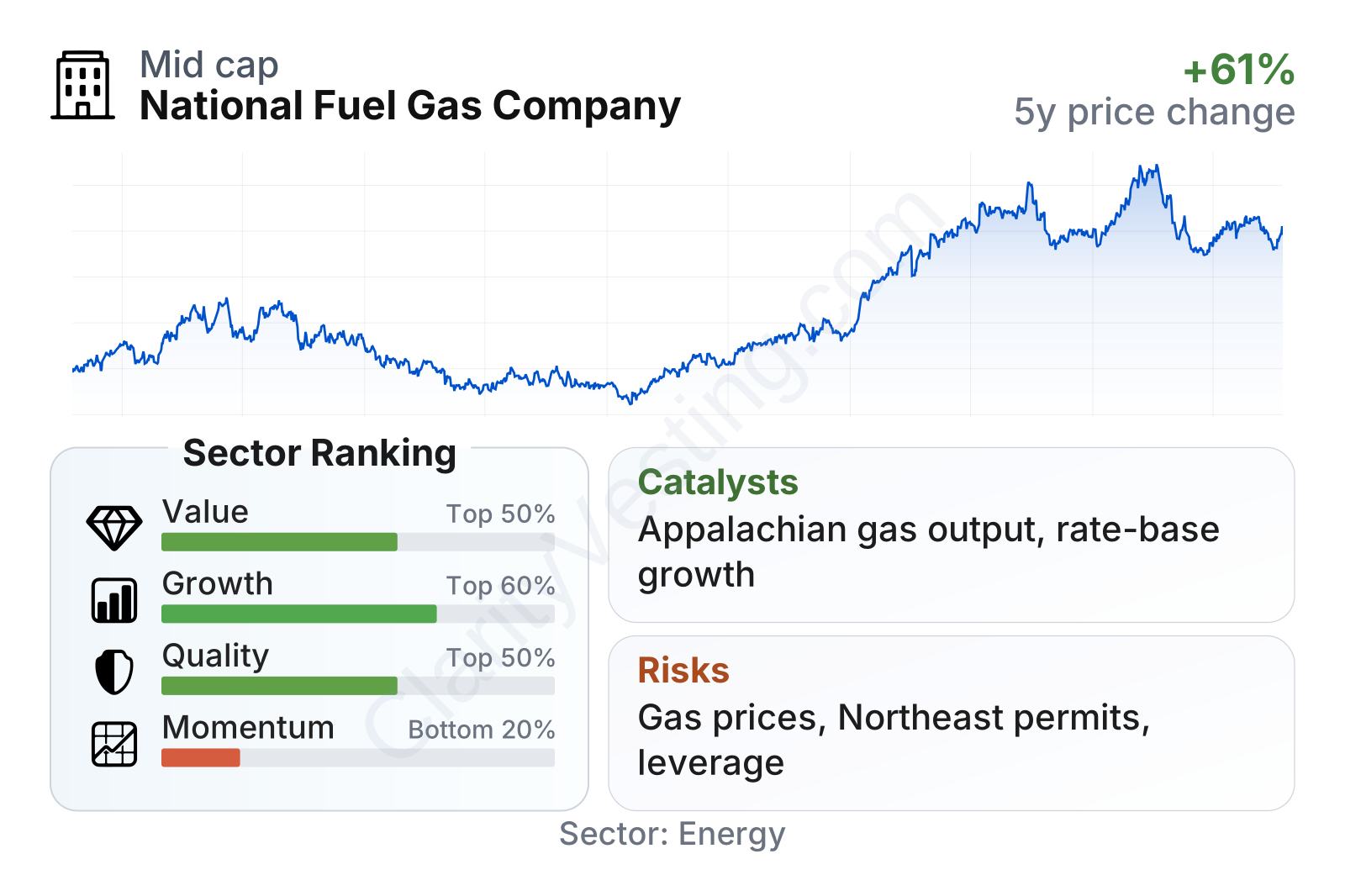
National Fuel Gas is a mid-sized energy company with a market value in the lower single-digit billions and a notably low beta of about 0.38, meaning the stock has historically moved less than the broader market. On valuation, the earnings multiple sits below the sector median, while the enterprise-value-based earnings measure looks stronger than the sector median. Quality is solid overall: returns on capital and assets are slightly above sector norms, and margins are clearly stronger than many peers. Growth is more mixed. Long-term book value and free cash flow trends have been good, but recent revenue growth has been much slower than the broader energy group. Market performance has also cooled recently, with weaker momentum over the last six to twelve months despite a much stronger multi-year share price trend.
Growth
National Fuel Gas operates in a sector that remains important for long-term U.S. energy needs, especially natural gas. Gas still plays a central role in home heating, power generation, industrial demand, and LNG exports. That backdrop supports companies with low-cost gas resources and strategically located pipeline systems, particularly in the Appalachian region where NFG is active.
The company’s strategy is logical for long-term development because it links production with owned infrastructure. That reduces dependence on third parties and can improve economics when drilling activity rises. It also balances the more volatile exploration business with regulated and fee-based operations. This is not a pure high-growth model, but it is a more resilient setup than a standalone producer.
Revenue growth has been uneven rather than smooth. The company experienced a strong expansion phase in 2022, then a clear slowdown and contraction during 2023 and part of 2024 as energy prices normalized. More recently, growth recovered sharply before moderating again to around flat to low-single-digit territory. That pattern suggests National Fuel Gas is still sensitive to the commodity cycle, even if its integrated model softens the extremes.
Cash generation has improved meaningfully from earlier weaker levels. Free cash flow moved from negative territory a few years ago to a clearly positive level more recently, with the latest trailing twelve-month figure above $200 million. Over a five-year period, free cash flow growth has been far stronger than the sector median, which is an encouraging sign for a capital-intensive business.
One of the most important catalysts is the continuing buildout of Appalachian gas development and related takeaway infrastructure. If the company keeps increasing production efficiently while using its own gathering and pipeline network, operating leverage can improve. Another useful tailwind is the regulated utility and pipeline base, where capital investment can support future rate-based earnings growth. In simple terms, NFG has a credible path to grow through a combination of drilling, infrastructure utilization, and steady utility investment rather than relying on a single driver.
Risks
This article is for informational purposes only and does not constitute financial advice. Some content is AI-generated. See Disclaimer


