Stock Analysis · Nextdecade Corp (NEXT)
Overview
NextDecade Corp is a U.S. energy infrastructure company focused on liquefied natural gas, or LNG. Its main asset is the Rio Grande LNG project in Brownsville, Texas, a large export facility designed to take natural gas from the U.S. and ship it overseas after cooling it into liquid form. The company is also developing carbon capture and storage tied to that site through the Rio Grande CCS project. In simple terms, NextDecade is not a traditional oil and gas producer. It is a project developer trying to build, finance, and operate a major LNG export platform.
For now, the business is still in a development-heavy phase, so revenue remains limited and uneven. Recent SEC filings show that the economic case rests much more on future contracted LNG capacity than on current operating income. The company’s reported revenue has mainly come from early-stage activities such as land and option arrangements, management services, and development-related items rather than large-scale LNG sales, because the core export facility is still being built.
The revenue mix is therefore unusually narrow and not yet representative of the long-term target model. Based on the latest annual disclosures, the current sources can be summarized as follows:
- Development and project-related service revenue: the vast majority of current revenue, approximately more than 90%. This reflects fees and arrangements connected to project development rather than mature plant operations.
- Other minor revenue items: approximately less than 10%. These can include miscellaneous project-related receipts and contractual items.
- LNG operating revenue: currently 0% on a commercial scale, because Rio Grande LNG is not yet in full operation.
That makes NextDecade very different from established energy companies. Today it resembles a financing-and-construction platform built around one large asset. If Rio Grande LNG moves into sustained operations, the business model could shift dramatically from low current revenue to long-term contracted cash generation.
The financial flow still reflects a pre-operating company: reported revenue has been close to zero while administrative costs, development spending, and interest expense have climbed sharply. The key change is not current profitability, but the scale-up in spending tied to getting Rio Grande LNG built and financed.
Key Figures
| Metric | Value | Sector ⓘ |
|---|---|---|
| Date | Oct 17, 2026 | |
| Context | ||
| Sector | Energy | |
| Industry | Oil & Gas Equipment & Services | |
| Market Cap ⓘ | $1.73B | |
| Beta ⓘ | 1.54 | |
Value (Cheapness) | ||
| P/E Ratio ⓘ | N/A | 15.44 |
| P/B Ratio ⓘ | N/A | 1.73 |
| FCF Yield ⓘ | -223.21% | 8.20% |
| Dividend Yield ⓘ | N/A | 3.59% |
| EBIT / EV ⓘ | -2.99% | 7.46% |
| PEG ⓘ | N/A | |
Growth (Business expansion) | ||
| Revenue Growth ⓘ | N/A | 26.90% |
| RPS Growth (5Y CAGR) ⓘ | N/A | 6.90% |
| EPS Growth (5Y CAGR) ⓘ | N/A | -15.73% |
| BVPS Growth (5Y CAGR) ⓘ | -30.73% | 6.07% |
| Margin Growth (5Y Trend) ⓘ | N/A | 0.58% |
| FCF Growth (5Y CAGR) ⓘ | N/A | 1.86% |
| DPS Growth (5Y CAGR) ⓘ | N/A | 16.79% |
Quality (Business durability) | ||
| ROIC (Latest) ⓘ | -3.29% | 11.40% |
| ROA (Latest) ⓘ | -2.84% | 6.06% |
| ROIC (5Y Median) ⓘ | -15.37% | 10.30% |
| ROA (5Y Median) ⓘ | -8.92% | 5.42% |
| Net Debt / EBIT (Latest) ⓘ | N/A | 1.64 |
| Net Debt / EBIT (5Y Median) ⓘ | N/A | 1.83 |
| Net Debt / EBITDA (Latest) ⓘ | N/A | 1.08 |
| Net Debt / Assets ⓘ | 68.75% | 17.29% |
| EBITDA / Interest ⓘ | N/A | 9.64 |
| Operating Margin (Latest) ⓘ | N/A | 16.27% |
| Operating Margin (5Y Median) ⓘ | N/A | 20.39% |
| Debt to Equity (Latest) ⓘ | -18395.90% | 54.76% |
| Profit Margin (Latest) ⓘ | N/A | 8.82% |
| Free Cash Flow (Latest) ⓘ | -$3.85B | |
Momentum (Price trend) | ||
| 3Y Return ⓘ | +34.21% | +67.38% |
| 12M Return (excl. last month) ⓘ | +8.33% | +49.19% |
| 6M Return ⓘ | -17.41% | +7.07% |
| Price vs. 200-Day MA ⓘ | -11.20% | +9.56% |
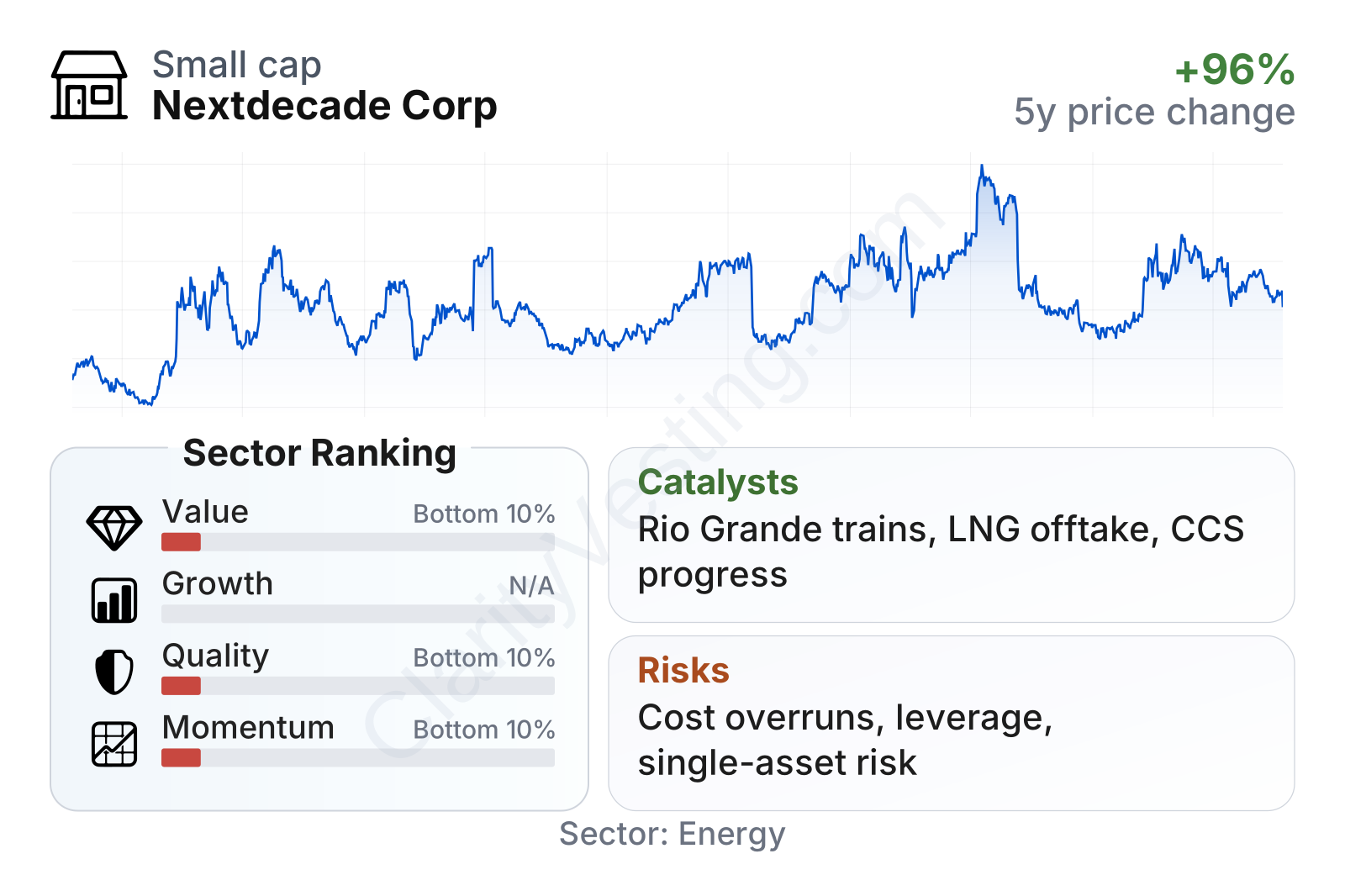
NextDecade currently screens as weak on value, quality, and momentum versus most energy peers, which is not surprising for a company still building its core asset. The market value is in the small-to-mid-cap range, share price volatility is elevated, free cash flow is deeply negative, and profitability measures remain far below sector norms. In other words, the stock is being shaped more by project milestones and financing progress than by standard operating metrics.
Growth
The broader sector backdrop is supportive. LNG remains one of the main ways the U.S. can supply natural gas to Europe, Asia, and other import markets, and long-term demand is still being supported by energy security concerns, coal-to-gas switching in some regions, and the need for flexible fuel supply. That does not make growth automatic, but it does mean NextDecade is operating in a part of the energy market where new export capacity can still attract global buyers.
Its strategy is straightforward and logical for that backdrop: secure long-term customer contracts, raise project financing, build liquefaction trains in phases, and then expand once the first phase is de-risked. This phased approach matters because a project of this size is too large to build speculatively. It needs lenders, partners, contractors, and customers aligned over many years. NextDecade has spent the last several years trying to assemble exactly that structure.
The sharp swings in revenue growth do not say much about end-market demand because current revenue is still small and development-based. A triple-digit jump from a low base can look dramatic without changing the core reality: the investment case depends on future LNG operations, not on today’s top line.
Free cash flow has become much more negative as construction activity accelerated. That is typical for a large infrastructure project in build-out mode, but the size of the outflow is still important. It shows that growth, if it arrives, is being purchased upfront with very heavy capital spending.
A major catalyst has been the continued commercialization and construction progress at Rio Grande LNG. Public company updates in 2026 indicate ongoing work on Train 1 through Train 3 and continued efforts to advance additional trains. Another important opportunity is the carbon capture component. If NextDecade can pair LNG exports with lower-emissions infrastructure, it could improve project positioning with customers that are under pressure to reduce lifecycle emissions. That is not yet the core value driver, but it could become a meaningful differentiator over time.
The most significant near-to-medium-term opportunity is simple: each additional long-term sales contract, financing package, or final investment decision on later trains can materially change how the market views the company’s future earning power. For a developer like NextDecade, these milestones matter more than quarter-to-quarter accounting results.
Risks
This article is for informational purposes only and does not constitute financial advice. Some content is AI-generated. See Disclaimer


