Stock Analysis · NewMarket Corporation (NEU)
Overview
NewMarket Corporation is a specialty chemicals company best known for products used in fuels and lubricants. Its core business is not selling gasoline or motor oil directly to consumers. Instead, it develops and manufactures chemical additives that help fuels burn more efficiently and help lubricants protect engines and industrial equipment. These additives are sold to large oil companies, lubricant makers, and industrial customers around the world.
The business is centered on Afton Chemical, which supplies petroleum additives for transportation and industrial uses, and on AMPAC, which operates in specialty materials and energetic systems for defense and space-related applications. In practice, NewMarket is still primarily an additives company, with the newer specialty materials activities adding a smaller but strategically important second leg.
Based on recent company reporting, revenue is mainly generated from the following areas:
- Petroleum additives: about 85% to 90% of total revenue. This includes lubricant additives for passenger cars, heavy-duty vehicles, industrial machinery, and marine uses, as well as fuel additives that improve combustion, cleanliness, and performance.
- Specialty materials / energetic systems: about 10% to 15% of total revenue. This activity includes products and systems tied to defense, aerospace, and related industrial applications through AMPAC.
The financial flow over the last several years shows a useful pattern: revenue has stayed within a fairly tight range, but profitability has improved much more than sales. That suggests the recent equity performance has been driven less by rapid expansion and more by better pricing, product mix, and operating discipline.
Key Figures
| Metric | Value | Sector ⓘ |
|---|---|---|
| Date | Nov 02, 2026 | |
| Context | ||
| Sector | Basic Materials | |
| Industry | Specialty Chemicals | |
| Market Cap ⓘ | $7.21B | |
| Beta ⓘ | 0.56 | |
Value (Cheapness) | ||
| P/E Ratio ⓘ | 15.90 | 16.65 |
| P/B Ratio ⓘ | 3.73 | 1.68 |
| FCF Yield ⓘ | 5.67% | 5.70% |
| Dividend Yield ⓘ | 1.49% | 2.15% |
| EBIT / EV ⓘ | 7.73% | 7.26% |
| PEG ⓘ | 5.64 | |
Growth (Business expansion) | ||
| Revenue Growth ⓘ | 3.80% | 11.00% |
| RPS Growth (5Y CAGR) ⓘ | 7.30% | 4.49% |
| EPS Growth (5Y CAGR) ⓘ | 10.60% | -12.73% |
| BVPS Growth (5Y CAGR) ⓘ | 27.87% | 5.51% |
| Margin Growth (5Y Trend) ⓘ | 10.07% | -1.42% |
| FCF Growth (5Y CAGR) ⓘ | 54.42% | 0.52% |
| DPS Growth (5Y CAGR) ⓘ | 9.03% | 6.02% |
Quality (Business durability) | ||
| ROIC (Latest) ⓘ | 17.97% | 9.41% |
| ROA (Latest) ⓘ | 12.81% | 4.90% |
| ROIC (5Y Median) ⓘ | 17.60% | 7.76% |
| ROA (5Y Median) ⓘ | 12.65% | 3.88% |
| Net Debt / EBIT (Latest) ⓘ | 1.35 | 1.35 |
| Net Debt / EBIT (5Y Median) ⓘ | 1.53 | 1.70 |
| Net Debt / EBITDA (Latest) ⓘ | 1.12 | 0.92 |
| Net Debt / Assets ⓘ | 22.96% | 13.13% |
| EBITDA / Interest ⓘ | 21.10 | 12.36 |
| Operating Margin (Latest) ⓘ | 22.46% | 12.74% |
| Operating Margin (5Y Median) ⓘ | 17.90% | 11.87% |
| Debt to Equity (Latest) ⓘ | 47.40% | 40.30% |
| Profit Margin (Latest) ⓘ | 16.51% | 6.60% |
| Free Cash Flow (Latest) ⓘ | $408.43M | |
Momentum (Price trend) | ||
| 3Y Return ⓘ | +71.02% | +76.58% |
| 12M Return (excl. last month) ⓘ | +10.13% | +22.12% |
| 6M Return ⓘ | +16.81% | -3.84% |
| Price vs. 200-Day MA ⓘ | +3.31% | -3.29% |
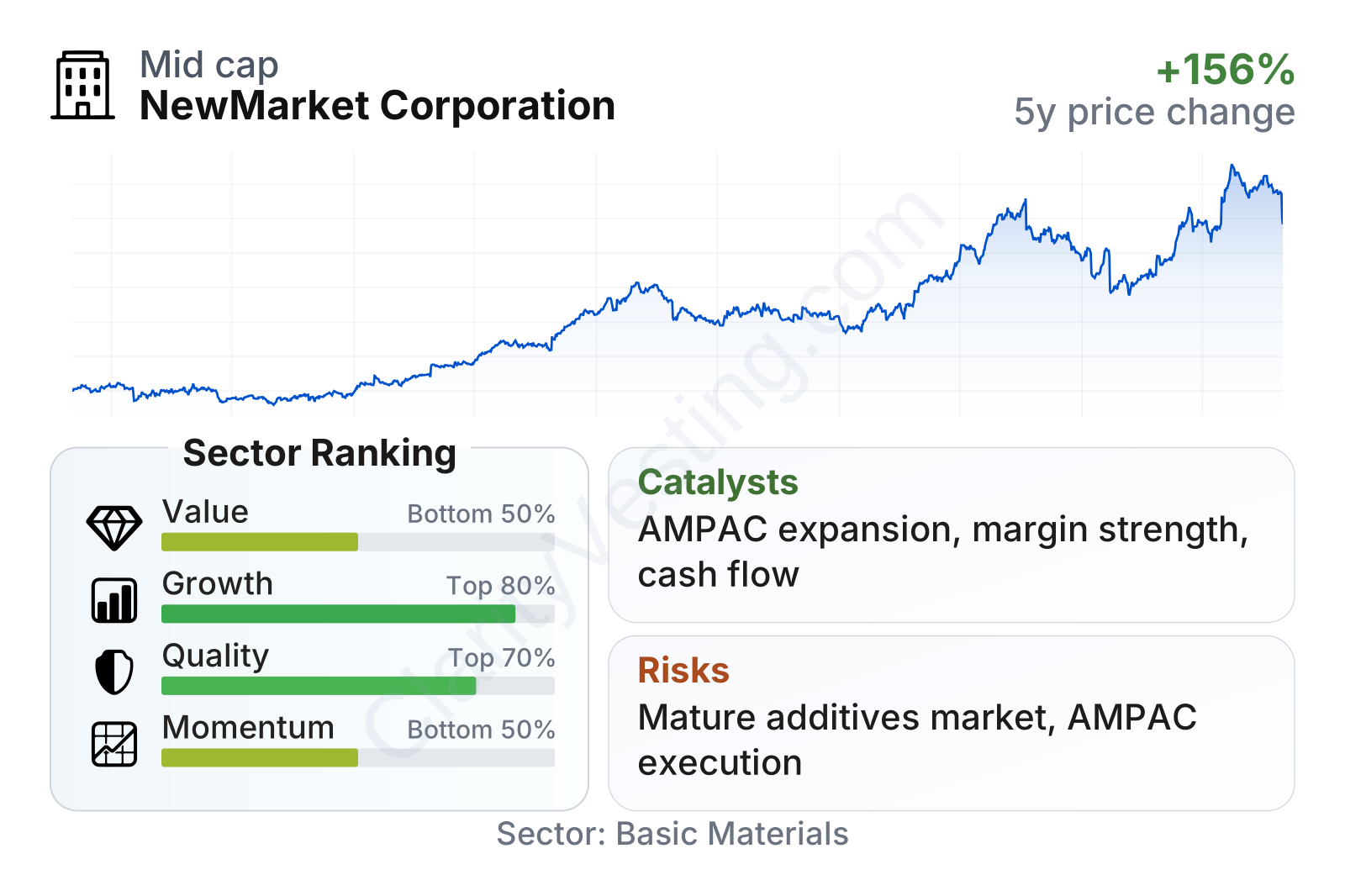
NewMarket is a mid-sized specialty chemicals company with a relatively low stock volatility, shown by a beta near 0.6. The overall profile is unusual in a positive way: valuation is not especially cheap on book value, but profitability and capital efficiency stand clearly above much of the sector. Growth metrics are also stronger than they may appear from recent quarterly sales alone, because the longer-term record for earnings, free cash flow, and book value has been solid. Market momentum is more mixed, with the stock having performed well over several years but less consistently versus the sector over the past year.
Growth
NewMarket operates in a mature but still essential part of the chemicals industry. Demand for lubricant and fuel additives is linked to global vehicle fleets, freight movement, industrial activity, and tightening engine-performance and emissions standards. This is not a classic high-growth market, but it can still produce steady expansion when a company has strong technology, global customer relationships, and the ability to raise value per gallon or per ton sold.
The company’s strategy makes sense for long-term growth because it is built around specialized formulations rather than commodity chemicals. That matters because customers are often buying performance and reliability, not just raw volume. In lubricant additives especially, qualification cycles can be long, and products are deeply integrated into customer formulations. This can support repeat business and pricing resilience.
Recent sales growth has been uneven. NewMarket moved from strong growth in 2022 to declines in parts of 2023 and 2025, followed by a return to positive year-over-year growth in 2026. That pattern points to a business influenced by customer inventory changes, industrial demand cycles, and end-market volumes rather than a straight-line expansion path. Still, the longer-term record looks better than the recent quarterly noise: five-year revenue per share growth is above the sector median, while earnings growth has been materially stronger than many peers.
Cash generation is one of the more compelling parts of the picture. Free cash flow rose sharply over the last several years and has remained at a high level, even after peaking. That gives the company flexibility to fund capital spending, support dividends, manage debt, and pursue selective expansion. A free cash flow yield around the sector median may look ordinary at first glance, but paired with above-average returns on capital and margins, it suggests the business is converting profits into cash at a healthy rate.
An additional catalyst is AMPAC. NewMarket has been investing to expand beyond traditional additives into defense and aerospace-related energetic materials. That business is smaller today, but it adds exposure to a market with different demand drivers, including government programs and long project cycles. If AMPAC scales successfully, it could gradually improve the company’s growth mix and reduce reliance on the more mature additives market.
Recent company communications have also highlighted capacity expansion and project development tied to AMPAC and specialty materials. For a company of this size, successful execution in that area could matter more than small volume changes in its legacy business.
Risks
This article is for informational purposes only and does not constitute financial advice. Some content is AI-generated. See Disclaimer