Stock Analysis · Northern Star Resources Ltd (NESRF)
Overview
Northern Star Resources Ltd is a large gold mining company focused on producing and selling gold from operations in Australia and Alaska. The business owns and operates a portfolio of mines, processing plants, and exploration projects, with its best-known assets including Kalgoorlie in Western Australia, Pogo in Alaska, and other Australian mining hubs such as Yandal. In simple terms, Northern Star digs gold ore out of the ground, processes it into gold, and sells that output into global gold markets.
Revenue is overwhelmingly tied to gold sales, but the operating base is spread across several mining centers rather than a single asset. Based on company reporting and production mix, the main revenue sources can be summarized as follows:
- Kalgoorlie operations: approximately 45% to 50% of revenue. This includes the KCGM/Super Pit area and related processing infrastructure, which has become the company’s largest earnings engine.
- Yandal operations: approximately 20% to 25% of revenue. This group includes several Western Australian mines and processing assets.
- Pogo operations in Alaska: approximately 15% to 20% of revenue. Pogo adds geographic diversification outside Australia.
- Other Australian operations and by-products: approximately 10% to 15% of revenue. This includes smaller operations, stockpile processing, and minor metal by-product contributions where applicable.
The business model is relatively easy to understand: production volume, mining costs, reserve quality, and the gold price drive most of the company’s results. Over recent years, Northern Star has also become more cash-generative as larger, longer-life assets have gained scale.
The multi-year financial flow also shows a strong rise in revenue and operating profit since 2022, with a notable step-up in earnings by 2025 and 2026. That points to both higher sales and much better operating leverage, meaning more of each revenue dollar is turning into profit than before.
Key Figures
| Metric | Value | Sector ⓘ |
|---|---|---|
| Date | Oct 24, 2026 | |
| Context | ||
| Sector | Basic Materials | |
| Industry | Gold | |
| Market Cap ⓘ | $24.95B | |
| Beta ⓘ | 1.33 | |
Value (Cheapness) | ||
| P/E Ratio ⓘ | 22.44 | 16.92 |
| P/B Ratio ⓘ | 1.59 | 1.66 |
| FCF Yield ⓘ | 5.96% | 5.83% |
| Dividend Yield ⓘ | 3.27% | 2.07% |
| EBIT / EV ⓘ | N/A | 6.38% |
| PEG ⓘ | 0.24 | |
Growth (Business expansion) | ||
| Revenue Growth ⓘ | 18.70% | 11.25% |
| RPS Growth (5Y CAGR) ⓘ | 12.89% | 4.49% |
| EPS Growth (5Y CAGR) ⓘ | 43.49% | -15.24% |
| BVPS Growth (5Y CAGR) ⓘ | 11.44% | 5.49% |
| Margin Growth (5Y Trend) ⓘ | 17.99% | -1.54% |
| FCF Growth (5Y CAGR) ⓘ | 3.41% | 0.37% |
| DPS Growth (5Y CAGR) ⓘ | 29.75% | 5.91% |
Quality (Business durability) | ||
| ROIC (Latest) ⓘ | N/A | 9.59% |
| ROA (Latest) ⓘ | 16.81% | 4.92% |
| ROIC (5Y Median) ⓘ | 7.99% | 7.91% |
| ROA (5Y Median) ⓘ | 4.95% | 3.92% |
| Net Debt / EBIT (Latest) ⓘ | 0.15 | 1.36 |
| Net Debt / EBIT (5Y Median) ⓘ | 0.16 | 1.69 |
| Net Debt / EBITDA (Latest) ⓘ | 0.09 | 0.93 |
| Net Debt / Assets ⓘ | 3.22% | 13.69% |
| EBITDA / Interest ⓘ | 45.11 | 12.38 |
| Operating Margin (Latest) ⓘ | 33.19% | 13.24% |
| Operating Margin (5Y Median) ⓘ | 20.91% | 11.82% |
| Debt to Equity (Latest) ⓘ | 11.00% | 40.30% |
| Profit Margin (Latest) ⓘ | 21.83% | 6.38% |
| Free Cash Flow (Latest) ⓘ | $1.49B | |
Momentum (Price trend) | ||
| 3Y Return ⓘ | +145.83% | +73.47% |
| 12M Return (excl. last month) ⓘ | +15.68% | +27.59% |
| 6M Return ⓘ | +9.48% | -4.02% |
| Price vs. 200-Day MA ⓘ | +7.91% | -0.65% |
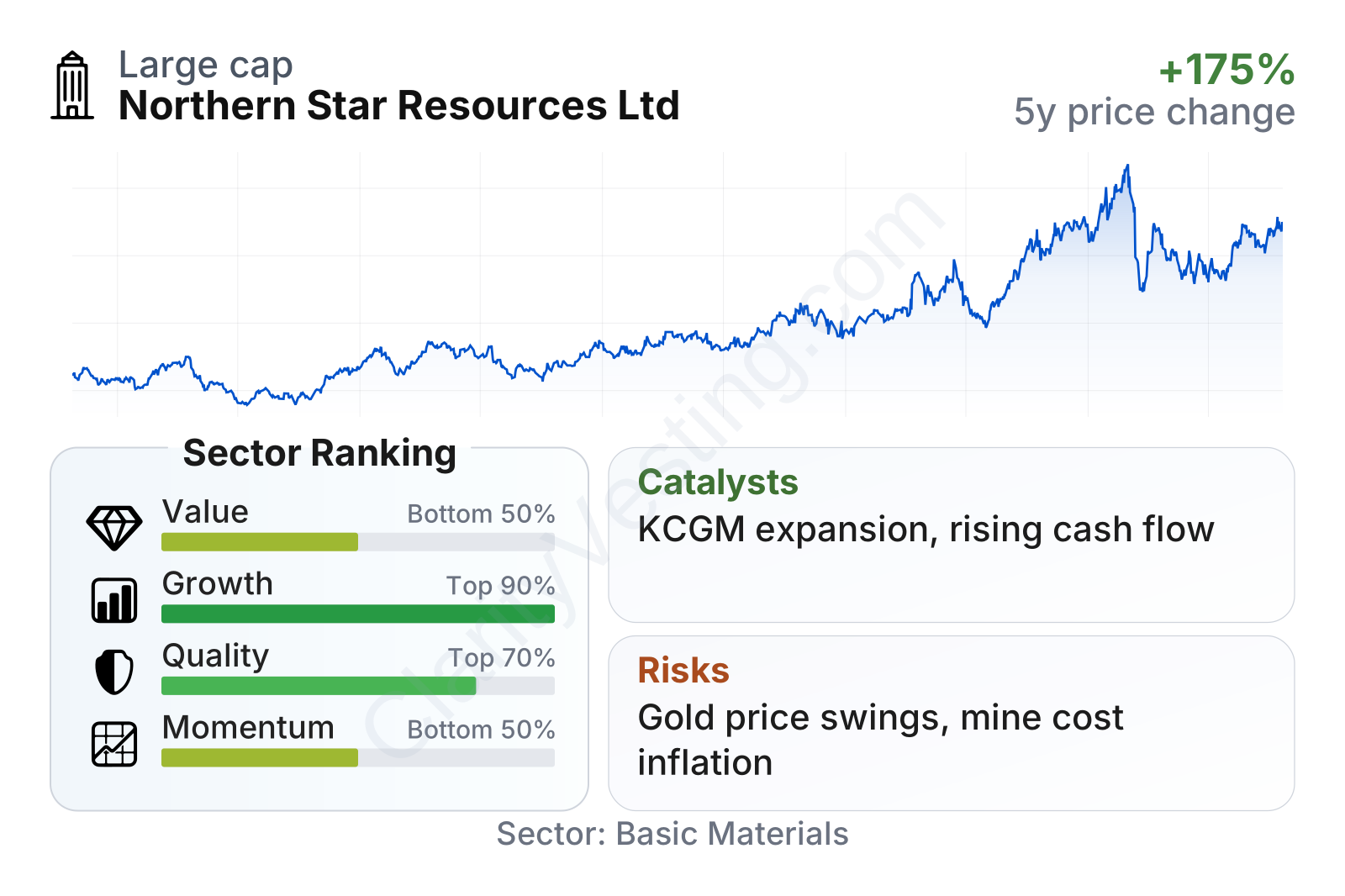
Northern Star is now a large gold producer by market value, with a stock that has been volatile but has climbed sharply over the last several years. On fundamental measures, the profile looks stronger than many peers. Growth metrics rank near the top of the sector, quality indicators are comfortably above average, and leverage remains low. Value is more mixed: the earnings multiple is a little above the sector median, but cash flow yield, dividend yield, and asset-based valuation remain supportive.
The company also stands out for profitability and balance-sheet discipline. Debt levels are modest relative to earnings, and interest coverage is very strong, which gives the group more flexibility than many miners during weaker parts of the commodity cycle.
Growth
Gold mining is not a classic high-volume growth industry, but it is part of a sector benefiting from durable demand drivers: central bank buying, investor demand for hard assets, inflation hedging, and geopolitical uncertainty. In that context, scale, mine life, and low-cost production matter more than raw industry expansion. Northern Star’s strategy fits that logic well. It has concentrated on long-life, large-scale assets in stable mining jurisdictions and has continued investing in processing capacity, mine development, and exploration around existing hubs.
A major growth pillar is the Kalgoorlie platform, especially the long-term development of KCGM. This matters because large gold systems can support production for many years and usually justify infrastructure spending that smaller mines cannot. Northern Star has been repositioning itself toward this kind of asset base, which can improve consistency and reduce dependence on short-life deposits.
Recent operating trends support that strategy. Revenue growth has been well above the sector median, and longer-term per-share growth has also been much stronger than many gold peers. Earnings growth over five years has been particularly strong, showing that scale gains and margin improvement have not been lost to dilution or cost inflation.
Free cash flow has also moved up materially, which is one of the most important signs for a miner. Production growth alone is not enough in this industry; it must convert into cash after capital spending. Northern Star appears to be doing that better than before, and that opens room for dividends, project funding, and balance-sheet resilience without relying heavily on new borrowing.
A meaningful recent catalyst is the company’s ongoing effort to unlock more value from its flagship assets through mine-life extensions, mill upgrades, and operational optimization. In a gold market that has remained supportive, these internal improvements can have a large impact because a modest increase in production or recovery rates can translate into a much larger increase in profit.
Risks
This article is for informational purposes only and does not constitute financial advice. Some content is AI-generated. See Disclaimer


