Stock Analysis · Neogen Corporation (NEOG)
Overview
Neogen Corporation is a food and animal safety company. Its products are used to detect contamination, verify sanitation, test for allergens and pathogens, support livestock and companion animal health, and improve traceability in the food supply chain. In simple terms, Neogen sells tools and services that help food producers, laboratories, farms, and animal health professionals reduce safety risks and meet regulatory and customer standards.
The company’s business is mainly organized around two broad revenue streams. Based on the latest annual filing and company reporting, the mix is approximately:
- Food Safety – about 62% to 66% of revenue: diagnostic tests for pathogens such as Salmonella and Listeria, allergen testing, sanitation verification, genomics-related food quality tools, and broader laboratory products used by food manufacturers and testing facilities.
- Animal Safety – about 34% to 38% of revenue: veterinary instruments and consumables, animal health products, cleaners and disinfectants, supplements, rodent and insect control, biosecurity products, and related items for livestock and companion animals.
A major change in Neogen’s profile came from the combination with 3M’s food safety business, which made the company larger, more international, and more exposed to recurring testing demand from food producers. That transaction also increased debt and integration complexity, which still shape the investment case today.
From a business model perspective, Neogen is attractive because a large share of its sales comes from consumables and routine testing rather than one-time capital equipment. That can support repeat purchases, although profitability has been under pressure since the 3M transaction.
The broad pattern over the last several years is clear: revenue stepped up sharply after the 3M deal, but that increase did not translate smoothly into profit. Gross profit remained substantial, yet selling, administrative, and interest costs absorbed much of the benefit. More recently, operating profit has recovered from the large impairment-driven loss year, but net income is still near break-even to slightly negative.
Key Figures
| Metric | Value | Sector ⓘ |
|---|---|---|
| Date | Oct 17, 2026 | |
| Context | ||
| Sector | Healthcare | |
| Industry | Medical Devices | |
| Market Cap ⓘ | $2.65B | |
| Beta ⓘ | 1.79 | |
Value (Cheapness) | ||
| P/E Ratio ⓘ | N/A | 24.79 |
| P/B Ratio ⓘ | 1.28 | 3.08 |
| FCF Yield ⓘ | 1.88% | 3.15% |
| Dividend Yield ⓘ | N/A | 1.94% |
| EBIT / EV ⓘ | -0.31% | 0.57% |
| PEG ⓘ | 0.66 | |
Growth (Business expansion) | ||
| Revenue Growth ⓘ | 6.50% | 7.45% |
| RPS Growth (5Y CAGR) ⓘ | -4.84% | 8.61% |
| EPS Growth (5Y CAGR) ⓘ | -47.24% | -17.81% |
| BVPS Growth (5Y CAGR) ⓘ | 4.03% | 3.72% |
| Margin Growth (5Y Trend) ⓘ | -5.84% | -0.62% |
| FCF Growth (5Y CAGR) ⓘ | -7.52% | 1.04% |
| DPS Growth (5Y CAGR) ⓘ | N/A | 6.77% |
Quality (Business durability) | ||
| ROIC (Latest) ⓘ | 1.45% | 3.24% |
| ROA (Latest) ⓘ | -1.68% | 3.01% |
| ROIC (5Y Median) ⓘ | 1.34% | 4.60% |
| ROA (5Y Median) ⓘ | -0.23% | 1.89% |
| Net Debt / EBIT (Latest) ⓘ | 12.12 | 1.34 |
| Net Debt / EBIT (5Y Median) ⓘ | 12.25 | 1.84 |
| Net Debt / EBITDA (Latest) ⓘ | 5.73 | 1.00 |
| Net Debt / Assets ⓘ | 18.23% | 5.45% |
| EBITDA / Interest ⓘ | 1.86 | 9.64 |
| Operating Margin (Latest) ⓘ | -1.27% | 9.27% |
| Operating Margin (5Y Median) ⓘ | 5.58% | 7.38% |
| Debt to Equity (Latest) ⓘ | 37.11% | 28.58% |
| Profit Margin (Latest) ⓘ | -6.35% | 3.59% |
| Free Cash Flow (Latest) ⓘ | $49.75M | |
Momentum (Price trend) | ||
| 3Y Return ⓘ | -20.27% | +42.80% |
| 12M Return (excl. last month) ⓘ | +123.95% | +18.50% |
| 6M Return ⓘ | +30.25% | +7.57% |
| Price vs. 200-Day MA ⓘ | +20.16% | +5.12% |
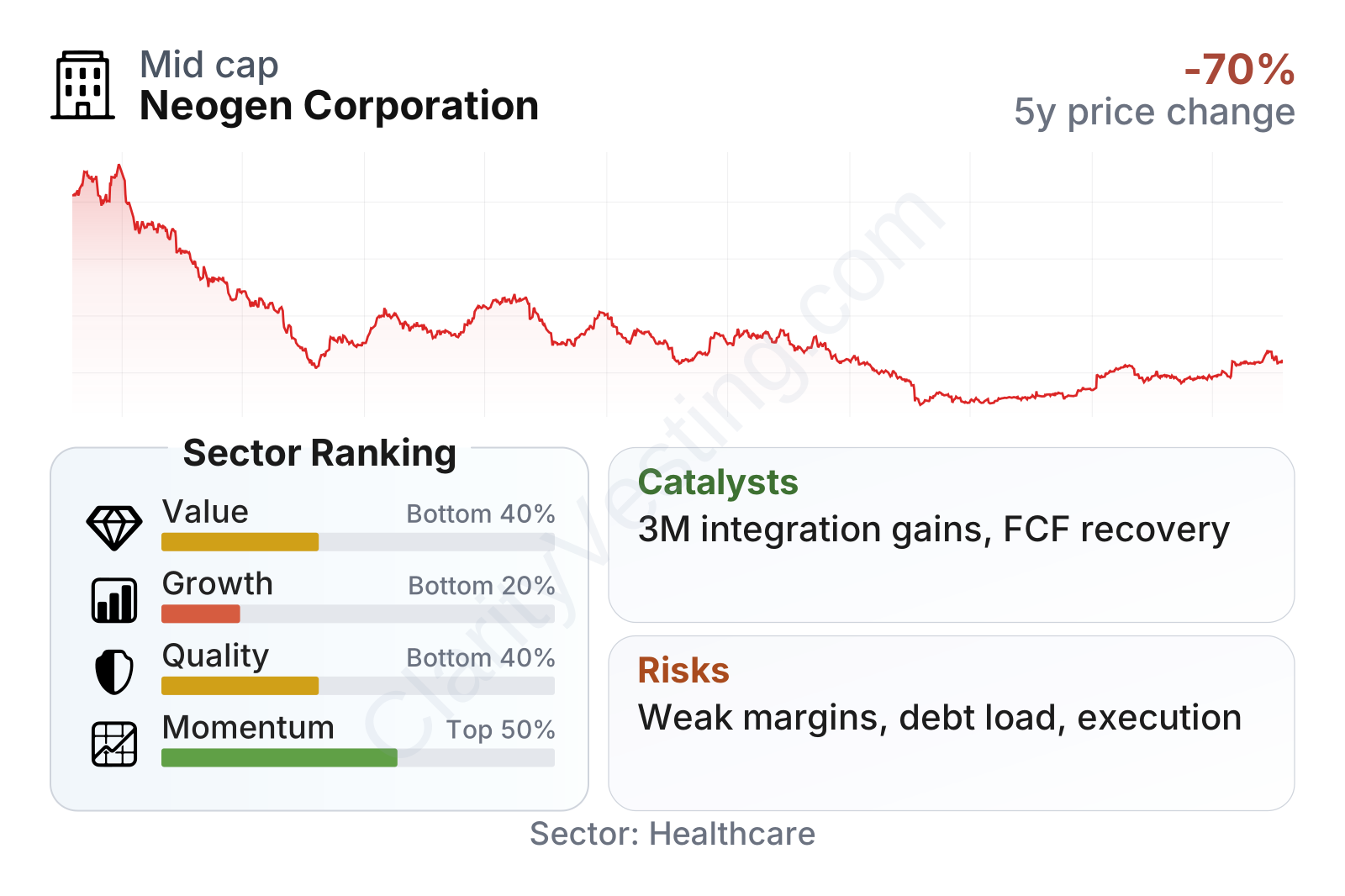
Neogen is now a mid-sized company by market value, with above-average share price volatility for the healthcare sector. The factor profile is mixed: valuation metrics look inexpensive on book value and growth-adjusted earnings assumptions, but quality and growth indicators rank weakly versus sector medians. Profitability remains below typical healthcare peers, while balance-sheet pressure is elevated. On the positive side, recent price momentum has improved noticeably after a very weak longer-term share performance.
The stock chart shows a business that has gone through a major reset. Shares traded far higher in 2021, then declined sharply as integration challenges, weaker margins, and non-cash charges weighed on confidence. The more recent rebound suggests sentiment has stabilized, but the long-term chart still reflects a company that needs to prove a durable turnaround.
Growth
Neogen operates in a sector with long-term structural support. Food safety testing tends to benefit from tighter regulation, rising quality standards, greater supply-chain complexity, and the high cost of product recalls. Animal safety also has durable demand drivers, including biosecurity needs, livestock productivity, and companion animal care. These are not fad markets; they are tied to essential daily activities in food production and animal health.
The company’s strategy also makes industrial sense. The 3M food safety combination broadened Neogen’s menu of products, customer relationships, and geographic reach. In theory, that should create cross-selling opportunities, expand recurring consumables revenue, and make the company more relevant to large food manufacturers and labs looking for a broader testing partner. The main issue is not whether the strategy is logical, but whether management can convert it into cleaner execution and stronger margins.
Recent revenue trends show that the earlier post-acquisition jump has faded, and growth became flat to negative for a stretch before showing a modest improvement most recently. That matters because Neogen is no longer being judged mainly on deal-related scale; it is being judged on whether the combined company can return to steady organic expansion. A return to mid-single-digit growth would be more reassuring than the uneven pattern seen since the merger integration period began.
Cash generation has become a more constructive point. Free cash flow turned positive again after earlier negative periods, which is important for a company carrying meaningful debt. Positive cash flow gives management more flexibility to reduce leverage, fund product development, and support operational improvements without relying as heavily on external financing.
One notable recent opportunity is the continuing rollout and adoption of Neogen’s rapid food testing platforms, particularly in areas where food producers want faster contamination detection and workflow efficiency. Another catalyst is plain operational recovery: if the company keeps simplifying the combined manufacturing and distribution footprint, even modest sales growth could have an outsized effect on earnings because margins are still rebuilding from a low base.
Risks
This article is for informational purposes only and does not constitute financial advice. Some content is AI-generated. See Disclaimer


