Stock Analysis · NeoGenomics Inc (NEO)
Overview
NeoGenomics is a cancer diagnostics company focused on testing and information services used by oncologists, pathologists, hospitals, and biopharma companies. In simple terms, it helps detect, classify, and monitor cancer through laboratory testing, and it also supports drug developers running clinical trials and companion diagnostics programs. The business sits at the intersection of oncology, precision medicine, and laboratory services, which makes it more specialized than a broad routine-testing lab.
Its revenue mainly comes from two operating areas disclosed in company filings: clinical services and advanced diagnostics / pharma services. Clinical services cover tests ordered for patient care, while the biopharma-related side supports pharmaceutical and biotechnology customers with testing, trial services, and development work tied to targeted therapies. Based on recent annual reporting, the mix appears to be weighted toward clinical testing, with biopharma and advanced services representing a meaningful secondary contributor.
- Clinical Services: approximately 70% to 75% of revenue. This includes oncology testing for community oncologists, hospital systems, pathologists, and other providers.
- Advanced Diagnostics and Pharma Services: approximately 25% to 30% of revenue. This includes biomarker testing, companion diagnostics support, clinical trial services, and work performed for drug developers.
The revenue profile matters because clinical testing can provide recurring demand tied to patient volumes, while pharma services can offer higher-value growth opportunities when precision medicine adoption expands. Over the last several years, total revenue has moved up from roughly $484 million in 2021 to about $727 million in 2025, showing that demand has grown even though profitability has remained under pressure. One visible shift, however, is that costs and operating expenses have also stayed heavy, which has limited the conversion of sales growth into earnings.
The long-term pattern is encouraging on the top line: revenue has expanded meaningfully since 2021. But the flow of revenue into profit is still weak, with selling, administrative, and research spending continuing to absorb most of gross profit. That makes NeoGenomics a growth-oriented diagnostics company still working through its operating model rather than a mature cash-generating lab business.
Key Figures
| Metric | Value | Sector ⓘ |
|---|---|---|
| Date | Oct 03, 2026 | |
| Context | ||
| Sector | Healthcare | |
| Industry | Diagnostics & Research | |
| Market Cap ⓘ | $2.36B | |
| Beta ⓘ | 1.75 | |
Value (Cheapness) | ||
| P/E Ratio ⓘ | N/A | 24.06 |
| P/B Ratio ⓘ | 0.59 | 3.08 |
| FCF Yield ⓘ | -0.31% | 3.07% |
| Dividend Yield ⓘ | N/A | 2.05% |
| EBIT / EV ⓘ | -1.98% | 0.63% |
| PEG ⓘ | 2.09 | |
Growth (Business expansion) | ||
| Revenue Growth ⓘ | 11.20% | 7.50% |
| RPS Growth (5Y CAGR) ⓘ | 8.90% | 8.70% |
| EPS Growth (5Y CAGR) ⓘ | N/A | -18.20% |
| BVPS Growth (5Y CAGR) ⓘ | -8.31% | 3.95% |
| Margin Growth (5Y Trend) ⓘ | N/A | -0.58% |
| FCF Growth (5Y CAGR) ⓘ | -30.03% | 0.88% |
| DPS Growth (5Y CAGR) ⓘ | N/A | 6.80% |
Quality (Business durability) | ||
| ROIC (Latest) ⓘ | -3.40% | 3.29% |
| ROA (Latest) ⓘ | -3.80% | 3.02% |
| ROIC (5Y Median) ⓘ | -6.34% | 4.75% |
| ROA (5Y Median) ⓘ | -5.14% | 1.93% |
| Net Debt / EBIT (Latest) ⓘ | N/A | 1.33 |
| Net Debt / EBIT (5Y Median) ⓘ | N/A | 1.83 |
| Net Debt / EBITDA (Latest) ⓘ | 23.50 | 0.99 |
| Net Debt / Assets ⓘ | 22.39% | 5.33% |
| EBITDA / Interest ⓘ | 4.99 | 9.63 |
| Operating Margin (Latest) ⓘ | -6.86% | 9.25% |
| Operating Margin (5Y Median) ⓘ | -14.64% | 7.80% |
| Debt to Equity (Latest) ⓘ | 57.06% | 28.99% |
| Profit Margin (Latest) ⓘ | -6.77% | 3.60% |
| Free Cash Flow (Latest) ⓘ | -$7.36M | |
Momentum (Price trend) | ||
| 3Y Return ⓘ | +49.41% | +37.48% |
| 12M Return (excl. last month) ⓘ | +98.75% | +20.85% |
| 6M Return ⓘ | +129.42% | +9.73% |
| Price vs. 200-Day MA ⓘ | +44.64% | +4.69% |
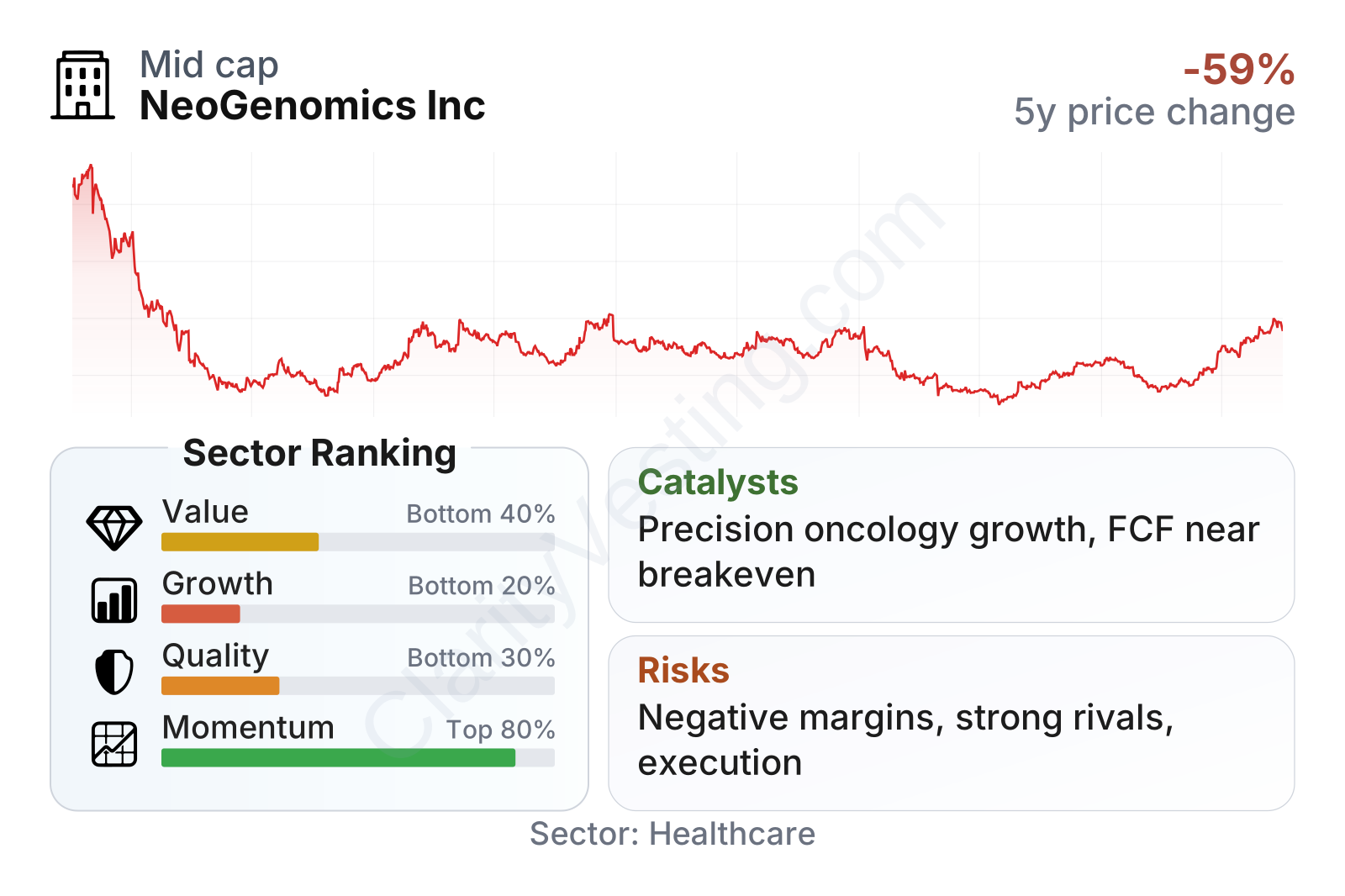
NeoGenomics is a mid-sized healthcare company with a stock that has been notably volatile. Price momentum has improved sharply over the past year, but the underlying business metrics remain mixed. Revenue growth has recently run above the healthcare sector median, while profitability, cash generation, and returns on capital still rank below average. The balance between improving growth and weak margins is the central point to watch.
The valuation profile is also unusual. Traditional earnings-based measures are not very helpful when a company is still losing money, so balance-sheet and operating-trend indicators become more important. The stock has recently traded with strong momentum despite below-sector quality metrics, which suggests the market is focusing more on future improvement than on present profitability.
Growth
NeoGenomics operates in a part of healthcare that has attractive structural support. Cancer incidence, broader use of molecular testing, and the rise of targeted therapies all support continued demand for more specialized diagnostics. Precision oncology is one of the clearer long-term growth areas in healthcare because treatment decisions increasingly depend on identifying specific biomarkers rather than relying only on traditional pathology.
The company’s strategy broadly fits that trend. It has built a platform around oncology testing, a national laboratory footprint, and relationships with biopharma customers. That combination can matter because drug developers increasingly need diagnostics partners that can help identify patients for trials and support companion diagnostics tied to approved therapies. If more cancer drugs are approved with biomarker-linked testing, specialized labs such as NeoGenomics can benefit from both clinical and biopharma demand.
Recent growth has been steady rather than explosive. Year-over-year revenue growth has stayed around the low double digits lately, which is ahead of the sector median and shows that demand has not stalled. The more important question is whether NeoGenomics can maintain that pace while improving efficiency. Revenue growth alone is not enough if each new dollar of sales still carries too much overhead.
Cash flow trends are one of the more constructive developments. Free cash flow has remained negative, but the deficit has narrowed substantially over time, moving much closer to break-even than it was a few years ago. That suggests the business may be progressing toward better operating discipline, even if it has not yet crossed into consistent self-funded growth.
One recent opportunity highlighted by company communications has been continued expansion in oncology testing capabilities and pharma-services activity. The strategic logic is clear: clinical testing provides recurring case volume, while pharma services can deepen ties to the precision medicine pipeline. If both areas scale together, the company could improve utilization across its lab network and spread fixed costs more effectively.
Risks
This article is for informational purposes only and does not constitute financial advice. Some content is AI-generated. See Disclaimer