Stock Analysis · Nextera Energy Inc (NEE)
Overview
NextEra Energy is one of the largest electric power companies in the United States. Its business is built around two main pillars. The first is a regulated utility in Florida, Florida Power & Light, which generates, transmits, distributes, and sells electricity to residential, commercial, and industrial customers. The second is a large energy infrastructure and power development platform, NextEra Energy Resources, which develops and operates wind, solar, battery storage, natural gas, and nuclear-related assets and also serves wholesale power markets.
This mix matters for long-term analysis because regulated utilities usually provide steadier earnings and cash flow visibility, while the energy resources business adds a stronger growth engine tied to renewable power demand, grid expansion, and long-dated energy contracts.
Based on the company’s latest annual reporting structure, revenue is primarily generated from the following sources:
- Florida Power & Light (regulated electric utility): approximately 55% to 65% of total operating revenue in recent years. This includes retail electricity sales, fuel and other cost recovery mechanisms, and related regulated services in Florida.
- NextEra Energy Resources: approximately 35% to 45% of total operating revenue. This includes wholesale electricity sales, contracted renewable generation, battery storage, natural gas pipeline-related activities, and other energy marketing operations.
- Corporate and other activities: low single-digit share when reported separately, including intercompany eliminations and smaller non-core items that can vary meaningfully by year.
The broader financial flow shows a company that has expanded revenue materially over the last several years, while maintaining strong operating profitability even as interest expense has become a much larger claim on earnings. That pattern is typical of a capital-intensive utility expanding aggressively, but it also puts financing conditions at the center of the investment case.
Key Figures
| Metric | Value | Sector ⓘ |
|---|---|---|
| Date | Oct 17, 2026 | |
| Context | ||
| Sector | Utilities | |
| Industry | Utilities - Regulated Electric | |
| Market Cap ⓘ | $163.17B | |
| Beta ⓘ | 0.64 | |
Value (Cheapness) | ||
| P/E Ratio ⓘ | 17.58 | 17.28 |
| P/B Ratio ⓘ | 3.55 | 1.51 |
| FCF Yield ⓘ | 1.87% | 0.65% |
| Dividend Yield ⓘ | 3.03% | 3.77% |
| EBIT / EV ⓘ | 3.90% | 5.01% |
| PEG ⓘ | 1.55 | |
Growth (Business expansion) | ||
| Revenue Growth ⓘ | 12.40% | 6.10% |
| RPS Growth (5Y CAGR) ⓘ | 11.03% | 3.87% |
| EPS Growth (5Y CAGR) ⓘ | -6.74% | -11.30% |
| BVPS Growth (5Y CAGR) ⓘ | 8.62% | 4.23% |
| Margin Growth (5Y Trend) ⓘ | 10.34% | 3.57% |
| FCF Growth (5Y CAGR) ⓘ | N/A | -8.84% |
| DPS Growth (5Y CAGR) ⓘ | 9.94% | 4.84% |
Quality (Business durability) | ||
| ROIC (Latest) ⓘ | 7.46% | 6.53% |
| ROA (Latest) ⓘ | 4.25% | 3.20% |
| ROIC (5Y Median) ⓘ | 6.17% | 5.95% |
| ROA (5Y Median) ⓘ | 3.39% | 2.75% |
| Net Debt / EBIT (Latest) ⓘ | 10.27 | 7.13 |
| Net Debt / EBIT (5Y Median) ⓘ | 10.20 | 7.23 |
| Net Debt / EBITDA (Latest) ⓘ | 6.10 | 4.31 |
| Net Debt / Assets ⓘ | 46.10% | 38.42% |
| EBITDA / Interest ⓘ | 5.01 | 4.58 |
| Operating Margin (Latest) ⓘ | 36.02% | 20.83% |
| Operating Margin (5Y Median) ⓘ | 33.13% | 20.08% |
| Debt to Equity (Latest) ⓘ | 192.90% | 137.69% |
| Profit Margin (Latest) ⓘ | 32.40% | 11.37% |
| Free Cash Flow (Latest) ⓘ | $3.05B | |
Momentum (Price trend) | ||
| 3Y Return ⓘ | +57.22% | +52.37% |
| 12M Return (excl. last month) ⓘ | +17.22% | +8.84% |
| 6M Return ⓘ | -12.89% | -3.95% |
| Price vs. 200-Day MA ⓘ | -9.16% | -0.79% |
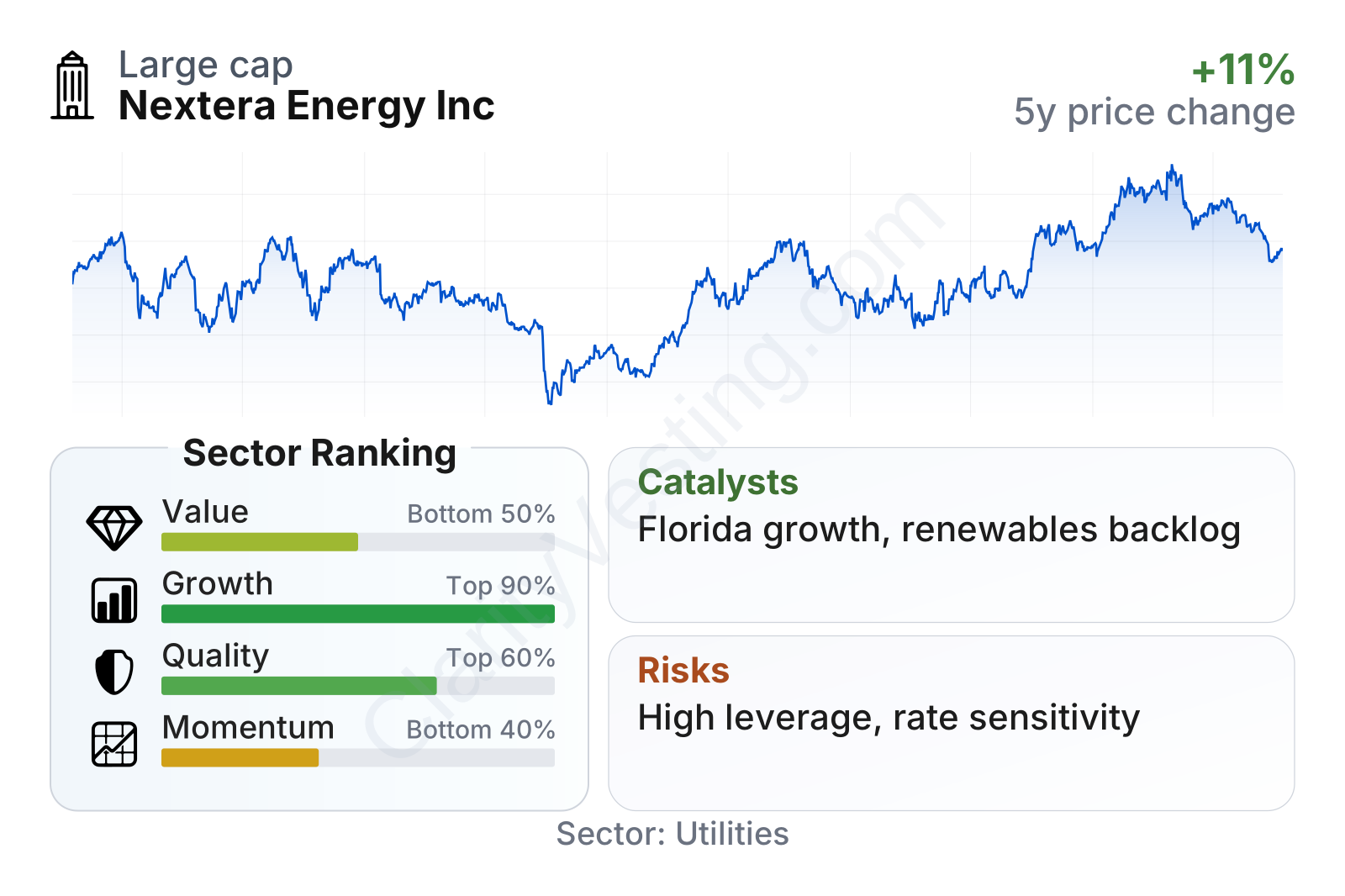
NextEra Energy is a very large utility with relatively low share-price volatility, as shown by its beta well below 1. On fundamentals, the profile is mixed but clear: growth ranks near the top of the sector, quality is above average, value is weaker, and recent market momentum has lagged. Profitability stands out, with operating and net margins well above sector medians, while leverage and negative trailing free cash flow reduce the margin of safety. The stock has also had a volatile path in recent years, with a sharp drop in 2023 followed by a strong rebound and then some pullback, showing how sensitive utility valuations can be to interest-rate expectations.
Growth
NextEra Energy operates in a sector with durable long-term demand. Electricity use is supported by population growth, electrification of transport and heating, industrial reshoring, and a rising need for data center capacity. At the same time, utilities and power developers are central to the buildout of solar, wind, storage, transmission, and grid modernization. That gives the company exposure both to defensive utility demand and to structural energy transition spending.
The strategy is coherent. Florida remains one of the faster-growing large states in the U.S., which supports customer additions and regulated capital investment opportunities at Florida Power & Light. On top of that, NextEra Energy Resources gives the group a nationwide platform in renewables and storage at a scale that few competitors can match. This combination of local regulated growth and national clean-energy development is a major reason the company has historically grown faster than a typical utility.
Revenue per share has trended upward strongly over the last five years, despite some year-to-year fluctuations. That matters because it suggests growth has not depended only on issuing more shares or relying solely on accounting effects. The company’s five-year revenue-per-share growth rate is well above the sector median, and book value growth and dividend growth have also outpaced many peers.
Free cash flow deserves a careful reading. The recent pattern shows that cash generation can improve sharply in some periods, but it remains uneven because the business spends heavily on long-lived infrastructure. This is common in utilities and renewable developers: large capital programs can pressure free cash flow in the short run while aiming to build future rate base, contracted generation, and earnings. For NextEra, that means growth is visible, but it is capital-hungry.
Recent company updates have continued to emphasize a large renewable and storage development backlog, ongoing investment in Florida’s grid and generation fleet, and a favorable runway from population and economic growth in its regulated territory. Those are meaningful catalysts because they support both earnings expansion and the case for sustained capital deployment over many years.
Risks
This article is for informational purposes only and does not constitute financial advice. Some content is AI-generated. See Disclaimer


