Stock Analysis · Noble Corporation plc (NE)
Overview
Noble Corporation plc is an offshore drilling contractor. In simple terms, it owns and operates large drilling rigs that energy companies rent when they want to drill oil and gas wells in offshore areas. Noble does not usually own the oil or gas being produced. Its business is to provide the rigs, crews, technical operations, and related drilling services needed to help customers explore for and produce hydrocarbons at sea.
The company’s fleet is focused on two main rig categories: floaters, which are used mainly in deeper water, and jackups, which are used mainly in shallower offshore fields. Its customers are typically large oil and gas producers, including national oil companies, majors, and independent exploration and production companies. Because contracts are often multi-year and dayrates can be high, results depend heavily on fleet utilization, contract pricing, and how much offshore spending customers commit each year.
Noble reports revenue largely as contract drilling services rather than through many separate product lines, so exact revenue percentages by business line are not always broken out in a simple way in headline reporting. Based on the company’s fleet structure and industry economics, the main revenue sources can be summarized as follows:
- Floaters: approximately 55% to 65% of revenue. This includes drillships and semisubmersibles used in deepwater and harsh-environment drilling, where dayrates are generally higher.
- Jackups: approximately 35% to 45% of revenue. These rigs serve shallower-water projects, often with shorter-cycle development work and, in some regions, stronger contract turnover.
- Other operating and reimbursable items: typically a small share of revenue. This can include customer reimbursements and other contract-related service items.
Noble became larger and broader through consolidation, especially after combining with Maersk Drilling and later agreeing to acquire Diamond Offshore. That matters because scale is important in offshore drilling: larger fleets can improve customer reach, fleet flexibility, and bargaining power when contract markets are tight.
The longer financial picture shows a business that recovered strongly as offshore demand improved. Revenue expanded sharply between 2022 and 2025, but profit conversion became less favorable more recently as interest expense increased and margins came down from prior highs.
The business has clearly grown since 2021, with revenue rising from under $1 billion to above $3 billion by 2025. Even so, a larger share of operating gains has been absorbed by higher costs and interest expense, which helps explain why net income has not kept pace with revenue growth in the same way.
Key Figures
| Metric | Value | Sector ⓘ |
|---|---|---|
| Date | Oct 03, 2026 | |
| Context | ||
| Sector | Energy | |
| Industry | Oil & Gas Drilling | |
| Market Cap ⓘ | $6.70B | |
| Beta ⓘ | 0.93 | |
Value (Cheapness) | ||
| P/E Ratio ⓘ | 45.10 | 14.47 |
| P/B Ratio ⓘ | 1.50 | 1.70 |
| FCF Yield ⓘ | 4.24% | 8.66% |
| Dividend Yield ⓘ | 4.69% | 3.77% |
| EBIT / EV ⓘ | 3.96% | 7.46% |
| PEG ⓘ | N/A | |
Growth (Business expansion) | ||
| Revenue Growth ⓘ | -16.30% | 27.35% |
| RPS Growth (5Y CAGR) ⓘ | 9.84% | 6.75% |
| EPS Growth (5Y CAGR) ⓘ | -32.68% | -15.45% |
| BVPS Growth (5Y CAGR) ⓘ | 3.30% | 5.85% |
| Margin Growth (5Y Trend) ⓘ | -32.51% | 0.75% |
| FCF Growth (5Y CAGR) ⓘ | N/A | 3.62% |
| DPS Growth (5Y CAGR) ⓘ | 1762.49% | 16.85% |
Quality (Business durability) | ||
| ROIC (Latest) ⓘ | 6.06% | 11.33% |
| ROA (Latest) ⓘ | 2.01% | 6.03% |
| ROIC (5Y Median) ⓘ | 14.26% | 10.16% |
| ROA (5Y Median) ⓘ | 6.66% | 5.34% |
| Net Debt / EBIT (Latest) ⓘ | 4.23 | 1.62 |
| Net Debt / EBIT (5Y Median) ⓘ | 0.84 | 1.91 |
| Net Debt / EBITDA (Latest) ⓘ | 1.57 | 1.06 |
| Net Debt / Assets ⓘ | 19.78% | 17.29% |
| EBITDA / Interest ⓘ | 5.74 | 9.64 |
| Operating Margin (Latest) ⓘ | 11.04% | 16.32% |
| Operating Margin (5Y Median) ⓘ | 19.18% | 19.53% |
| Debt to Equity (Latest) ⓘ | 42.12% | 54.41% |
| Profit Margin (Latest) ⓘ | 5.19% | 8.79% |
| Free Cash Flow (Latest) ⓘ | $283.92M | |
Momentum (Price trend) | ||
| 3Y Return ⓘ | -1.15% | +62.93% |
| 12M Return (excl. last month) ⓘ | +67.94% | +44.83% |
| 6M Return ⓘ | -13.11% | -1.62% |
| Price vs. 200-Day MA ⓘ | -1.03% | +5.18% |
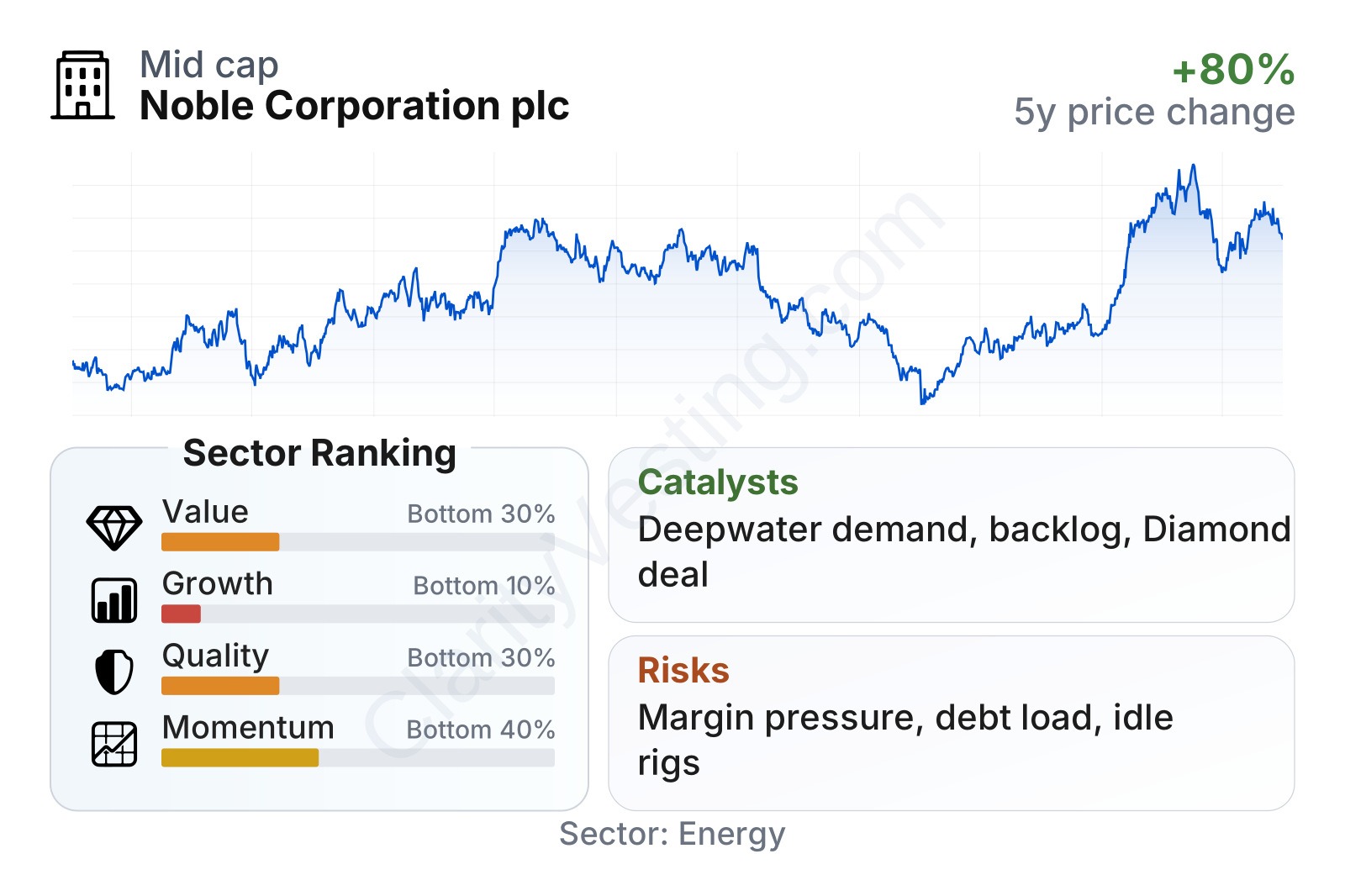
Noble is a mid-sized energy services company with stock volatility slightly below the broader market. The current profile is mixed: income return is supported by a dividend yield above the sector median, but valuation measures tied to earnings and operating value sit in a weaker relative position. Quality and growth rankings are also on the lower side at the moment, reflecting softer recent revenue trends, thinner margins, and higher leverage compared with earlier periods.
The stock price history shows how cyclical the name is. It moved through a strong upcycle into 2024, suffered a sharp drop during 2025, and then rebounded strongly into 2026. That pattern is consistent with how offshore drillers trade: expectations around dayrates, contract awards, utilization, and oil company spending can quickly change market sentiment.
Growth
Offshore drilling is in a better industry position than it was several years ago. After a long downturn, global offshore spending has improved because many oil companies want long-life reserves, stable production, and project economics that still work at moderate oil prices. Deepwater in particular has regained relevance because some fields can generate attractive returns once infrastructure and drilling programs are in place. That creates a supportive backdrop for contractors with modern rigs.
Noble’s strategy is logical for this environment. The company has focused on high-specification offshore rigs, commercial discipline, and fleet scale. In offshore drilling, size matters because customers prefer contractors that can offer several rigs across regions and maintain strong operating standards. Noble’s consolidation moves fit that logic. The Diamond Offshore acquisition, announced previously and advanced through 2025, expanded exposure to floating rigs and added more presence in important offshore basins.
Recent growth has become less linear than the earlier recovery period. Year-over-year revenue growth was exceptionally strong during the rebound phase in 2022 and 2023, remained positive in much of 2024 and early 2025, and then turned negative in the latest periods. That slowdown does not necessarily mean the industry backdrop has broken down, but it does show that Noble is now moving from recovery-driven growth into a phase where contract timing, rig downtime, and integration execution matter more.
Free cash flow has improved materially from negative territory in 2022 to clearly positive levels more recently. That is important because offshore drillers need meaningful cash generation to handle maintenance, debt service, and shareholder distributions. Noble’s ability to produce positive free cash flow through the current cycle is one of the more constructive parts of the thesis, even if the latest trailing figure is below the recent peak shown elsewhere in its metrics.
There are also practical catalysts for future activity. Offshore rig supply remains relatively constrained, especially for high-quality assets, because the industry spent years underinvesting and scrapping older equipment. When supply is tight, contract dayrates can stay firm. Noble has also continued to announce fleet contracts and backlog additions through company communications, which support revenue visibility over multiple years. In a business known for swings, backlog is one of the clearest indicators of future operating activity.
A notable opportunity comes from the company’s larger and more diversified fleet after consolidation. If management executes well, Noble can benefit from more cross-selling to customers, improved fleet allocation across regions, and stronger bargaining leverage in negotiations. The broad industry setup still appears healthier than it was in the late 2010s, even if near-term growth rates are no longer as explosive as during the initial rebound.
Risks
This article is for informational purposes only and does not constitute financial advice. Some content is AI-generated. See Disclaimer