Stock Analysis · Nordson Corporation (NDSN)
Overview
Nordson Corporation is an industrial technology company that makes highly engineered equipment used to dispense, apply, inspect, test, and treat materials with precision. In simple terms, its machines help manufacturers put the right amount of adhesive, coating, sealant, polymer, fluid, or electronic material exactly where it needs to go. Its products are used in everyday end markets such as packaging, consumer non-durables, electronics, medical devices, and broader industrial manufacturing.
Nordson’s business is built around specialized production equipment rather than mass-market machinery. That matters because customers often integrate Nordson systems into critical manufacturing steps, which can support recurring sales of replacement parts, upgrades, and consumables after the original machine is installed.
Based on the company’s recent reporting structure, revenue comes mainly from three segments:
- Industrial Precision Solutions: approximately 44% of revenue. This segment includes adhesive dispensing, coating, and other precision systems used in packaging, product assembly, and industrial processes.
- Medical and Fluid Solutions: approximately 31% of revenue. This business includes precision components and systems used in medical applications and fluid management, including single-use and specialized healthcare-related products.
- Advanced Technology Solutions: approximately 25% of revenue. This segment focuses on electronics, semiconductor-related testing and dispensing, and other high-precision technology manufacturing applications.
Geographically, Nordson is a global company with a meaningful presence in the Americas, Europe, and Asia-Pacific, which gives it access to multiple manufacturing regions but also exposes it to swings in worldwide industrial demand.
The business mix also shows an appealing characteristic: revenue is spread across several end markets rather than relying on one customer group alone. Over the last several years, sales have trended upward overall, while profitability has remained notably strong for an industrial company.
Over time, revenue has increased from about $2.4 billion to roughly $2.8 billion, while gross profit has also expanded. Operating income has held up well, showing that Nordson has preserved strong economics even as interest expense moved higher.
Key Figures
| Metric | Value | Sector ⓘ |
|---|---|---|
| Date | Oct 17, 2026 | |
| Context | ||
| Sector | Industrials | |
| Industry | Specialty Industrial Machinery | |
| Market Cap ⓘ | $18.41B | |
| Beta ⓘ | 0.99 | |
Value (Cheapness) | ||
| P/E Ratio ⓘ | 33.46 | 22.10 |
| P/B Ratio ⓘ | 5.63 | 1.97 |
| FCF Yield ⓘ | 3.96% | 6.38% |
| Dividend Yield ⓘ | 0.99% | 1.94% |
| EBIT / EV ⓘ | 4.08% | 4.79% |
| PEG ⓘ | 1.83 | |
Growth (Business expansion) | ||
| Revenue Growth ⓘ | 10.30% | 9.30% |
| RPS Growth (5Y CAGR) ⓘ | 5.09% | 7.81% |
| EPS Growth (5Y CAGR) ⓘ | -2.79% | -13.06% |
| BVPS Growth (5Y CAGR) ⓘ | 9.82% | 6.14% |
| Margin Growth (5Y Trend) ⓘ | -0.36% | 0.88% |
| FCF Growth (5Y CAGR) ⓘ | 6.83% | 11.01% |
| DPS Growth (5Y CAGR) ⓘ | 17.28% | 9.48% |
Quality (Business durability) | ||
| ROIC (Latest) ⓘ | 13.01% | 10.84% |
| ROA (Latest) ⓘ | 9.36% | 5.41% |
| ROIC (5Y Median) ⓘ | 25.78% | 9.38% |
| ROA (5Y Median) ⓘ | 10.75% | 4.95% |
| Net Debt / EBIT (Latest) ⓘ | 2.13 | 2.08 |
| Net Debt / EBIT (5Y Median) ⓘ | 2.73 | 2.27 |
| Net Debt / EBITDA (Latest) ⓘ | 1.80 | 1.39 |
| Net Debt / Assets ⓘ | 28.60% | 19.28% |
| EBITDA / Interest ⓘ | 8.27 | 9.58 |
| Operating Margin (Latest) ⓘ | 26.84% | 10.50% |
| Operating Margin (5Y Median) ⓘ | 25.39% | 10.29% |
| Debt to Equity (Latest) ⓘ | 55.50% | 65.48% |
| Profit Margin (Latest) ⓘ | 18.63% | 6.67% |
| Free Cash Flow (Latest) ⓘ | $728.49M | |
Momentum (Price trend) | ||
| 3Y Return ⓘ | +53.39% | +61.68% |
| 12M Return (excl. last month) ⓘ | +39.87% | +12.58% |
| 6M Return ⓘ | +18.51% | 0.00% |
| Price vs. 200-Day MA ⓘ | +13.63% | +0.02% |
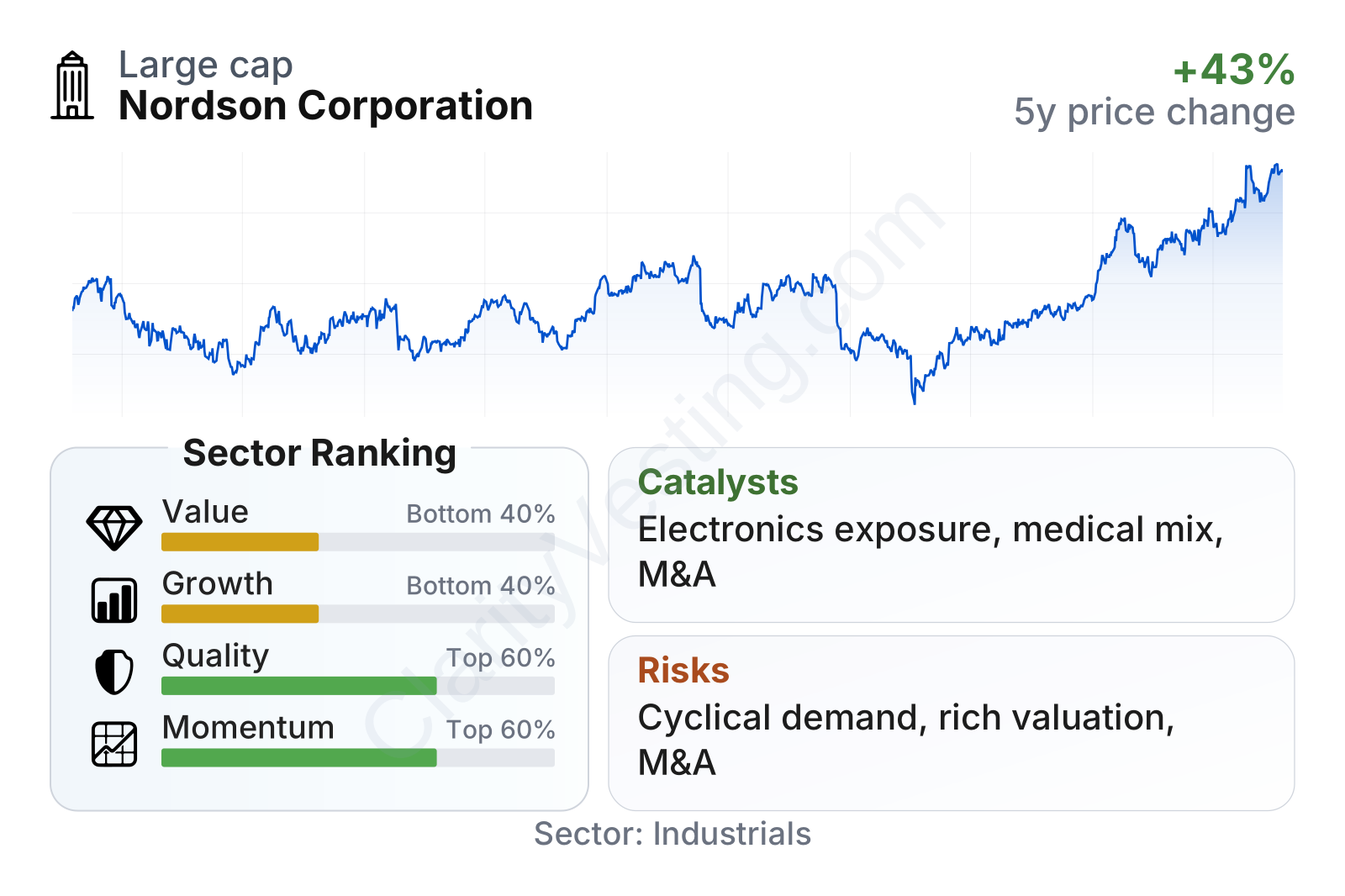
Nordson stands out more for business quality than for cheapness. Profitability is clearly above typical sector levels, with operating margin around 27% and profit margin near 19%, both well ahead of the industry median. Returns on capital and assets are also strong. On the other hand, valuation metrics sit on the richer side, and long-term growth metrics are more mixed than the current share price might suggest.
The stock has also shown solid recent momentum, with stronger medium-term price performance than much of the industrial sector. That can reflect improving sentiment around the company’s exposure to electronics, medical, and precision manufacturing.
Growth
Nordson operates in parts of the industrial market that still have long-term growth drivers. Precision dispensing and inspection benefit from manufacturers wanting less waste, tighter quality control, more automation, and higher throughput. In medical technology, demand is supported by healthcare usage and the need for highly specialized components. In electronics and semiconductor-related areas, rising complexity in chips and packaging can create demand for more precise equipment.
The company’s strategy also looks coherent for long-term expansion. Nordson has historically combined internal product development with acquisitions, using its niche positions to enter adjacent markets where precision and reliability matter more than price alone. That approach makes sense because specialized industrial equipment often rewards companies that build application know-how and close customer relationships over many years.
Recent revenue growth has improved again after a choppier period. The latest year-over-year figures are running around high-single-digit to low-double-digit percentages, which suggests business conditions have strengthened compared with the softer patches seen earlier.
Cash generation remains an important support for the growth case. Free cash flow has been uneven from year to year, but the overall level is strong, recently running in the several-hundred-million-dollar range. That gives Nordson room for acquisitions, debt reduction, dividends, and reinvestment without depending heavily on external financing.
A meaningful catalyst is the company’s exposure to electronics and test-related markets through its Advanced Technology Solutions segment, especially as semiconductor packaging and electronics manufacturing become more demanding. Medical and fluid solutions also add a steadier structural growth layer than a purely cyclical industrial portfolio. In addition, Nordson’s installed base can help it grow service, parts, and recurring aftermarket revenue as customers continue using its systems.
Recent company communications have also highlighted portfolio actions and ongoing investment in higher-value end markets, reinforcing the idea that Nordson is trying to tilt the business toward segments with better long-term demand and margin potential rather than simply chasing volume.
Risks
This article is for informational purposes only and does not constitute financial advice. Some content is AI-generated. See Disclaimer


