Stock Analysis · Nine Dragons Paper Holdings Ltd (NDGPY)
Overview
Nine Dragons Paper Holdings Ltd is one of the largest containerboard and packaging paper producers in China. The company mainly turns recovered paper, wood pulp, and other fiber inputs into industrial paper products used to make shipping boxes, consumer goods packaging, and other corrugated packaging materials. It also has upstream pulp operations and some exposure to downstream packaging-related products, which gives it a broader role across the paper packaging value chain.
Its business is closely tied to manufacturing output, export activity, domestic consumption, and the long-term shift toward packaged delivery and retail distribution. In simple terms, when more goods are produced, moved, and delivered, demand for containerboard and related paper products tends to rise.
Based on company reporting, revenue is primarily generated from packaging paper products, with a smaller contribution from pulp and related businesses. The mix can vary with pricing and market conditions, but the broad structure is as follows:
- Packaging paper: approximately 80% to 90% of revenue. This includes containerboard, linerboard, high-performance corrugating medium, coated duplex board, and other paper grades used in boxes and industrial packaging.
- Pulp products: approximately 10% to 20% of revenue. This includes virgin pulp and other fiber-related materials used internally and sold externally.
- Other operations: a small share of revenue. This may include paper-related raw materials, recycled fiber activities, and ancillary products depending on the reporting period.
The recent financial flow also shows a meaningful recovery in operating performance. Revenue and gross profit improved strongly in the latest year after a weak 2023 period, suggesting that pricing, volumes, or input costs moved back in a more favorable direction. That matters for a paper producer because small changes in margins can have a large impact on earnings.
Key Figures
| Metric | Value | Sector ⓘ |
|---|---|---|
| Date | Oct 17, 2026 | |
| Context | ||
| Sector | Basic Materials | |
| Industry | Paper & Paper Products | |
| Market Cap ⓘ | $3.23B | |
| Beta ⓘ | 1.28 | |
Value (Cheapness) | ||
| P/E Ratio ⓘ | 6.35 | 16.90 |
| P/B Ratio ⓘ | 0.06 | 1.65 |
| FCF Yield ⓘ | -305.09% | 5.76% |
| Dividend Yield ⓘ | N/A | 2.13% |
| EBIT / EV ⓘ | 69.26% | 6.30% |
| PEG ⓘ | N/A | |
Growth (Business expansion) | ||
| Revenue Growth ⓘ | 26.90% | 11.10% |
| RPS Growth (5Y CAGR) ⓘ | 4.31% | 4.49% |
| EPS Growth (5Y CAGR) ⓘ | 14.74% | -13.47% |
| BVPS Growth (5Y CAGR) ⓘ | 1.98% | 5.51% |
| Margin Growth (5Y Trend) ⓘ | 2.28% | -1.54% |
| FCF Growth (5Y CAGR) ⓘ | -20.66% | 0.37% |
| DPS Growth (5Y CAGR) ⓘ | -29.24% | 6.08% |
Quality (Business durability) | ||
| ROIC (Latest) ⓘ | N/A | 9.26% |
| ROA (Latest) ⓘ | 4.05% | 4.91% |
| ROIC (5Y Median) ⓘ | 2.88% | 7.70% |
| ROA (5Y Median) ⓘ | 1.51% | 3.86% |
| Net Debt / EBIT (Latest) ⓘ | 8.07 | 1.40 |
| Net Debt / EBIT (5Y Median) ⓘ | 14.37 | 1.70 |
| Net Debt / EBITDA (Latest) ⓘ | 4.37 | 0.95 |
| Net Debt / Assets ⓘ | 50.16% | 13.69% |
| EBITDA / Interest ⓘ | 5.43 | 12.34 |
| Operating Margin (Latest) ⓘ | 7.08% | 13.20% |
| Operating Margin (5Y Median) ⓘ | 6.19% | 11.80% |
| Debt to Equity (Latest) ⓘ | 180.42% | 40.56% |
| Profit Margin (Latest) ⓘ | 5.28% | 6.43% |
| Free Cash Flow (Latest) ⓘ | -$9.86B | |
Momentum (Price trend) | ||
| 3Y Return ⓘ | +18.72% | +68.89% |
| 12M Return (excl. last month) ⓘ | +17.02% | +30.21% |
| 6M Return ⓘ | -14.86% | -4.16% |
| Price vs. 200-Day MA ⓘ | -23.44% | -1.27% |
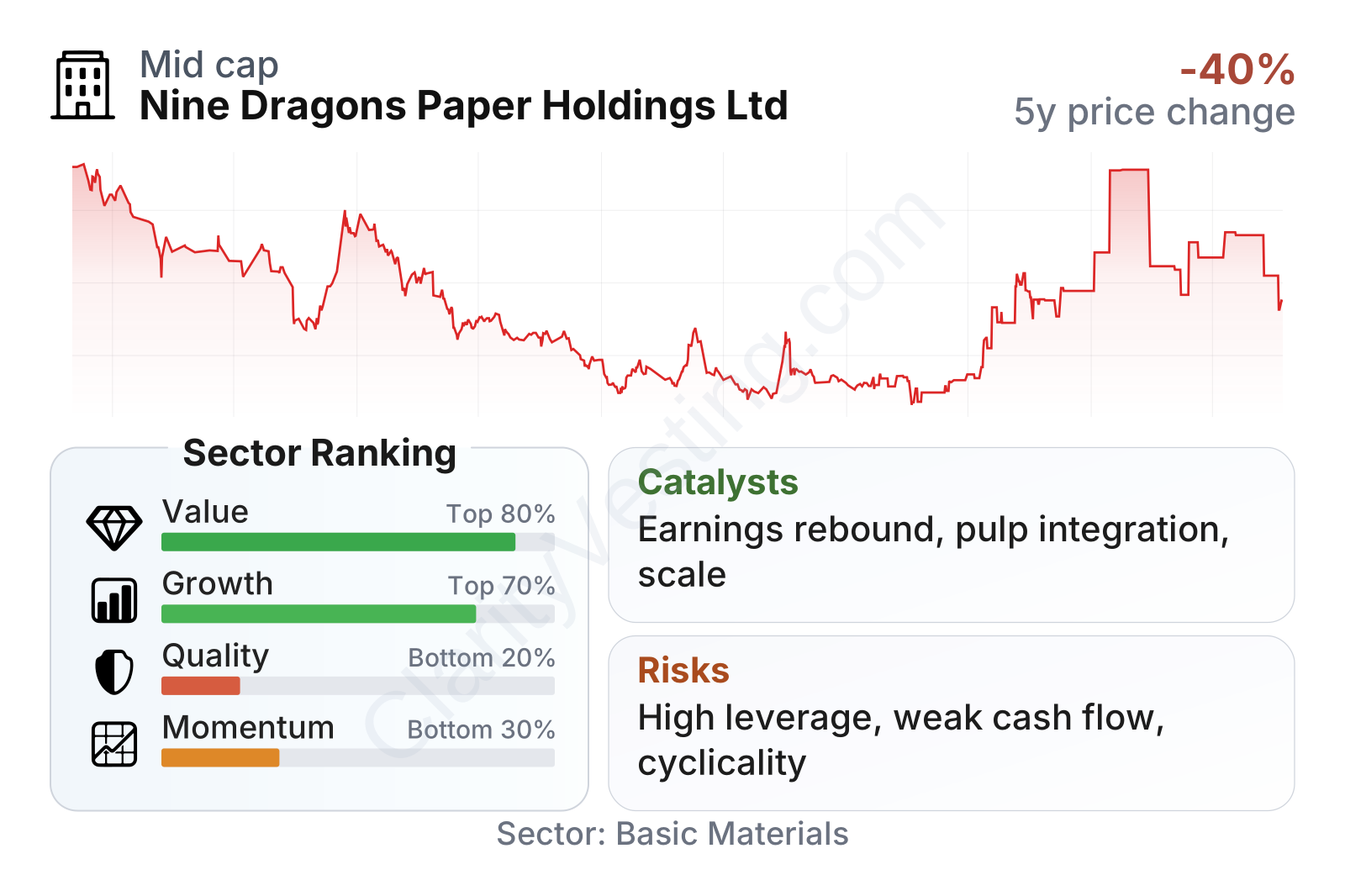
Nine Dragons appears inexpensive on earnings and book value multiples compared with the broader materials sector, while growth indicators are better than average in several areas. Revenue growth and long-term earnings growth stand out positively, and operating margin trends have improved over five years. However, the quality profile is weak. Profitability sits below sector norms, leverage is much higher than average, and free cash flow remains negative. Price performance has also been uneven: the shares rebounded sharply over the past year, but the longer-term path has been volatile and recent momentum has softened.
The stock history reflects that same pattern. After a deep decline from 2021 into 2024, the shares recovered strongly into early 2026, then pulled back before stabilizing. That behavior fits a cyclical company whose valuation can change quickly when margins recover, but also reverse when the market worries about debt, demand, or pricing.
Growth
The company operates in a sector that is mature in basic function but still supported by durable demand drivers. Corrugated packaging benefits from e-commerce, logistics, food and beverage distribution, and the steady replacement of heavier or less recyclable packaging formats. In China and broader Asia, paper packaging demand also tracks industrial production and consumer goods circulation, which can create periods of stronger growth when economic activity improves.
Nine Dragons’ strategy broadly makes industrial sense. Large scale matters in paper production because mills are capital intensive, procurement is complex, and customers often want stable supply. The company has spent years building capacity across major paper grades and adding pulp integration, which can improve raw material security and reduce dependence on outside suppliers. That upstream positioning is especially relevant when fiber costs are volatile.
A clear catalyst is the recent earnings recovery. Revenue in the latest fiscal year rose meaningfully, and profit rebounded from the weaker conditions seen earlier. The financial flow shows gross profit and operating income improving sharply by fiscal 2026, which suggests the business is benefiting from a better balance between selling prices and production costs. If that improvement proves durable, the company’s earnings power could look materially different from the trough period that shaped market sentiment earlier.
Another potential support is industry structure. Packaging paper is not a niche business with unlimited pricing power, but larger producers can still benefit when smaller competitors struggle with energy costs, financing, environmental compliance, or raw material access. In that kind of environment, scale players such as Nine Dragons can defend utilization rates better than fragmented rivals.
Risks
This article is for informational purposes only and does not constitute financial advice. Some content is AI-generated. See Disclaimer


