Stock Analysis · Nine Dragons Paper Limited (NDGPF)
Overview
Nine Dragons Paper Limited is one of the largest containerboard and packaging paper producers in China. The company makes the paper grades that are used to manufacture cardboard boxes, industrial packaging, and other paper-based shipping materials. It also produces printing and writing paper, specialty paper, and pulp. In simple terms, its business sits in the middle of modern commerce: goods are produced, moved, stored, and sold, and most of that activity still needs paper packaging.
The company’s revenue mainly comes from selling packaging paper products, with additional contribution from pulp and other paper grades. Based on recent annual reporting and company disclosures, the revenue mix is approximately concentrated as follows:
- Linerboard, high-performance corrugating medium, and coated duplex board: about 75% to 85% of revenue. These are the company’s core packaging grades used for corrugated boxes and carton packaging.
- Printing and writing paper, specialty paper, and related products: about 10% to 20%. This includes cultural paper and certain higher-value paper products outside basic transport packaging.
- Pulp and other businesses: about 5% to 10%. This includes sales linked to upstream fiber and pulp operations.
Geographically, the business is centered on China, where demand is tied to manufacturing output, domestic consumption, exports, and e-commerce logistics. The company has also expanded its raw-material and production footprint outside mainland China, including Southeast Asia and North America, to secure fiber supply and improve cost flexibility.
The operating profile has improved sharply in the most recent year. Revenue rose from roughly RMB 63 billion in fiscal 2025 to around RMB 76 billion in fiscal 2026, while operating income and net income rebounded much faster than sales. That pattern suggests not only stronger demand, but also better pricing, mix, or input-cost conditions than in the prior period.
The flow of the business has become healthier after a difficult period. Revenue has recovered above prior levels, and gross profit has expanded much faster than sales, which points to a meaningful improvement in margins. The main point to watch is that interest expense remains large, showing that a substantial share of operating progress is still absorbed by financing costs.
Key Figures
| Metric | Value | Sector ⓘ |
|---|---|---|
| Date | Oct 24, 2026 | |
| Context | ||
| Sector | Basic Materials | |
| Industry | Paper & Paper Products | |
| Market Cap ⓘ | $2.96B | |
| Beta ⓘ | 1.28 | |
Value (Cheapness) | ||
| P/E Ratio ⓘ | 5.73 | 16.92 |
| P/B Ratio ⓘ | 0.06 | 1.66 |
| FCF Yield ⓘ | 100.50% | 5.83% |
| Dividend Yield ⓘ | N/A | 2.07% |
| EBIT / EV ⓘ | 69.23% | 6.38% |
| PEG ⓘ | N/A | |
Growth (Business expansion) | ||
| Revenue Growth ⓘ | 26.90% | 11.25% |
| RPS Growth (5Y CAGR) ⓘ | 4.20% | 4.49% |
| EPS Growth (5Y CAGR) ⓘ | -0.60% | -15.24% |
| BVPS Growth (5Y CAGR) ⓘ | 1.97% | 5.49% |
| Margin Growth (5Y Trend) ⓘ | 2.93% | -1.54% |
| FCF Growth (5Y CAGR) ⓘ | -20.81% | 0.37% |
| DPS Growth (5Y CAGR) ⓘ | -29.24% | 5.91% |
Quality (Business durability) | ||
| ROIC (Latest) ⓘ | N/A | 9.59% |
| ROA (Latest) ⓘ | 4.05% | 4.92% |
| ROIC (5Y Median) ⓘ | 3.57% | 7.91% |
| ROA (5Y Median) ⓘ | 1.51% | 3.92% |
| Net Debt / EBIT (Latest) ⓘ | 8.07 | 1.36 |
| Net Debt / EBIT (5Y Median) ⓘ | 11.94 | 1.69 |
| Net Debt / EBITDA (Latest) ⓘ | 4.37 | 0.93 |
| Net Debt / Assets ⓘ | 50.16% | 13.69% |
| EBITDA / Interest ⓘ | 5.43 | 12.38 |
| Operating Margin (Latest) ⓘ | 7.08% | 13.24% |
| Operating Margin (5Y Median) ⓘ | 5.77% | 11.82% |
| Debt to Equity (Latest) ⓘ | 180.42% | 40.30% |
| Profit Margin (Latest) ⓘ | 5.28% | 6.38% |
| Free Cash Flow (Latest) ⓘ | $2.97B | |
Momentum (Price trend) | ||
| 3Y Return ⓘ | +11.33% | +73.47% |
| 12M Return (excl. last month) ⓘ | +9.86% | +27.59% |
| 6M Return ⓘ | -27.59% | -4.02% |
| Price vs. 200-Day MA ⓘ | -29.43% | -0.65% |
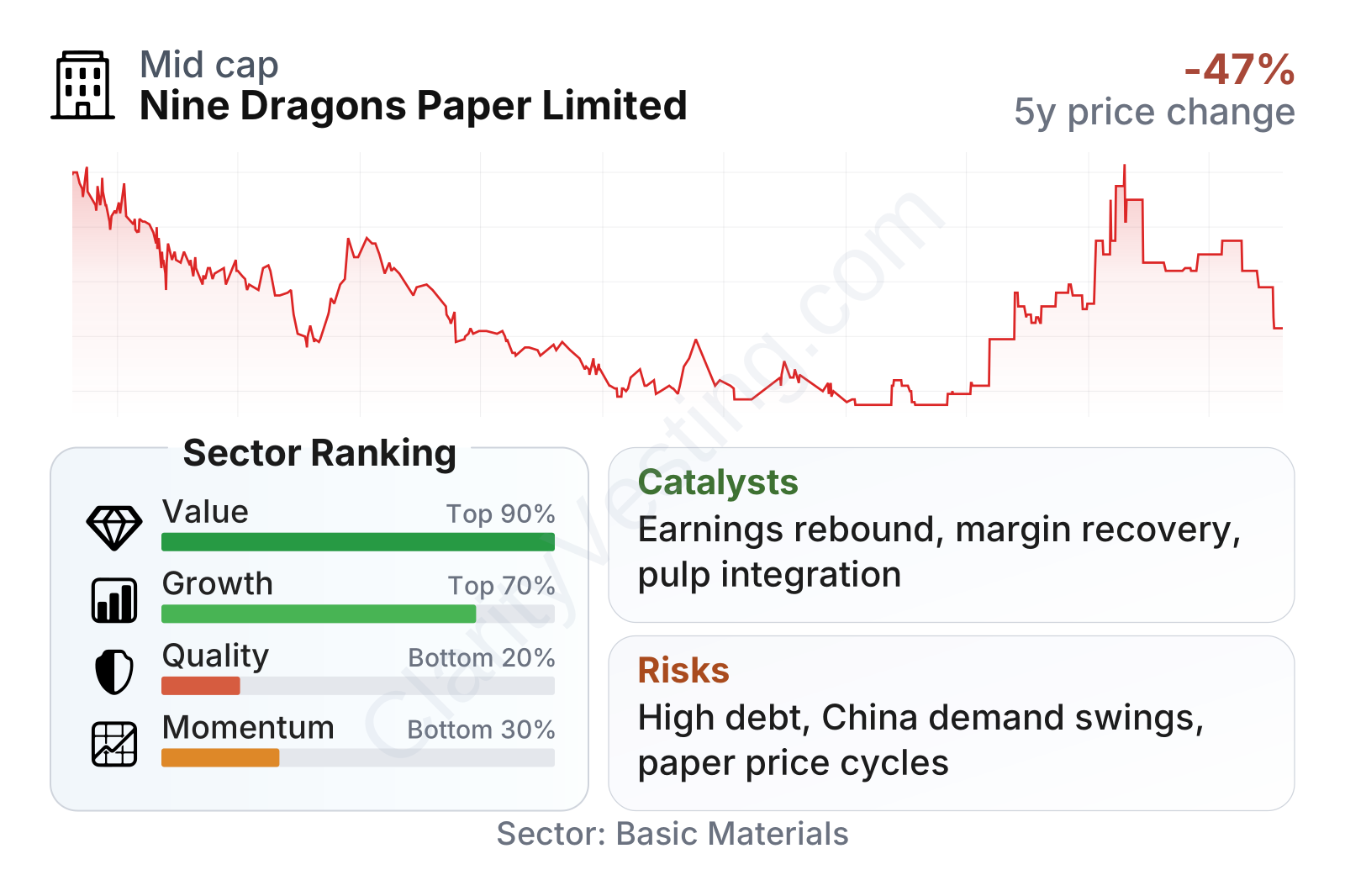
The stock has been volatile over the past several years, with a deep decline followed by a strong rebound and then another pullback. That pattern fits a cyclical materials company whose earnings can swing significantly with paper prices, demand conditions, and financing costs.
The valuation metrics stand out as unusually low compared with the sector. Earnings and book-based multiples are far below industry medians, and cash-flow-based measures also look very compressed. At the same time, the quality profile is weak: leverage is high, margins are below sector norms, and debt service absorbs an important part of operating profit. Growth indicators are mixed but improving, with recent revenue growth ahead of the sector and margin trends recovering from depressed levels. Momentum has cooled after the latest rally, which suggests the market is still weighing whether the earnings rebound is durable.
Growth
Nine Dragons operates in a sector that is mature overall, but still supported by several long-term demand drivers. Corrugated packaging benefits from e-commerce, consumer goods distribution, food and beverage shipping, and ongoing substitution away from some plastic-based packaging formats. In China and across Asian manufacturing hubs, the need for transport packaging remains closely tied to industrial production and trade flows, which gives the company exposure to broad economic activity rather than a narrow end market.
The company’s strategy is logical for this industry. Scale matters in paper because producers need purchasing power in recovered paper and pulp, efficient mill networks, and the ability to run large volumes through capital-intensive assets. Nine Dragons has spent years building that scale. Its investments in pulp capacity and overseas fiber access are also strategically important because raw materials are one of the biggest cost drivers in the business. More control over fiber supply can reduce earnings volatility over time, even if it requires heavy capital and balance-sheet capacity upfront.
A visible catalyst is the latest earnings recovery. Fiscal 2026 revenue increased by roughly 20% year over year based on the figures shown, while operating income and net income grew much faster than that. When a paper producer shows profit growth that outpaces sales by a wide margin, it often means utilization, spread management, and product pricing are moving in the right direction together. If that trend continues, the market may place more weight on normalized earnings power rather than trough-period weakness.
Another useful support is the company’s positioning in containerboard, where large customers value reliable supply, broad distribution, and consistent quality. That does not make the business immune to cycles, but it does matter when demand improves and mills with scale can capture volume more efficiently than smaller producers.
Risks
This article is for informational purposes only and does not constitute financial advice. Some content is AI-generated. See Disclaimer


