Stock Analysis · Northeast Bancorp (NBN)
Overview
Northeast Bancorp is a regional bank based in Maine that operates through Northeast Bank. Its business is unusual compared with many community banks because it combines a traditional branch banking franchise with a national lending platform focused on buying and originating commercial loans. In simple terms, the company gathers deposits, uses that funding to make or purchase loans, earns interest on those assets, and keeps the spread after funding and operating costs.
The company’s revenue is driven mainly by net interest income, which is the difference between interest earned on loans and investments and interest paid on deposits and borrowings. Non-interest income exists, but it is a much smaller part of the business. Based on recent annual filings and the company’s operating model, the main sources of revenue can be summarized as follows:
- Net interest income: approximately 90% to 95% — primarily income from purchased commercial loans, directly originated commercial real estate and business loans, residential mortgages held by the bank, and securities, minus funding costs on deposits and borrowings.
- Loan-related fees and gains: approximately 3% to 7% — includes fees tied to loan origination, servicing, and occasionally gains associated with loan sales or other lending activities.
- Other non-interest income: approximately 1% to 3% — includes deposit account fees and other routine banking income.
That revenue mix matters because it shows how dependent Northeast Bancorp is on credit performance, loan growth, and the level of interest rates. The branch network supports funding, but the core earnings engine is the lending platform, especially commercial loans acquired or originated outside a narrow local footprint.
One notable trend is that total revenue and net income have climbed strongly over the last several years, while operating expenses rose much more slowly. Interest expense has also increased sharply as funding costs reset higher, but the company has still expanded profits, which suggests its loan yields and loan growth have more than offset that pressure so far.
Key Figures
| Metric | Value | Sector ⓘ |
|---|---|---|
| Date | Oct 17, 2026 | |
| Context | ||
| Sector | Financial Services | |
| Industry | Banks - Regional | |
| Market Cap ⓘ | $1.06B | |
| Beta ⓘ | 0.61 | |
Value (Cheapness) | ||
| P/E Ratio ⓘ | 9.71 | 12.26 |
| P/B Ratio ⓘ | 1.75 | 1.23 |
| FCF Yield ⓘ | -6.01% | 10.40% |
| Dividend Yield ⓘ | 0.03% | 3.02% |
| EBIT / EV ⓘ | N/A | 8.14% |
| PEG ⓘ | 5.27 | |
Growth (Business expansion) | ||
| Revenue Growth ⓘ | 11.30% | 9.35% |
| RPS Growth (5Y CAGR) ⓘ | 34.63% | 12.19% |
| EPS Growth (5Y CAGR) ⓘ | 24.29% | -9.53% |
| BVPS Growth (5Y CAGR) ⓘ | 22.85% | 4.99% |
| Margin Growth (5Y Trend) ⓘ | -20.25% | -3.86% |
| FCF Growth (5Y CAGR) ⓘ | N/A | 4.81% |
| DPS Growth (5Y CAGR) ⓘ | 0.64% | 8.79% |
Quality (Business durability) | ||
| ROIC (Latest) ⓘ | N/A | 9.49% |
| ROE (Latest) ⓘ | 19.23% | 13.90% |
| ROA (Latest) ⓘ | 2.29% | 1.55% |
| ROIC (5Y Median) ⓘ | 9.37% | 7.86% |
| ROE (5Y Median) ⓘ | 17.54% | 12.17% |
| ROA (5Y Median) ⓘ | 2.24% | 1.30% |
| Net Debt / EBIT (Latest) ⓘ | N/A | 0.96 |
| Net Debt / EBIT (5Y Median) ⓘ | 0.40 | 0.73 |
| Net Debt / EBITDA (Latest) ⓘ | 5.72 | 0.92 |
| Operating Margin (Latest) ⓘ | N/A | 22.30% |
| Operating Margin (5Y Median) ⓘ | 36.03% | 24.63% |
| Debt to Equity (Latest) ⓘ | 142.05% | 58.56% |
| Profit Margin (Latest) ⓘ | 45.36% | 26.57% |
| Free Cash Flow (Latest) ⓘ | -$63.99M | |
Momentum (Price trend) | ||
| 3Y Return ⓘ | +183.46% | +88.33% |
| 12M Return (excl. last month) ⓘ | +21.33% | +19.38% |
| 6M Return ⓘ | +1.38% | +4.75% |
| Price vs. 200-Day MA ⓘ | +1.95% | +3.50% |
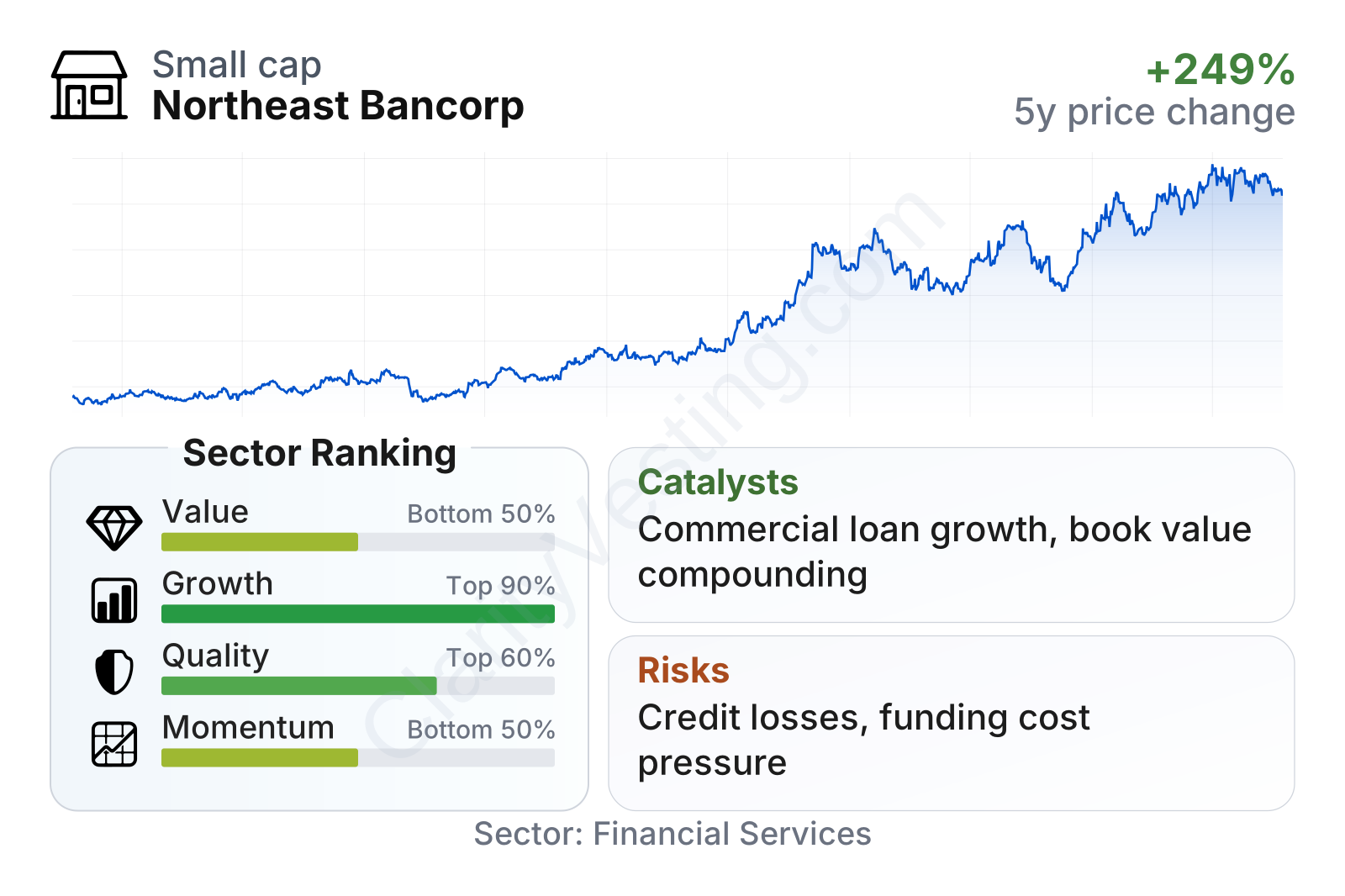
Northeast Bancorp is a relatively small public bank by market value, at a little over $1 billion, and its share price volatility has been lower than the broader market, with a beta around 0.6. The stock’s longer-term performance has been strong, but the factor mix is more nuanced. Growth stands out as a clear strength versus the regional bank peer group, while value and recent momentum are less compelling. The valuation picture is mixed: the earnings multiple is below the sector median, but the price-to-book ratio sits above the median, showing that the market is paying up for profitability and growth rather than treating the bank as a bargain asset play.
Quality metrics are also favorable. Return on equity and return on assets are both above sector medians, and profit margin is notably strong for a regional bank. At the same time, leverage measures and negative trailing free cash flow remind readers that banks should not be judged like industrial companies. For a lender, balance-sheet structure, funding mix, and credit quality matter more than standard free cash flow screens.
Growth
Northeast Bancorp operates in a mature sector, but within banking it has exposure to a niche that can still grow faster than typical branch-based community banks. Its strategy centers on specialized commercial lending and loan acquisition, areas where scale, underwriting skill, and access to funding can create room for expansion even when the broader banking market grows slowly. That makes the company less dependent on opening large numbers of new branches and more dependent on disciplined credit execution.
The company’s recent growth record has been strong. Revenue growth has outpaced the sector median, and the longer-term trend in revenue per share, earnings per share, and book value per share has been especially impressive for a bank of this size. This suggests growth has not come only from taking more risk or issuing large amounts of new equity; it has also translated into higher value per share.
Earnings per share have risen sharply over the last five fiscal years, moving from the mid-$5 range to more than $12. That kind of progression is unusual in regional banking and helps explain why the market has rewarded the stock despite a higher funding-cost environment.
Book value per share has also climbed steadily, from a little above $31 to more than $71 over the same period. For banks, book value growth is an important signal because it reflects retained earnings and the ability to compound capital over time. Northeast Bancorp’s pace here has been far stronger than the sector median.
A meaningful catalyst is the company’s business model in loan purchasing and specialized commercial lending. Many smaller banks remain tied to local markets and slower balance-sheet growth. Northeast Bancorp has built a platform that can source assets more broadly, which may continue to support above-average expansion if credit quality remains sound. Another potential tailwind is industry fragmentation: many regional and community banks lack scale or appetite in the kinds of loans Northeast targets, leaving room for selective share gains.
Recent company communications have continued to highlight loan growth, profitability, and capital generation. In the current environment, that combination is significant because it indicates the company has so far navigated higher rates better than many peers that have faced margin compression or weaker demand.
Risks
This article is for informational purposes only and does not constitute financial advice. Some content is AI-generated. See Disclaimer


