Stock Analysis · Neurocrine Biosciences Inc (NBIX)
Overview
Neurocrine Biosciences is a biopharmaceutical company focused on treatments for neurological, neuroendocrine, and psychiatric conditions. In simple terms, it develops medicines for disorders linked to the brain, the nervous system, and certain hormone-related diseases. The company’s business today is centered on a small number of commercial medicines, with its largest product being INGREZZA, a treatment used in movement disorders such as tardive dyskinesia and Huntington’s disease chorea. Neurocrine also has partnered products and a pipeline of newer candidates that could expand the business beyond its current base.
The revenue mix is still concentrated, with one product driving most of the company’s sales. Based on recent company filings and 2026 quarterly reporting, the main sources of revenue are approximately:
- INGREZZA product sales: about 85% to 90% of total revenue. This is the core business and includes U.S. sales of valbenazine-based treatments for approved movement-disorder indications.
- License and collaboration revenue: about 10% to 15%. This includes milestone payments, partner-related revenue recognition, and collaboration economics tied to programs developed with other pharmaceutical companies.
- Other product-related revenue: low single-digit percentage or smaller when present, depending on the quarter. This can include smaller commercial or contract-related items.
That concentration has two sides. It gives Neurocrine a very clear commercial engine, but it also means that the company’s overall performance remains closely tied to the continued growth and durability of INGREZZA.
The financial flow over the last several years shows a business that scaled meaningfully: revenue rose from a little above $1.1 billion in 2021 to roughly $2.9 billion in 2025, while gross profit remained very high because drug manufacturing costs are relatively low compared with selling and research spending. Operating income and net income also improved, although the company has continued to reinvest heavily in research and development to build its next phase of growth.
Key Figures
| Metric | Value | Sector ⓘ |
|---|---|---|
| Date | Oct 24, 2026 | |
| Context | ||
| Sector | Healthcare | |
| Industry | Drug Manufacturers - Specialty & Generic | |
| Market Cap ⓘ | $14.36B | |
| Beta ⓘ | 0.40 | |
Value (Cheapness) | ||
| P/E Ratio ⓘ | 20.84 | 25.42 |
| P/B Ratio ⓘ | 4.04 | 3.08 |
| FCF Yield ⓘ | 6.06% | 3.12% |
| Dividend Yield ⓘ | N/A | 1.85% |
| EBIT / EV ⓘ | 6.04% | 0.56% |
| PEG ⓘ | 0.28 | |
Growth (Business expansion) | ||
| Revenue Growth ⓘ | 39.50% | 7.50% |
| RPS Growth (5Y CAGR) ⓘ | 24.60% | 8.60% |
| EPS Growth (5Y CAGR) ⓘ | 5.97% | -17.73% |
| BVPS Growth (5Y CAGR) ⓘ | 22.63% | 3.72% |
| Margin Growth (5Y Trend) ⓘ | 11.03% | -0.57% |
| FCF Growth (5Y CAGR) ⓘ | 33.87% | 0.96% |
| DPS Growth (5Y CAGR) ⓘ | N/A | 6.69% |
Quality (Business durability) | ||
| ROIC (Latest) ⓘ | 19.52% | 3.17% |
| ROA (Latest) ⓘ | 14.66% | 2.98% |
| ROIC (5Y Median) ⓘ | 17.24% | 4.56% |
| ROA (5Y Median) ⓘ | 8.89% | 1.87% |
| Net Debt / EBIT (Latest) ⓘ | 0.08 | 1.34 |
| Net Debt / EBIT (5Y Median) ⓘ | 0.45 | 1.86 |
| Net Debt / EBITDA (Latest) ⓘ | 0.08 | 1.00 |
| Net Debt / Assets ⓘ | 1.29% | 5.06% |
| EBITDA / Interest ⓘ | N/A | 9.55 |
| Operating Margin (Latest) ⓘ | 25.81% | 9.25% |
| Operating Margin (5Y Median) ⓘ | 20.92% | 7.33% |
| Debt to Equity (Latest) ⓘ | 10.88% | 26.68% |
| Profit Margin (Latest) ⓘ | 20.91% | 3.34% |
| Free Cash Flow (Latest) ⓘ | $870.40M | |
Momentum (Price trend) | ||
| 3Y Return ⓘ | +32.79% | +51.61% |
| 12M Return (excl. last month) ⓘ | -2.98% | +19.90% |
| 6M Return ⓘ | +9.23% | +10.10% |
| Price vs. 200-Day MA ⓘ | -2.58% | +6.44% |
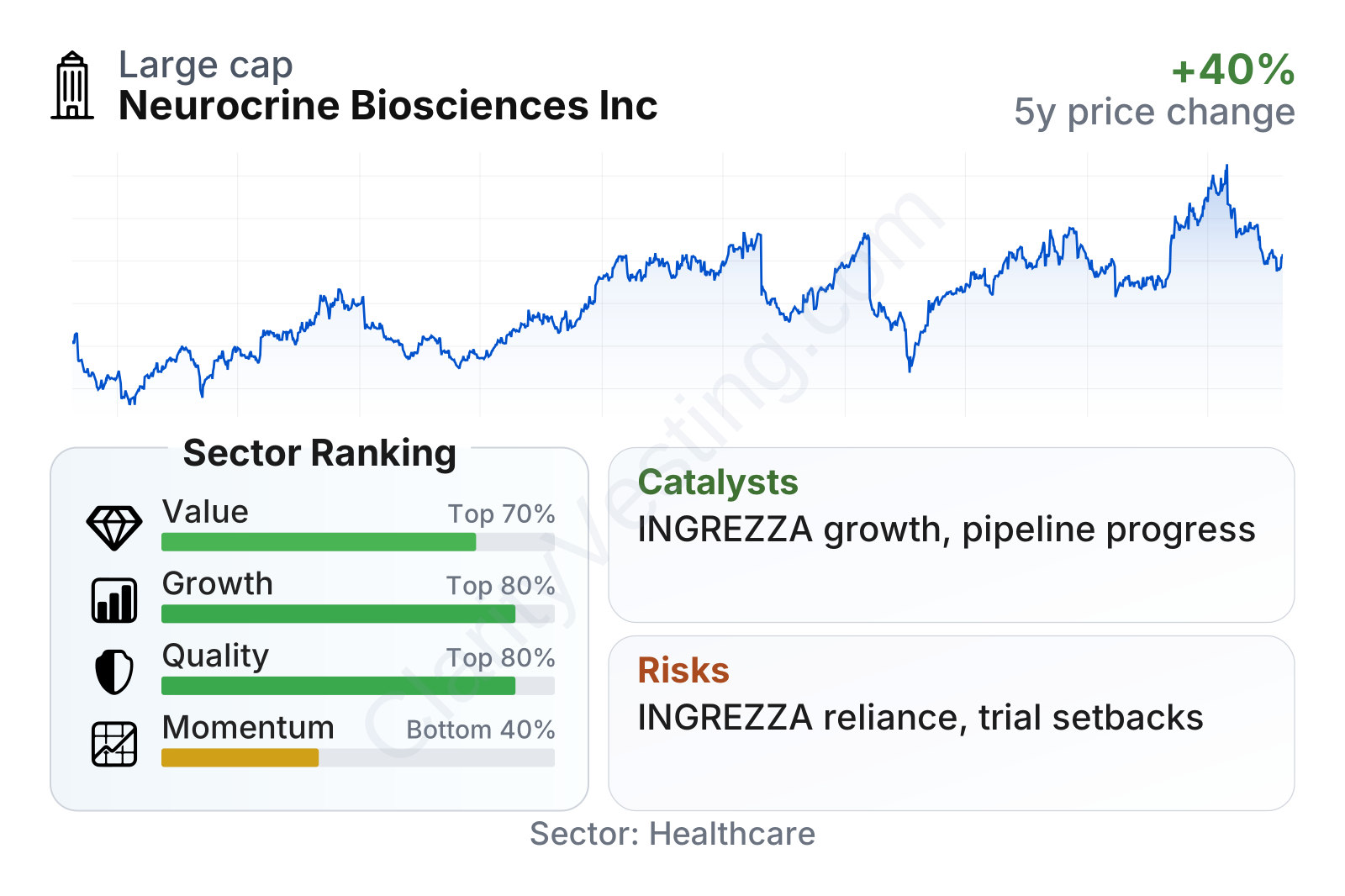
Neurocrine sits in the large-cap biotech range, but its trading profile is relatively less volatile than many healthcare peers, with a beta well below 1. The latest metrics point to a business that ranks strongly on growth and quality within its sector. Profitability is well above the industry median, returns on capital are strong, and free cash flow generation is solid. On value, the picture is more balanced: the earnings multiple is around the sector median or slightly below it, while the price-to-book ratio is somewhat richer. Momentum is the weaker area, meaning the stock’s recent market performance has lagged stronger names in the healthcare group even though the underlying business has continued to improve.
Growth
Neurocrine operates in a part of healthcare with attractive long-term demand drivers. Neurology and psychiatry remain large markets with significant unmet medical need, and successful drugs in these areas can remain commercially relevant for a long time if they show clear clinical benefit. That matters because doctors and patients often need better options for chronic disorders, and payers are generally willing to support treatments that improve quality of life or reduce serious side effects from other medicines.
The company’s strategy for future expansion is logical. First, it is still pushing to grow INGREZZA through deeper physician adoption and broader patient reach. Second, it is trying to build follow-on growth through pipeline programs in psychiatry, endocrinology, and neurology. Third, it uses partnerships to spread scientific and financial risk while keeping access to important assets.
The revenue trend has been notably strong. Year-over-year growth stayed above the healthcare sector median for an extended period and accelerated again in the latest reported quarters, reaching roughly 40% recently. That suggests Neurocrine is not simply depending on a mature product base; it is still expanding meaningfully from its current commercial platform.
Cash generation also reinforces the growth case. Free cash flow moved from just above $100 million in early 2022 to more than $800 million on a trailing basis by 2026. That gives the company flexibility to fund clinical trials, support launches, pursue business development, and absorb setbacks better than many biotech peers that rely heavily on external financing.
A major catalyst in recent years has been the broadening of the valbenazine franchise and the continued execution around INGREZZA. Another important opportunity is pipeline progress, especially in schizophrenia-related and other central nervous system programs that could diversify revenue over time. Recent company updates in 2026 also pointed to continued commercial momentum and advancing late-stage or mid-stage programs, which keeps the market focused on whether Neurocrine can evolve from a one-franchise company into a broader neuroscience platform.
Risks
This article is for informational purposes only and does not constitute financial advice. Some content is AI-generated. See Disclaimer


