Stock Analysis · National Bank Holdings Corporation (NBHC)
Overview
National Bank Holdings Corporation is a regional bank holding company built around community banking. Through its main banking subsidiary, it provides traditional banking services to individuals, businesses, and commercial real estate clients, with a footprint centered in Colorado and selected markets in Utah, New Mexico, Texas, Wyoming, Idaho, and the greater Kansas City area. In simple terms, it takes deposits, makes loans, earns interest on those loans and securities, and also collects fees from services such as wealth management, treasury management, cards, and deposit-related activity.
Its revenue mix is typical of a regional bank, with most income coming from the spread between what it earns on loans and securities and what it pays on deposits and borrowings. Based on recent annual reporting, the main sources of revenue are approximately:
- Net interest income: about 78% to 82% of total revenue. This includes interest earned on commercial loans, commercial real estate loans, residential mortgage and consumer loans, plus the securities portfolio, minus interest paid on deposits and other funding.
- Non-interest income: about 18% to 22% of total revenue. This includes wealth management and trust fees, service charges and deposit fees, debit and credit card income, mortgage banking, treasury management, and other customer service fees.
Within lending, commercial and commercial real estate activities are the core of the business, while consumer and mortgage lending play a smaller role. That gives the company meaningful exposure to local business formation, property activity, and the health of middle-market clients in its footprint.
The business model remains straightforward, but one notable recent pattern is that revenue has risen meaningfully over the last several years while earnings have been less steady, showing that higher funding costs and expense pressure have absorbed part of the top-line benefit.
Revenue expanded strongly from 2021 through 2024 and stayed near that higher level in 2025, but net income did not keep pace. That gap suggests the key issue is not demand alone; it is how much of that revenue the bank can keep after deposit costs, interest expense, and operating expenses.
Key Figures
| Metric | Value | Sector ⓘ |
|---|---|---|
| Date | Oct 17, 2026 | |
| Context | ||
| Sector | Financial Services | |
| Industry | Banks - Regional | |
| Market Cap ⓘ | $1.64B | |
| Beta ⓘ | 0.83 | |
Value (Cheapness) | ||
| P/E Ratio ⓘ | 15.60 | 12.26 |
| P/B Ratio ⓘ | 0.86 | 1.23 |
| FCF Yield ⓘ | 7.73% | 10.40% |
| Dividend Yield ⓘ | 3.38% | 3.02% |
| EBIT / EV ⓘ | 8.14% | 8.14% |
| PEG ⓘ | 1.57 | |
Growth (Business expansion) | ||
| Revenue Growth ⓘ | 22.10% | 9.35% |
| RPS Growth (5Y CAGR) ⓘ | 11.62% | 12.19% |
| EPS Growth (5Y CAGR) ⓘ | -14.34% | -9.53% |
| BVPS Growth (5Y CAGR) ⓘ | -37.04% | 4.99% |
| Margin Growth (5Y Trend) ⓘ | -13.11% | -3.86% |
| FCF Growth (5Y CAGR) ⓘ | -7.31% | 4.81% |
| DPS Growth (5Y CAGR) ⓘ | 8.65% | 8.79% |
Quality (Business durability) | ||
| ROIC (Latest) ⓘ | 6.31% | 9.49% |
| ROE (Latest) ⓘ | 6.48% | 13.90% |
| ROA (Latest) ⓘ | 0.87% | 1.55% |
| ROIC (5Y Median) ⓘ | 8.22% | 7.86% |
| ROE (5Y Median) ⓘ | 8.15% | 12.17% |
| ROA (5Y Median) ⓘ | 1.20% | 1.30% |
| Net Debt / EBIT (Latest) ⓘ | -0.26 | 0.96 |
| Net Debt / EBIT (5Y Median) ⓘ | -0.03 | 0.73 |
| Net Debt / EBITDA (Latest) ⓘ | -0.20 | 0.92 |
| Operating Margin (Latest) ⓘ | 21.74% | 22.30% |
| Operating Margin (5Y Median) ⓘ | 24.87% | 24.63% |
| Debt to Equity (Latest) ⓘ | 20.80% | 58.56% |
| Profit Margin (Latest) ⓘ | 21.80% | 26.57% |
| Free Cash Flow (Latest) ⓘ | $127.05M | |
Momentum (Price trend) | ||
| 3Y Return ⓘ | +34.82% | +88.33% |
| 12M Return (excl. last month) ⓘ | +13.29% | +19.38% |
| 6M Return ⓘ | -7.87% | +4.75% |
| Price vs. 200-Day MA ⓘ | -7.76% | +3.50% |
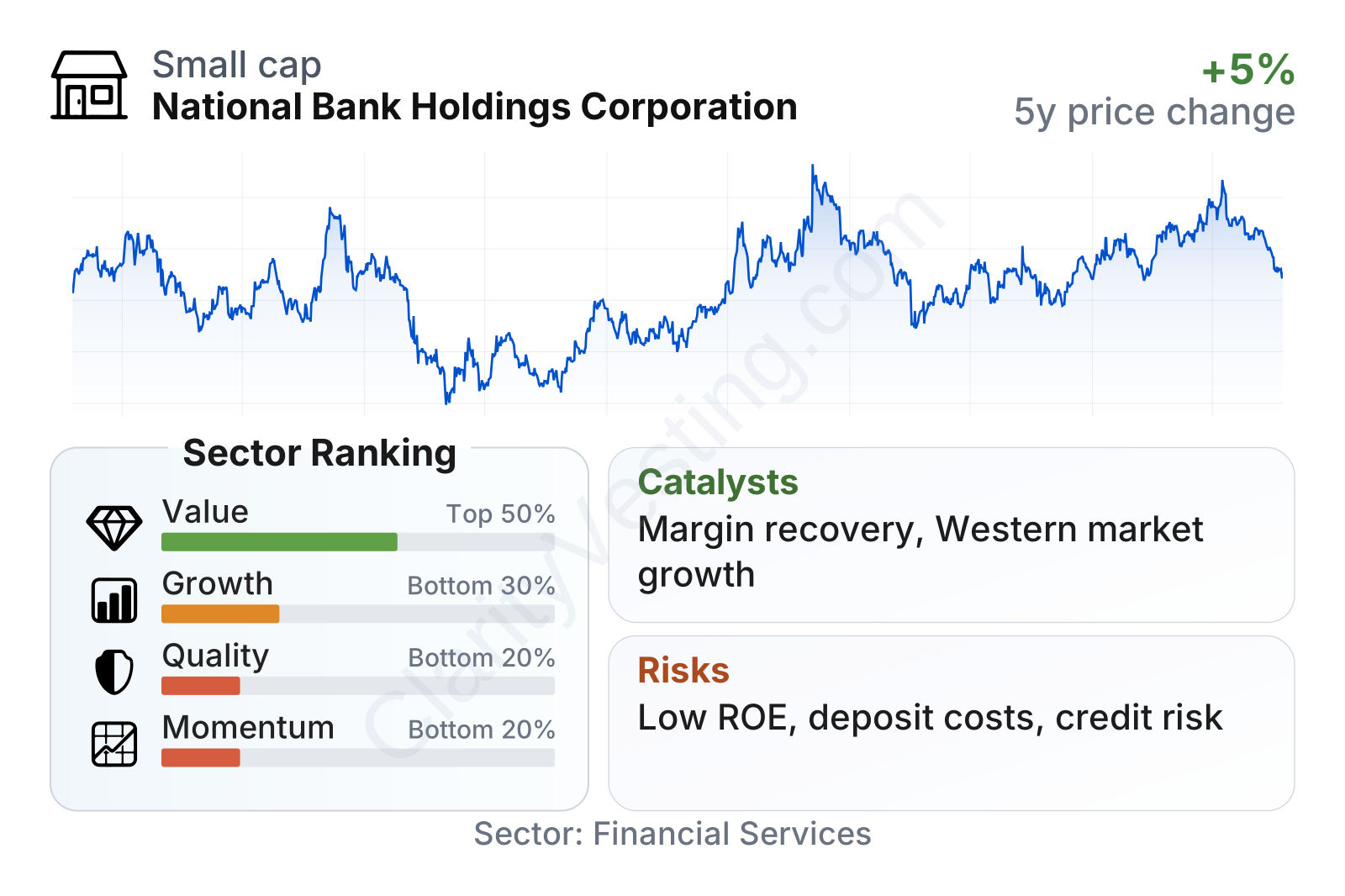
National Bank Holdings is a small-cap regional bank with a below-market share-price sensitivity, which can make trading less volatile than many peers. On valuation, it looks mixed: the earnings multiple is above the sector median, while the price-to-book ratio is below the sector median. That combination usually means the market is not giving the company a premium for profitability, even though the shares are not deeply distressed. The broader factor picture is less favorable. Growth and quality rank in the lower end of the regional bank group, and momentum is also weak, reflecting a business that has improved in size but not consistently in efficiency or returns.
The stock has recovered well from the regional banking stress seen in 2023 and has moved to new highs for this cycle in 2026. Even so, the path has been uneven, which fits a bank that has shown resilience but not a clear re-rating based on superior profitability.
Growth
Regional banking is not a high-growth industry in the way software or semiconductors can be, but it can still grow steadily when a bank gains deposits, expands commercial lending, deepens relationships with local businesses, and adds fee-based services. National Bank Holdings operates in attractive Western and Mountain-region markets that have generally benefited from population growth, small-business formation, and real estate development over time. That gives the company a reasonable structural backdrop, even if the sector itself is mature.
The company’s strategy has centered on relationship banking, commercial lending, and selective expansion in markets where management believes it can gather core deposits and cross-sell services. For a regional bank, that approach makes sense because low-cost and stable deposits are one of the most important engines of future profitability. A bank that can grow loans without overpaying for deposits is usually in a better position than one chasing volume alone.
There are also smaller but useful growth levers outside pure lending. Wealth management, treasury services, and card-related fees can make revenue less dependent on interest rates. These lines are not the majority of the business, but they can improve the earnings mix if management continues to build them.
Earnings per share have been choppy rather than steadily upward. After a strong 2023 rebound, earnings eased in 2024 and 2025, pointing to a bank that has not yet converted revenue growth into a durable earnings trend. That matters for long-term compounding because banks are often judged not just by growth in assets or revenue, but by consistent growth in per-share earnings.
Book value per share has improved in the last few years after a distorted earlier reading, and the recent direction is constructive. For banks, book value is important because it represents the equity base supporting lending and capital returns. A rising book value per share can support long-term shareholder value, especially when shares trade near or below book value.
A meaningful near-term catalyst is the interest-rate cycle. If deposit pricing pressure eases faster than asset yields decline, net interest margin can improve. Another positive catalyst is any evidence that fee income becomes a larger contributor, because that would reduce dependence on lending spreads. In addition, continued economic strength in Colorado and surrounding growth markets could support commercial loan demand and customer acquisition.
Recent company reporting has also shown solid year-over-year revenue growth, which indicates the franchise is still expanding. The open question is whether that growth can translate into stronger returns instead of simply larger balance-sheet activity.
Risks
This article is for informational purposes only and does not constitute financial advice. Some content is AI-generated. See Disclaimer


