Stock Analysis · Nordic American Tankers Limited (NAT)
Overview
Nordic American Tankers Limited is a shipping company focused on moving crude oil by sea. Its business is simple to understand: it owns and operates a fleet of Suezmax tankers, a vessel class mainly used to transport crude oil on international routes. The company earns money by chartering these ships to oil companies, commodity traders, and other shipping customers. Because it is concentrated in one vessel category rather than many shipping segments, its results are closely tied to day rates for Suezmax crude tankers.
Revenue is largely generated from tanker hire, which means customers pay to use the ships for transporting cargo. Based on the company’s annual reporting structure, revenue is overwhelmingly tied to one operating activity rather than several unrelated businesses.
- Voyage and time charter revenue: approximately 100% of total revenue. This includes income from spot market voyages and short-term or time-charter employment of the fleet.
- Other revenue: minimal. The company does not have a major second business line such as refining, storage, or offshore services.
This narrow focus makes NAT easy to follow for long-term readers: when tanker demand, fleet utilization, and daily charter rates improve, revenue and profits can rise quickly; when rates weaken, the reverse also tends to happen. Over the last several years, the business has shown exactly that pattern, with revenue climbing strongly from 2021 into 2023, easing in 2024 and 2025, and then improving again more recently. Costs have been relatively stable compared with revenue swings, which means earnings can change sharply from one shipping cycle to another.
The operating picture has become much healthier than it was a few years ago. NAT moved from losses in 2021 to strong profitability in 2023, then saw a softer 2024 and 2025 before margins rebounded again. That tells readers two things at once: the fleet can produce meaningful cash and profit in favorable markets, but results remain cyclical rather than steadily compounding year after year.
Key Figures
| Metric | Value | Sector ⓘ |
|---|---|---|
| Date | Oct 17, 2026 | |
| Context | ||
| Sector | Energy | |
| Industry | Oil & Gas Midstream | |
| Market Cap ⓘ | $1.86B | |
| Beta ⓘ | -0.52 | |
Value (Cheapness) | ||
| P/E Ratio ⓘ | 14.90 | 15.44 |
| P/B Ratio ⓘ | 3.64 | 1.73 |
| FCF Yield ⓘ | 6.29% | 8.20% |
| Dividend Yield ⓘ | 12.29% | 3.59% |
| EBIT / EV ⓘ | 6.55% | 7.46% |
| PEG ⓘ | 1.21 | |
Growth (Business expansion) | ||
| Revenue Growth ⓘ | 97.50% | 26.90% |
| RPS Growth (5Y CAGR) ⓘ | 3.48% | 6.90% |
| EPS Growth (5Y CAGR) ⓘ | 86.06% | -15.73% |
| BVPS Growth (5Y CAGR) ⓘ | -8.98% | 6.07% |
| Margin Growth (5Y Trend) ⓘ | 63.95% | 0.58% |
| FCF Growth (5Y CAGR) ⓘ | N/A | 1.86% |
| DPS Growth (5Y CAGR) ⓘ | 60.90% | 16.79% |
Quality (Business durability) | ||
| ROIC (Latest) ⓘ | 18.14% | 11.40% |
| ROA (Latest) ⓘ | 13.39% | 6.06% |
| ROIC (5Y Median) ⓘ | 9.56% | 10.30% |
| ROA (5Y Median) ⓘ | 1.74% | 5.42% |
| Net Debt / EBIT (Latest) ⓘ | 2.21 | 1.64 |
| Net Debt / EBIT (5Y Median) ⓘ | 4.41 | 1.83 |
| Net Debt / EBITDA (Latest) ⓘ | 1.52 | 1.08 |
| Net Debt / Assets ⓘ | 29.78% | 17.29% |
| EBITDA / Interest ⓘ | 5.04 | 9.64 |
| Operating Margin (Latest) ⓘ | 33.20% | 16.27% |
| Operating Margin (5Y Median) ⓘ | 16.42% | 20.39% |
| Debt to Equity (Latest) ⓘ | 85.12% | 54.76% |
| Profit Margin (Latest) ⓘ | 33.28% | 8.82% |
| Free Cash Flow (Latest) ⓘ | $117.08M | |
Momentum (Price trend) | ||
| 3Y Return ⓘ | +179.48% | +67.38% |
| 12M Return (excl. last month) ⓘ | +179.45% | +49.19% |
| 6M Return ⓘ | +55.77% | +7.07% |
| Price vs. 200-Day MA ⓘ | +48.60% | +9.56% |
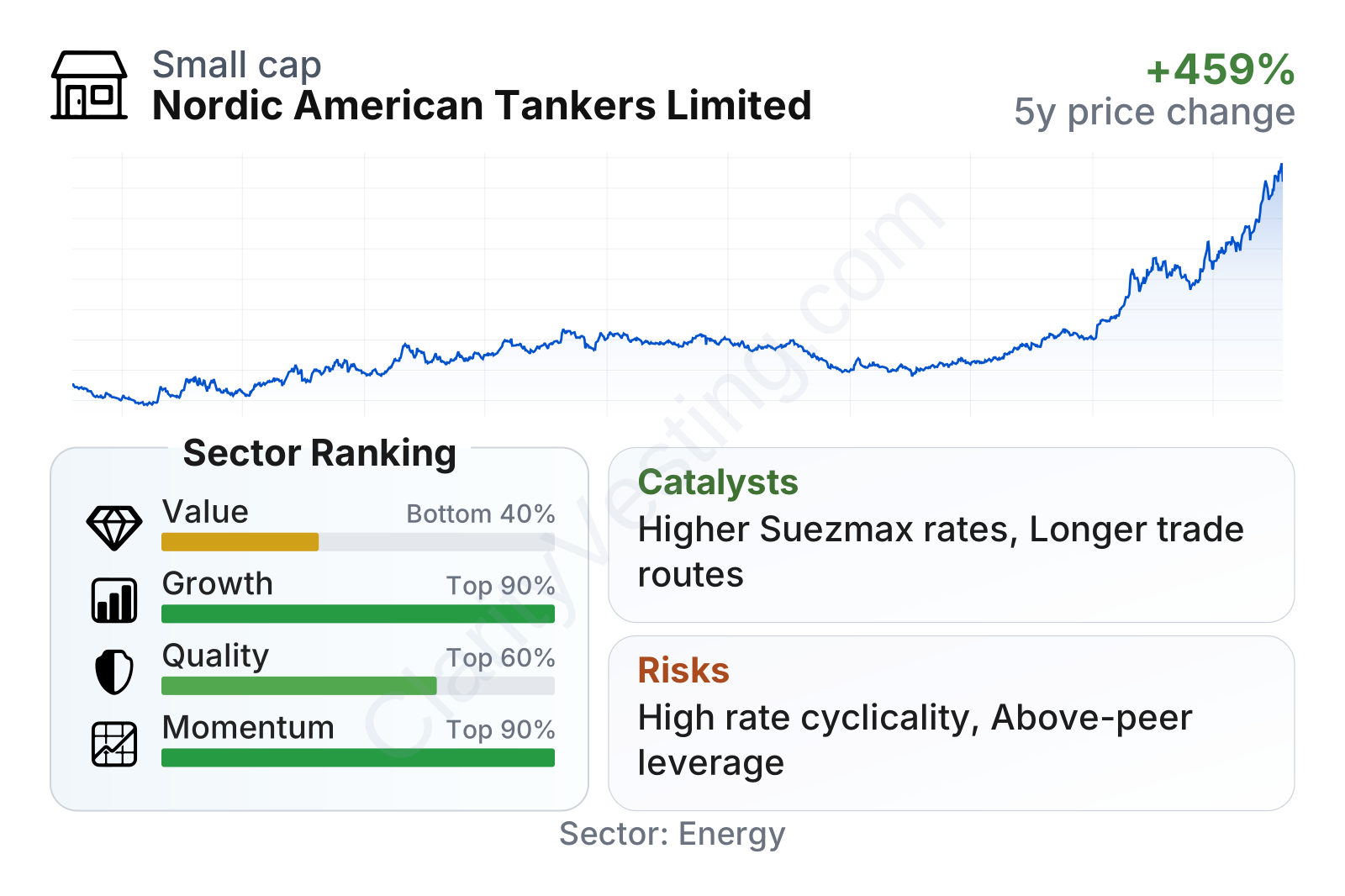
NAT is a mid-sized listed tanker company with a market value around the low-single-digit billions of dollars. The recent profile is unusual in a good way for a shipping stock: growth and price momentum rank near the top of the energy peer group, while profitability is also clearly above many peers. At the same time, the value profile is less attractive than it first appears because the stock trades at a high price-to-book ratio and its cash flow yield is not especially strong relative to the sector. The dividend yield is very high, but in shipping that figure can change quickly because payouts depend heavily on freight markets.
Growth
The crude tanker business is not a classic secular growth industry like software or semiconductors, but it can still offer strong earnings growth when market conditions turn favorable. Demand comes from global oil consumption, long-distance seaborne crude trade, and changes in trade routes. In recent years, shifting oil flows caused by sanctions, export realignment, and longer shipping distances have supported tanker demand because ships stay busy for more days per cargo movement.
For NAT specifically, the strategy is straightforward and internally consistent. The company stays focused on Suezmax crude tankers, a part of the market where scale, commercial relationships, and fleet availability matter. This specialization can help operational efficiency, but the bigger growth driver is market recovery rather than business diversification. NAT does not need to invent a new product; it mainly needs healthy tanker rates, strong fleet utilization, and disciplined vessel financing.
Recent revenue growth has reaccelerated sharply after a weaker patch in 2025. That rebound matters because it suggests the business is still highly responsive to improving freight conditions. Over a longer period, the pattern has been uneven rather than smooth, which is normal for tanker shipping. The company’s recent year-over-year growth rate stands far above the sector median, showing that NAT is currently benefiting more than many peers from the latest upturn.
Free cash flow has been much more volatile than accounting profit. NAT produced healthy positive free cash flow for a period, but it also swung back into negative territory more recently before improving at the latest reported run rate. For long-term analysis, this is important: shipping companies can look very profitable during strong markets, yet cash generation may still move around because of vessel spending, debt service, and working capital movements.
A practical catalyst is the company’s direct exposure to spot and short-term tanker rates. If crude trade volumes stay firm and voyage distances remain elevated, earnings can improve quickly. Another catalyst is fleet economics: when operating margins rise above peer medians, even moderate revenue gains can have an outsized impact on net income. NAT has also shown that its dividend can scale up when the market is supportive, which can attract market attention during stronger parts of the cycle.
Recent company communications and filings have continued to emphasize fleet employment, balance sheet management, and shareholder distributions as core themes. In plain terms, the opportunity is not based on a radical transformation plan; it is based on NAT remaining a pure-play vehicle on crude tanker rates at a time when the shipping market backdrop has improved from prior lows.
Risks
This article is for informational purposes only and does not constitute financial advice. Some content is AI-generated. See Disclaimer


