Stock Analysis · The Marzetti Company (MZTI)
Overview
The Marzetti Company is a U.S. packaged foods business focused on refrigerated and shelf-stable foods sold through both retail and foodservice channels. The company is best known for salad dressings, dips, croutons, breads, frozen pasta, and specialty ingredients used by restaurants and institutional customers. It operates through a portfolio of established brands, including Marzetti, New York Bakery, Sister Schubert’s, Flatout, and several foodservice-focused lines.
Its revenue mix is spread across a few major operating groups. Based on recent company reporting and segment disclosures, the business is centered on consumer packaged foods, with foodservice and specialty products also playing an important role. The broad mix appears to be approximately:
- Retail packaged foods: about 55% to 60% — branded dressings, dips, croutons, frozen breads, rolls, garlic breads, and related grocery items sold through supermarkets and mass retail.
- Foodservice products: about 25% to 30% — dressings, sauces, dips, breads, and customized items sold to restaurants, chains, and institutional customers.
- Specialty and ingredient businesses: about 15% to 20% — specialty foods, pasta, and other products supplied to commercial customers and selected retail channels.
The business model is relatively straightforward: manufacture branded and private-label food products, distribute them broadly, and use category positions in refrigerated dressings, bakery, and restaurant-oriented products to sustain shelf presence and repeat demand. Recent financial flow trends show a company that has grown revenue steadily over the last several years while expanding gross profit and operating income faster than sales, suggesting better pricing, mix, and manufacturing efficiency.
Over the past five fiscal years, sales moved from roughly $1.7 billion to just under $1.93 billion, while net income more than doubled. That matters because it shows earnings growth has not relied only on higher volumes; profitability has improved meaningfully as well.
Key Figures
| Metric | Value | Sector ⓘ |
|---|---|---|
| Date | Oct 17, 2026 | |
| Context | ||
| Sector | Consumer Defensive | |
| Industry | Packaged Foods | |
| Market Cap ⓘ | $2.76B | |
| Beta ⓘ | 0.36 | |
Value (Cheapness) | ||
| P/E Ratio ⓘ | 14.78 | 17.88 |
| P/B Ratio ⓘ | 2.77 | 1.29 |
| FCF Yield ⓘ | 7.46% | 12.39% |
| Dividend Yield ⓘ | 3.98% | 2.85% |
| EBIT / EV ⓘ | 7.98% | 6.43% |
| PEG ⓘ | 3.12 | |
Growth (Business expansion) | ||
| Revenue Growth ⓘ | -2.20% | 4.10% |
| RPS Growth (5Y CAGR) ⓘ | 3.64% | 6.18% |
| EPS Growth (5Y CAGR) ⓘ | 10.16% | -13.59% |
| BVPS Growth (5Y CAGR) ⓘ | 4.33% | 3.20% |
| Margin Growth (5Y Trend) ⓘ | 4.06% | -0.15% |
| FCF Growth (5Y CAGR) ⓘ | N/A | 4.10% |
| DPS Growth (5Y CAGR) ⓘ | 5.88% | 6.79% |
Quality (Business durability) | ||
| ROIC (Latest) ⓘ | N/A | 12.34% |
| ROA (Latest) ⓘ | 15.02% | 6.30% |
| ROIC (5Y Median) ⓘ | N/A | 10.49% |
| ROA (5Y Median) ⓘ | 13.49% | 5.44% |
| Net Debt / EBIT (Latest) ⓘ | -0.43 | 1.96 |
| Net Debt / EBIT (5Y Median) ⓘ | -0.43 | 2.35 |
| Net Debt / EBITDA (Latest) ⓘ | -0.34 | 1.38 |
| Net Debt / Assets ⓘ | -8.31% | 21.51% |
| EBITDA / Interest ⓘ | N/A | 9.46 |
| Operating Margin (Latest) ⓘ | 12.63% | 8.87% |
| Operating Margin (5Y Median) ⓘ | 11.45% | 9.53% |
| Debt to Equity (Latest) ⓘ | 5.56% | 72.35% |
| Profit Margin (Latest) ⓘ | 9.93% | 5.40% |
| Free Cash Flow (Latest) ⓘ | $206.14M | |
Momentum (Price trend) | ||
| 3Y Return ⓘ | -38.71% | +20.92% |
| 12M Return (excl. last month) ⓘ | -41.34% | +2.13% |
| 6M Return ⓘ | -28.22% | +1.26% |
| Price vs. 200-Day MA ⓘ | -20.17% | +1.39% |
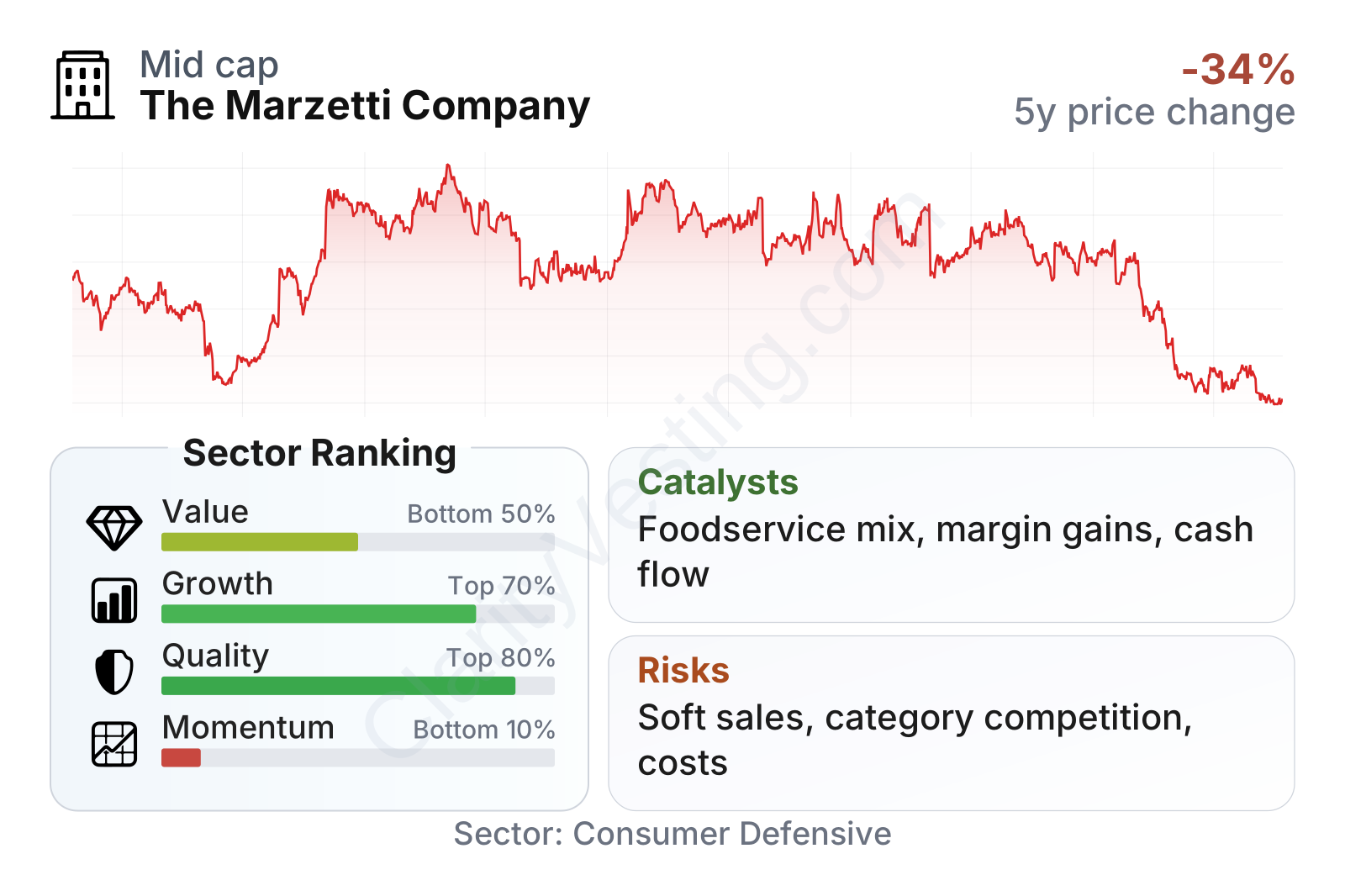
The company sits in the smaller-to-mid-sized range within public packaged foods, with a stock that has historically moved less than the broader market, as shown by its low beta. On valuation, the picture is mixed: the earnings multiple is below the sector median, but book value and free-cash-flow yield are less obviously cheap. Quality is a stronger point. Profitability, asset returns, and balance-sheet strength stand out well above many sector peers, while recent share-price momentum has been notably weak.
The stock-price history also shows a major reset from prior highs. That decline has pulled the valuation closer to sector norms after several years when the shares traded at a clear premium.
Growth
Packaged foods is not a fast-growth industry, but it is a durable one. Demand tends to be steadier than in many other sectors because consumers continue buying staple food products in both strong and weak economic periods. Within that landscape, Marzetti is positioned in categories that can still expand through product innovation, premium offerings, convenience, and channel gains, especially in refrigerated dressings, frozen bakery, and foodservice solutions.
The company’s strategy appears sensible for long-term expansion. It combines established brands with selective acquisitions, product line extensions, and a balance between grocery and away-from-home eating. That diversification matters because it reduces dependence on one category or one customer type. Management has also been investing in manufacturing capacity and operational improvements in recent years, which can support margin expansion even if industry volume growth stays modest.
Near-term sales growth has cooled. After a stretch of strong year-over-year gains in 2022 and parts of 2023, growth became choppier and recently turned slightly negative. That does not automatically mean the business is weakening structurally, but it does suggest that pricing-led growth is harder to sustain and that future progress may depend more on volumes, product mix, and execution.
Cash generation is a more encouraging signal. Free cash flow moved from negative territory a few years ago to a solid positive level and has remained strong. That gives the company flexibility for dividends, acquisitions, capital spending, and balance-sheet resilience. Combined with improving margins, this supports the view that the operating model has become more efficient over time.
A meaningful catalyst is the company’s ability to keep building in higher-value categories where brand loyalty and refrigerated shelf placement can matter more than pure price competition. Another potential driver is foodservice normalization and menu-related demand from restaurant chains. Recent company communications have also highlighted portfolio optimization and operating discipline, which can create growth in earnings even during slower revenue periods.
Risks
This article is for informational purposes only and does not constitute financial advice. Some content is AI-generated. See Disclaimer


