Stock Analysis · Molson Coors Canada Inc (MXGBF)
Overview
Molson Coors Canada Inc is tied to Molson Coors Beverage Company, one of the largest brewing groups in North America and Europe. The business is centered on beer, but it has been expanding beyond traditional brewing into flavored beverages, hard seltzers, spirits partnerships, energy drinks, and non-alcoholic options. Its best-known brands include Coors Light, Miller Lite, Molson Canadian, Carling, Blue Moon, Vizzy, and several regional and craft labels.
Revenue mainly comes from selling branded beverages through retailers, bars, restaurants, convenience stores, and distributors. Based on the company’s recent annual reporting structure, the business is mostly organized by geography rather than by product line, so the clearest revenue split available is by operating segment.
- Americas segment: about 79% of net sales in 2025. This includes the United States, Canada, and certain Latin American activities, with beer remaining the dominant contributor.
- EMEA & APAC segment: about 21% of net sales in 2025. This includes Europe, the Middle East, Africa, and Asia-Pacific, led by brands such as Carling and Coors in the U.K. and Central Europe.
Within those segments, beer still represents the large majority of volume and sales, while “above-premium,” flavored alcoholic beverages, and non-beer products are intended to improve mix and keep the portfolio relevant as drinking habits evolve.
The business profile is relatively defensive: beverage demand is usually steadier than in many cyclical industries, and the company operates at large scale with long-established brands and broad retail distribution.
The operating picture over the last several years shows a company that has kept annual revenue in roughly the same general range, while profitability has been more uneven. Gross profit and operating income improved meaningfully in 2023 and 2024 after a weaker 2022, but 2025 includes a large setback tied to charges that distorted reported earnings. That makes cash generation and adjusted operating trends more useful than one year’s bottom line alone.
Key Figures
| Metric | Value | Sector ⓘ |
|---|---|---|
| Date | Oct 17, 2026 | |
| Context | ||
| Sector | Consumer Defensive | |
| Industry | Beverages - Brewers | |
| Market Cap ⓘ | $9.03B | |
| Beta ⓘ | 0.40 | |
Value (Cheapness) | ||
| P/E Ratio ⓘ | N/A | 17.88 |
| P/B Ratio ⓘ | 0.92 | 1.29 |
| FCF Yield ⓘ | 14.69% | 12.39% |
| Dividend Yield ⓘ | 1.90% | 2.85% |
| EBIT / EV ⓘ | -18.96% | 6.43% |
| PEG ⓘ | N/A | |
Growth (Business expansion) | ||
| Revenue Growth ⓘ | -8.00% | 4.10% |
| RPS Growth (5Y CAGR) ⓘ | 4.32% | 6.18% |
| EPS Growth (5Y CAGR) ⓘ | -6.19% | -13.59% |
| BVPS Growth (5Y CAGR) ⓘ | -5.16% | 3.20% |
| Margin Growth (5Y Trend) ⓘ | -34.96% | -0.15% |
| FCF Growth (5Y CAGR) ⓘ | 0.40% | 4.10% |
| DPS Growth (5Y CAGR) ⓘ | 29.16% | 6.79% |
Quality (Business durability) | ||
| ROIC (Latest) ⓘ | N/A | 12.34% |
| ROA (Latest) ⓘ | -9.63% | 6.30% |
| ROIC (5Y Median) ⓘ | 5.87% | 10.49% |
| ROA (5Y Median) ⓘ | 3.64% | 5.44% |
| Net Debt / EBIT (Latest) ⓘ | N/A | 1.96 |
| Net Debt / EBIT (5Y Median) ⓘ | 4.03 | 2.35 |
| Net Debt / EBITDA (Latest) ⓘ | N/A | 1.38 |
| Net Debt / Assets ⓘ | 22.91% | 21.51% |
| EBITDA / Interest ⓘ | N/A | 9.46 |
| Operating Margin (Latest) ⓘ | -22.16% | 8.87% |
| Operating Margin (5Y Median) ⓘ | 12.70% | 9.53% |
| Debt to Equity (Latest) ⓘ | 76.19% | 72.35% |
| Profit Margin (Latest) ⓘ | -9.24% | 5.40% |
| Free Cash Flow (Latest) ⓘ | $1.33B | |
Momentum (Price trend) | ||
| 3Y Return ⓘ | +3.55% | +20.92% |
| 12M Return (excl. last month) ⓘ | -3.46% | +2.13% |
| 6M Return ⓘ | +2.78% | +1.26% |
| Price vs. 200-Day MA ⓘ | +1.76% | +1.39% |
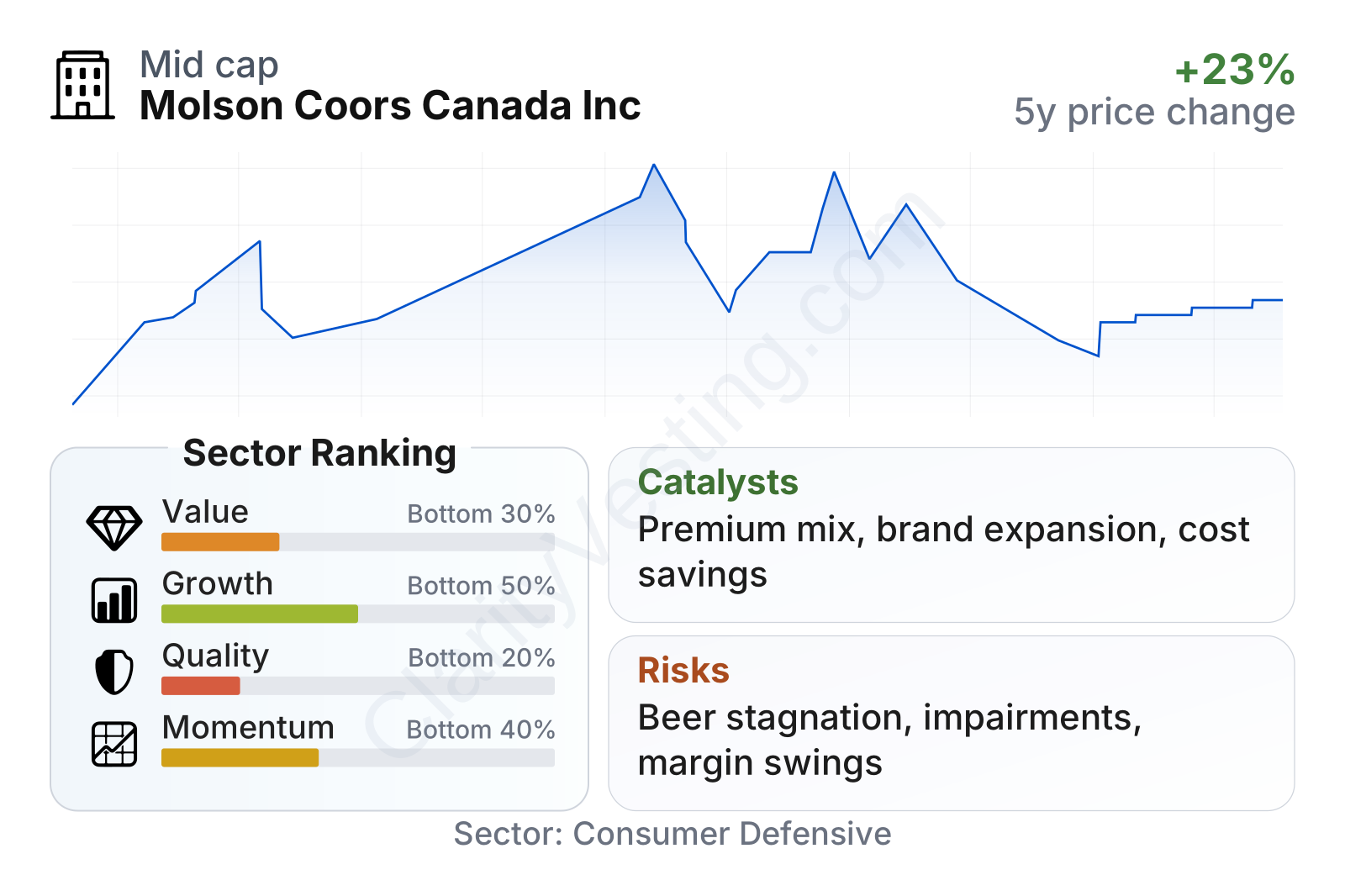
Molson Coors sits in the large-cap range and has had a relatively low-volatility trading profile, with a beta well below 1. In the factor summary, value looks stronger than growth, while quality appears weaker than much of the sector. That mix fits a mature beverage company: the market is assigning a modest earnings multiple, but recent operating disruption and slower top-line expansion limit enthusiasm.
The stock’s medium-term price performance has been positive but not especially strong compared with the broader consumer defensive beverage group. At the same time, free cash flow yield stands above the sector median, which suggests the market is giving meaningful credit to the company’s cash generation while remaining cautious on growth and earnings quality.
Growth
The beer industry is not a fast-growth sector in mature markets such as the United States and Canada. Long-term volume growth is typically modest, and in some categories it can be flat or negative. Growth therefore depends less on selling much more beer and more on improving pricing, product mix, premiumization, and expanding into adjacent beverages.
That is where Molson Coors’ strategy broadly makes sense. The company has been working to reduce its dependence on mainstream beer by developing a broader beverage portfolio and emphasizing higher-margin offerings. It has also focused on cost discipline, supply chain productivity, and brand support in categories that can still gain shelf space even when total beer demand is sluggish.
Recent revenue momentum has been mixed rather than consistently strong. There were periods of decline, followed by a return to slight year-over-year growth by early 2026. That pattern suggests the company is operating in a low-growth environment where execution matters more than sector tailwinds. For a business like this, steady pricing and mix improvement can be almost as important as volume growth.
Free cash flow is an important piece of the growth picture because it shows how much money remains after operating needs and capital spending. Molson Coors has generally produced solid cash flow over time, although the trailing figure most recently moved down sharply from earlier levels. Even so, the business still appears capable of generating meaningful cash, which supports debt management, dividends, and brand investment.
A notable catalyst is the company’s continued push into premium beer, flavored beverages, and non-beer categories. Another is ongoing productivity work, which can protect earnings even if volume remains soft. In a slow-growth category, margin improvement and category mix can create more value than raw sales expansion.
Recent company updates have also emphasized portfolio optimization and commercial execution rather than transformational expansion. That points to a practical near-term growth path: stronger brand mix, disciplined spending, and selective innovation instead of relying on a major rebound in industry volumes.
Risks
This article is for informational purposes only and does not constitute financial advice. Some content is AI-generated. See Disclaimer


